
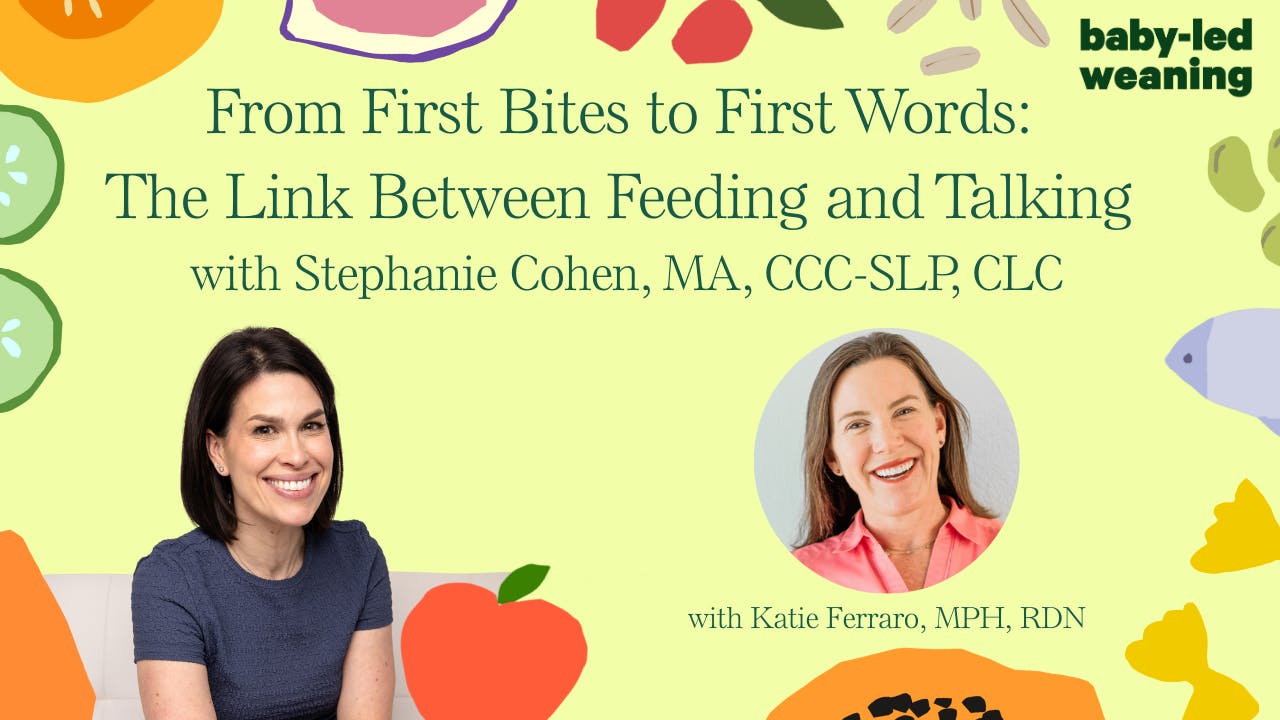
From First Bites to First Words: The Link Between Feeding and Talking with Stephanie Cohen, MA, CCC-SLP, CLC
- What early feeding milestones - like mouthing and chewing - have to do with your baby’s speech development
- Why responsive feeding supports both communication and connection at mealtimes
- How to use simple mealtime strategies to help your baby build the oral motor skills needed for talking
LISTEN TO THIS EPISODE
Episode Description
Did you know that feeding milestones can actually help your baby hit their speech milestones too? In this episode, I’m joined by Stephanie Cohen, MA, CCC-SLP, CLC, a speech-language pathologist, feeding therapist, and certified lactation counselor who breaks down the fascinating connection between eating and talking in babies.
We’re exploring how responsive feeding, oral motor skills, and early mealtime experiences lay the foundation for communication. Stephanie shares practical examples of how everyday feeding moments, from mouthing to chewing support speech development, plus tips for creating positive, communication-rich mealtimes.
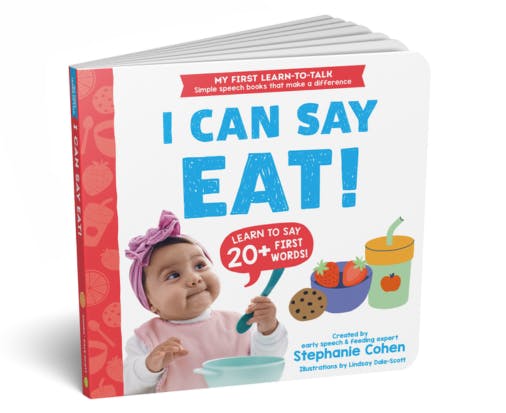
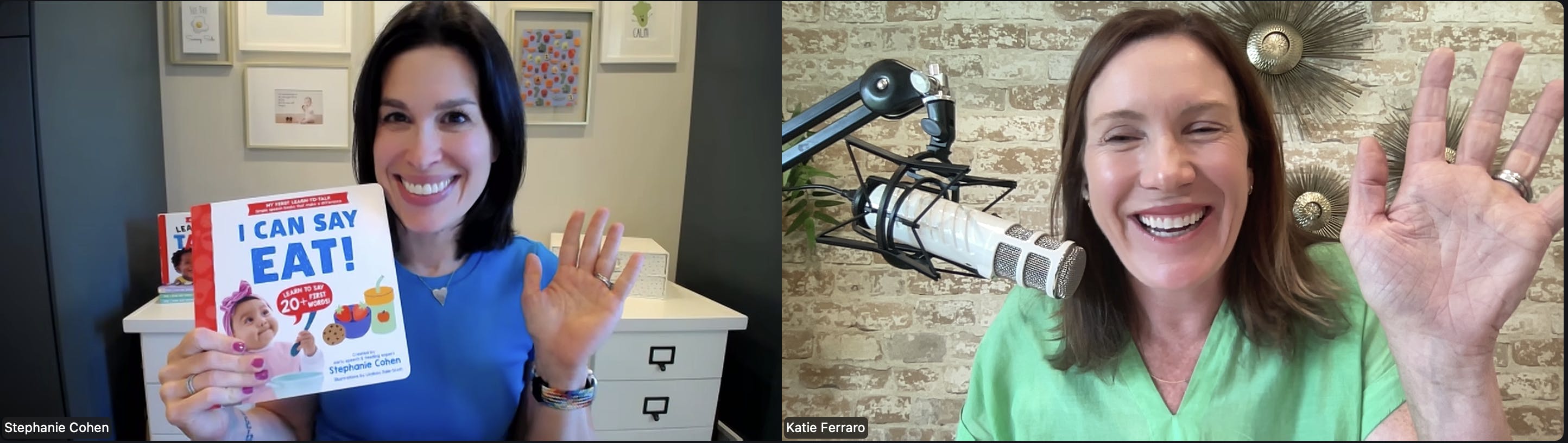
Stephanie’s new board book I Can Say… Eat!, is designed to help families celebrate feeding milestones and foster language development through playful, baby-friendly interactions. Whether your baby is just starting solid foods or already exploring tons of tastes and textures, this conversation will help you understand how feeding and talking go hand in hand.
About the Guest
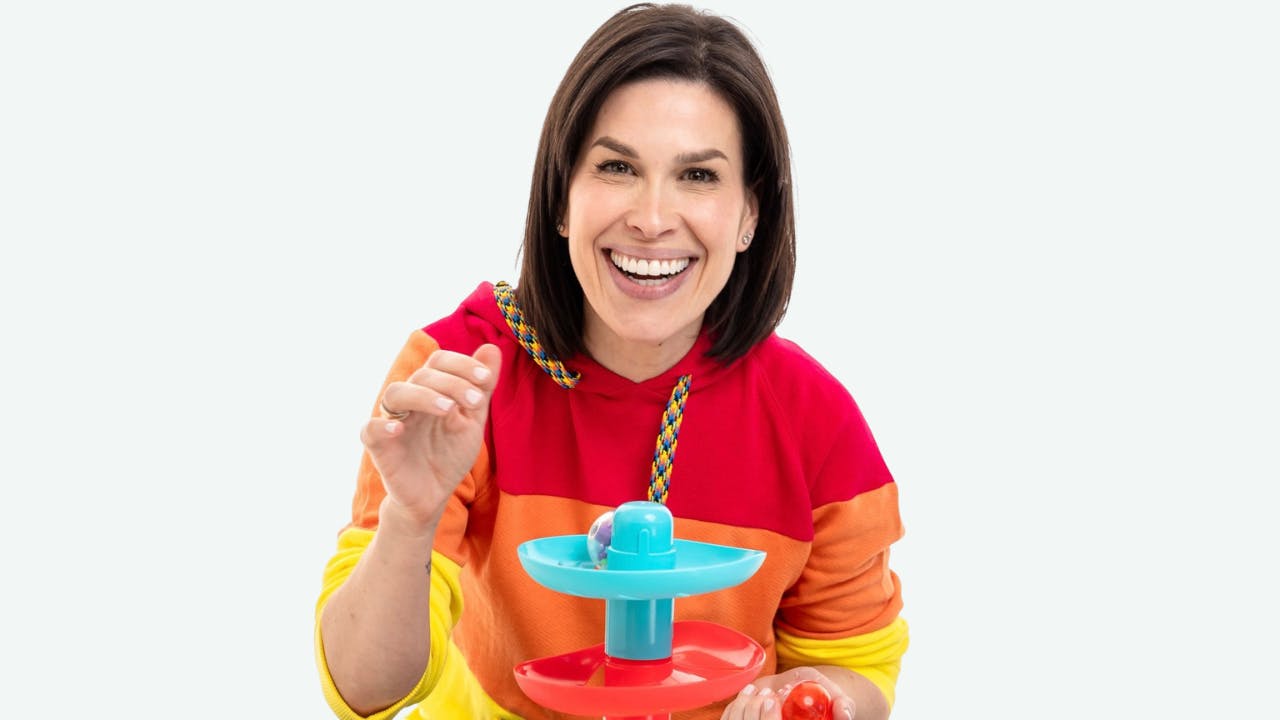
- Stephanie Cohen is a Speech Language Pathologist, feeding therapist and lactation counselor based in the Chicago area
- She is the author of a new board book I Can Say EAT! that explores the connection between food and speech for babies
Links from this Episode
- Get Stephanie’s new board book “I Can Say EAT!” for your baby here: https://a.co/d/7WmgnWa
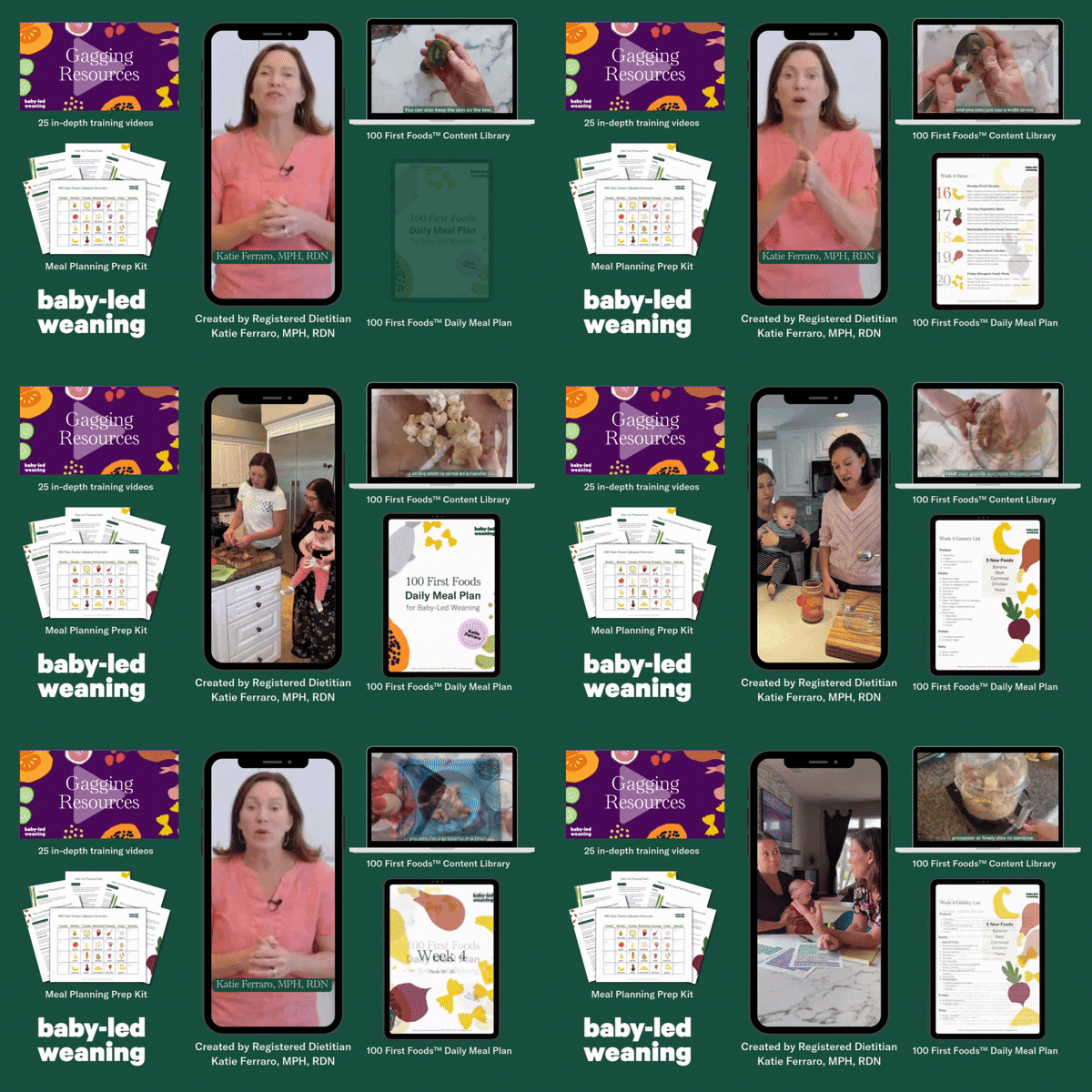
- Baby-Led Weaning with Katie Ferraro program with the 100 First Foods™ Daily Meal Plan, join here: https://babyledweaning.co/program and get $50 off when you sign up using the code BLWPOD50
JOIN NOW AT $50 OFF CODE: BLWPOD50
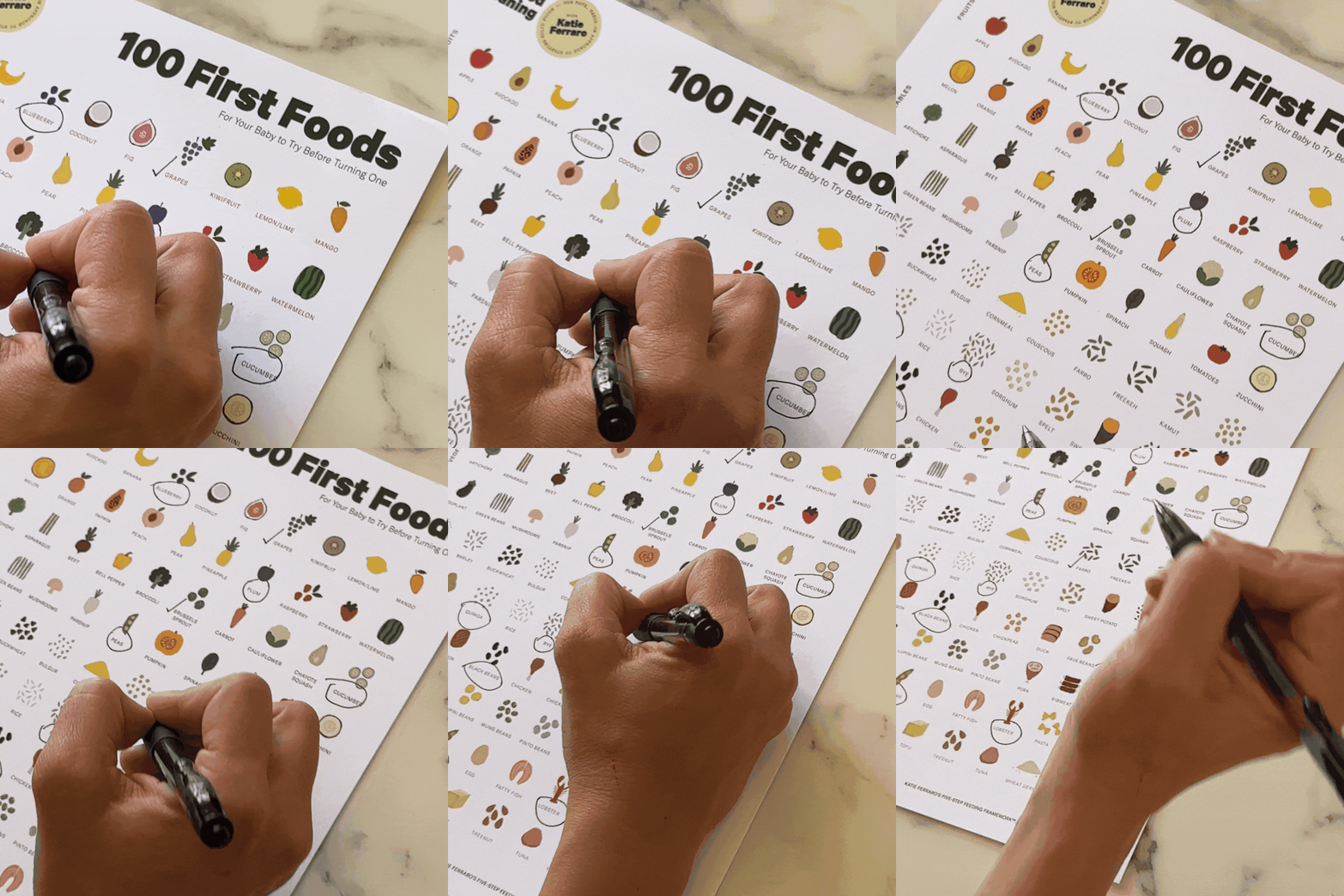
- Baby-Led Weaning for Beginners free online workshop with 100 First Foods™ list to all attendees, register here: https://babyledweaning.co/baby-led-weaning-for-beginners
Other Episodes Related to This Topic
- Episode 428 - Mouthing Objects: What does this mean about my baby’s ability to start solid foods? with Marsha Dunn Klein, OTR/L, MEd, FAOTA
- Episode 312 - 3 Easy Responsive Feeding Techniques when Starting Solid Foods with Stephanie Cohen, MA, CCC-SLP, CLC
- Episode 306 - Picky Eating Prevention Tips with Stephanie Cohen, MA, CCC-SLP, CLC

Latest Episodes

Hungry Root (0s):
I know that December is all about giving and giving to others. But if I may say, I sometimes do give gifts to myself. And the best gift that I gave myself this year was Hungry Root. Hungry Root takes the stress out of mealtimes by filling your cart with personalized picks and planning your week of meals, it gets smarter with every order. Like Hungry Root now knows I do not like beets. We accidentally got some beets in something and I made some tweaks Their, their technology is amazing with, there's over 15,000 recipes, first of all, that they choose from each week. My brain can't handle that. What I said is like, I want meals that are ready in just 15 minutes or less. There's this super wide grocery selection. There's things like smoothies and kids snacks and sweets and salad kits, ready to eat, meals, supplements. It is so easy to find options that are gonna fit your whole family's taste and nutrition goals too, because I know that you're in the thick of it with baby life and holiday madness and you're working and trying to maybe maintain a friendship or relationship. Or two, figuring out food every day for your family is a lot. Hungry Root knows that they fill my cart with the exact groceries and recipes that I need. Nothing more, nothing less. Everything is based on my own dietary goals. Our family food preferences. A little bit about what my kids will actually eat, but also kind of pushing the boundaries, sometimes trying new foods. It literally gets better every single time we use it. No holiday crowds. No last minute store runs. No guesswork. Hungry Root gets us. My last box had this cinnamon oat bake. Now I want every morning. I love the pre chopped veggies, the easiest beef stir fry I've ever made with a sauce that like was so delicious. I, I would never think of that on my own is all I have to say. I love that. Hungry Root is now like my kitchen brain. It's all clean ingredients, no junk. The meals are done in under 15 minutes. Truly a holiday miracle. Give yourself one less thing to worry about this season. If you want to check out Hungry Root, please take advantage of this exclusive offer for our listeners. For a limited time, you can get 40% off your first box, plus get a free item in every box for life. So go to hungry root.com/weaning and use code weaning. That's Hungry root.com/weaning code weaning to get 40% off your first box and a free item of your choice for life hungry root.com/weaning code weaning. And check it out. I think you'll love how much Hungry Root's gonna help streamline the meal prep in your family's life.
Rula (2m 31s):
Can we be real about productivity for a moment? Especially productivity post babies? I used to be the most productive person in the world because I really only had to worry about myself. And I feel like the more people that I've brought into the world, I'm like, what happened all of my time? And why can't I get anything done? Let's be real. Our culture is weird about productivity. You are now just supposed to magically be able to still do all the things, right, parent and work and manage a household, maybe keep a friendship or two alive and never slow down. Oh yeah. And work out and maybe be nice to your partner or spouse. That to-do list, it just never gets done. I have two sisters and one of my sisters who's self-employed, she's like very productive. And we were talking the other day like, okay, what if you, she's like, imagine this. You got everything on your to-do list done in a day. Like what would that actually feel? Feel like you worked out, you fulfilled all your obligations. What would you feel like? And she said, you would feel like a robot, right? Guess what? You're not a robot. You're not a machine. If you're feeling burnt out or anxious or stuck, you are not alone. Therapy can help, but therapy also has to be accessible and affordable. And that's where Rula comes in. Rula connects you with a licensed therapist or psychiatrist based on your needs and your schedule. So you answer a few questions and Rola finds someone who matches your preference and they take your insurance. So the average copay, it's only $15 per session. Seriously. And because RULA supports every step of your journey, including checking in to make sure that you're actually making progress, it doesn't feel like you're doing this alone. Thousands have already trusted RULA to support them on their journey towards improved mental health and overall wellbeing. So if you head over to ruler.com/weaning, you can get started today. After you sign up, they'll ask you where you heard about them. Please say the baby led weaning with Katie Ferraro podcast to help support our show. Go to RULA.com/weaning and take the first step towards better mental health today because you deserve quality care from someone who cares. And you are not a robot.
Stephanie Cohen (4m 40s):
When a baby is communicating in those early days when they're able to use gestures, when you can kind of hear the intonation in their voice, we think of those all as cues, cues, communication. What is your baby telling you about how they feel? And those early mealtime shared experiences are critical to establishing attachment and bonding and trust that this big person who shares mealtimes with me is going to be responsive to me. And that responsivity reinforces my communication. If I do something and someone responds, I'm gonna probably be motivated to do it again, especially if that adult understood what I wanted and I got another piece of avocado.
Katie Ferraro (5m 23s):
Hey there, I'm Katie Ferraro, registered dietitian, college nutrition professor and mom of seven specializing in baby-led weaning. Here on the baby-led weaning with Katie Ferraro podcast. I help you strip out all of the noise and nonsense about feeding, giving you the confidence and knowledge you need to give your baby a safe start to solid foods using baby led weaning. So when I first got into infant feeding as a dietician, I looked around and I was like, why are there so many speech language pathologists working in this field? I mean, stay in your lane, right? Like you guys do the talking stuff, I'm gonna do the eating stuff.
Katie Ferraro (6m 3s):
But here's the deal. Early feeding skill and future speech development are way more closely linked than most people think, or than I had any idea about. And my guest today is a speech language pathologist who also is a feeding therapist and she knows a ton about communicating with your baby at mealtimes. Her name is Stephanie Cohen. And Stephanie is a pediatric speech language pathologist and a feeding specialist. She's the co-founder and director of the Chicago Feeding Group, as well as a co-founder of the Get Permission Institute. So that's also Marsha Dunn Klein's Group. Marsha's another very frequent guest on this podcast. She literally wrote the book on pre feeding skills. So Stephanie's trained with and worked alongside Marsha for years.
Katie Ferraro (6m 46s):
Now Stephanie is a certified lactation counselor. She's also an author having just written a new board book for families called I Can Say, eat. And so today Stephanie is here to talk about how we help families move from first bites to first words and how caregivers can help strengthen the link between feeding and communication at mealtimes with their babies. So with no further ado, here is Stephanie Cohen.
Stephanie Cohen (7m 15s):
There is this little girl that I'm working with right now. She just started Solids. She has Down syndrome and her mom was pretty nervous about how to begin with her. And so she felt most comfortable introducing Purees first. We talked about all the different options and the benefits of both and sort of all her choices. And she said to me, I think I'm just the most comfortable starting with just oatmeal on the spoon. I think I'm gonna feed her 50% of the time and I'll let her feed herself 50% of the time. And this little girl also is learning to communicate, right? So there's a lot of learning that's happening at Mealtimes. So I said, okay, right?
Stephanie Cohen (7m 55s):
We're family-centered practitioners and part of how we support parents in setting their intention in creating a plan really has to take into account how those parents feel emotionally about the mealtime and what helps them to feel safe and comfortable. So I said, great. Sounds like a plan. She was gonna start over the weekend and I just saw her again yesterday and I said, how did it go? And she said, well, let me show you because it was fabulous. She said that she does this thing at the meal now where she's just kind of like frantic to get a hold of the spoon. And I said, wow, she's really communicating a lot to you.
Stephanie Cohen (8m 36s):
And so by talking about what this little girl is communicating at the table now, she's obviously not using words yet, but she is making sounds. She's using gestures, she's using facial expressions. And all of those things guided her mom to understand those just right opportunities for her to learn from the beginning. So this is the little one who mom felt comfortable being, you know, 50% of the time the feeder. But what she saw is her little one really wanted to be in charge. And so she, it quickly evolved in a very natural way from as great instincts to a completely baby led approach.
Stephanie Cohen (9m 16s):
And I know you talk about all the time that even when we are starting with purees, because it's the right thing for this family at this time, if it is infant led, then that infant really guides the process and helps us to know as the parent or the caregiver or the therapist what those just right opportunities are. And so from this point forward, this mom really felt so much more confident, right? In her ability to read her child's communication and understand. And it helped her to be able to think about a wider variety of foods that she could offer her. Yeah.
Katie Ferraro (9m 51s):
And like all good parenting stories, you thought it was gonna go one way. I'm gonna do it 50 50 and the baby's like Uhuh. I got other ideas. Mom, rip that spoon out of her hand and bring it to her mouth because she's been watching her mom for how many months now. Like babies instinctively know what to do here. So Stephanie, I am currently going through your Get Permission Institute course. It's called Learning Through Opportunity, feeding an Infancy and Toddlerhood you and Karen Fer teach it. I cannot tell you how much I am enjoying the course. Like I love being a learner. I love the whole Get Permission Institute. So you've previously been a guest on this podcast, as has Karen and Marsha Dun Klein, the founder of the Get Permission Approach. Tell me, us, our audience, everyone, a little bit about your philosophy about starting Solid foods, because I heard it there.
Katie Ferraro (10m 34s):
You were talking a little bit, you're like a family centered clinic, you are a family centered practitioner, you love a baby-led approach, but you're also gonna listen to the family. What is your philosophy about starting solid foods? What sort of approach do you take to this phase of development? Because it can be so stressful for families,
Stephanie Cohen (10m 50s):
So stressful. Absolutely. And you know, Katie, I don't think we learn in school enough about all of the options that are out there for parents and families. And so yes, you're absolutely right. I am first and foremost a family centered speech language pathologist. So my approach first and foremost is to get to know this family and understand what's important to them. What do they value? What are their practices around mealtimes? And what does this parent know about how babies learn to eat? And then my hope is I can help that parent better understand their child and what they're ready for, right? Have they learned those pre feeding skills? Are they interested in using their hands and bringing things to their mouth?
Stephanie Cohen (11m 32s):
Are they reaching out when they see their parent eating? And so once we partner to really understand what this baby is interested in and ready for, I love to share with parents the different options framed within a child-led lens. So it's important to me to help parents understand, and some parents kind of know this when we start meeting and some parents aren't familiar, that autonomy and independence is so, so important, as well as internal motivation, which are a couple of the responsive feeding values that we, I know we both prioritize. And so my approach really is to be a partner to this family, learn who they are, understand what their goals are, what their hopes are, and then help them understand how to bring their children into the family mealtime routines rather than a protocol, right?
Katie Ferraro (12m 27s):
Which no offense, a lot of your colleagues are really into protocols and it's like so formulaic and it's like, dude, every family is different. And I like that you start by asking the question like, what? What do you know about starting Solid foods? What do you wanna learn? What are your goals? Like that's what we should be doing as partners, asking questions like, nobody's here to, for me to tell you and spew all my knowledge on you. I wanna work with you and be a partner with the family. So I love that approach.
Stephanie Cohen (12m 55s):
Yeah, and I, I agree with you so much that I, I think that all of these sort of protocols that are out there and programs were developed in response probably to parents thinking they needed those things. And don't get me wrong, for some parents e emotionally, it's very comforting for them to have something to follow, right? A roadmap. But I just like to sort of create a roadmap together. Yeah. Based upon what this family's, again, their values are and their practices so that it really can be tailored.
Katie Ferraro (13m 26s):
I love that I, it's funny because I, we have the hundred first foods approach to starting solid foods. And so for years it was like, I have a five step feeding framework. Here's how the family can work. You know, within the confines of their food culture, whatever foods are available, here's how you pick the five foods each week that the baby's gonna try. It's 20 foods a month in five short months, your baby's eating a hundred foods. And over the years, parents were like, ah, that's great, Katie, but like, can you just pick the foods for me and tell me what order to feed them? And I'm like, no, I don't want it to be formulaic. There's no reason why you need to feed beets before buckwheat. But we got to a point where there is another track of our program with a hundred first Foods daily meal plan. Because there are some families who just wanna follow that exact plan.
Katie Ferraro (14m 6s):
But you have to come into it knowing, listen, it doesn't have to be this way. If you want to follow this track, it's there for you. But I also want you to understand that you don't have to do that. So I, there are different types of learners and one thing I love about all the courses that you teach is that you do give parents the option. It's almost like not everyone can have Stephanie Cohen as their one-on-one feeding therapist or clinician, but if you're in your courses, it kind of feels like you are. And that's what I've loved so much about taking this course with you right now. So thank you for that. I know when I first started in infant feeding, I was really surprised like how involved the profession of speech language like pathologists are. Like of course there's feeding therapists like yourself out there, but I was very interested to learn about the link between feeding and speaking and I think I should say maybe communication more.
Katie Ferraro (14m 50s):
So could you talk a little bit about the feeding or the communication milestones that parents tend to overlook? Like how do these actually lay the groundwork for speech development later on?
Stephanie Cohen (15m 3s):
Oh wow. Katie, there are so many different ways that communication and eating overlap. So I think historically in our field, probably in both of our fields, things were very technical, right? So we thought about how does that tongue move? How do those lips move? And what are those sort of discreet motor skills that happen at certain times? And my lens is a bit of a wider lens that thinks more about overall communication and how that impacts participation in mealtime opportunities. That's why we named our course Learning Through Opportunity. Because you know, I learned from Marsha, every mealtime experience is an opportunity to learn, right?
Stephanie Cohen (15m 43s):
And we as caregivers provide children opportunities to learn. But the big question is how do we know what it is that is that perfect opportunity in that moment? And really it's all about our connection and communication, right? So one thing that we prioritize and value so much at the Get Permission Institute is helping parents form stronger, more trusting relationships with their babies and toddlers. And that happens through responsive parenting and responsive communication. So responding promptly to children when they communicate like, yes, I'm interested, no I'm not. Or when they have a new experience that doesn't feel so pleasant to them when they're hungry and when they're satisfied.
Stephanie Cohen (16m 28s):
So the communication milestones that I think about are things like, can I sit with relatively good postural stability so I can begin to use my arms and hands to execute different actions like reaching for something, right? And then more specific communicative gestures. Maybe it's pointing to something that I want or a sign for more. And so we talk about all of the ways that babies communicate and when infants have difficulty with their motor development and maybe they're not quite so stable or they're not quite so coordinated, those signals can become less clear. And so what we really focus on, what I focus on is how do we myself and the caregiver partner to understand what baby or toddler is communicating, even if they're not quite so clear.
Stephanie Cohen (17m 18s):
So the milestones are different than, as I said, like, can you say this sound yet or can you say this first word? Although of course those first words are so valuable at the table, but communication really guides a mealtime partner in terms of where to go next, right? And how they share the experience. Now the other piece of the connection between communication and eating is that we need to understand what a child's neuromuscular system is, right? And how they're, you know, how they're coordinating their movements, how are they learning new motor plans? And so I think about kids who have underlying maybe lower muscle tone.
Stephanie Cohen (17m 58s):
And so they aren't quite so coordinated, they aren't quite, you know, at the level where they have the strength to engage in some of these pre feeding learning activities or even managing foods that are more resistive. And we might see that for that same reason that their speech is impacted as their speech develops. So that it isn't that one issue, the early feeding problem caused the later speech problem, but that the underlying reason for difficulties with feeding may also cause some difficulties in communication development, right? That child may have less clear speech or they may learn words a little bit later, right? So the connection I think is a little different than this.
Stephanie Cohen (18m 40s):
Like cause and effect feeding leads to speech problems. A lot of parents do ask me, but like, it is an early feeding challenge. Is
Katie Ferraro (18m 48s):
It safe to say, I mean, just to dumb it down, like taking out the motor planning and the tongue ization. Like if you are not learning to use the muscles in your mouth, 'cause you've only been sucking pure out of a plastic pouch for six months, you're probably not gonna have the muscles that you need to learn how to speak very well. Like is, is that a safe assumption from a totally non SLP standpoint? Like are they linked?
Stephanie Cohen (19m 9s):
So it's not necessarily,
Katie Ferraro (19m 14s):
She won't say it quite
Stephanie Cohen (19m 15s):
Well, it isn't necessarily quite that specific of a connection. Yes, those early oral sensory exploration experiences inform how our muscles move, right? So in that, from that perspective, absolutely, but the motor patterns for eating are different than the motor patterns for speech and the strength needed for different specific tasks. Like we think about function, right? Yeah. That's why we don't, we don't necessarily do oral motor exercises that work on, you know, a specific movement in isolation. I say let's work on eating while we're eating because the functional task is really where we grow. So I wish I could say yes exactly and wrap it up at a nice neat bow, but I wish
Katie Ferraro (19m 57s):
You could too. But like the more practice makes progress, right? Like the more practice we have at the mealtime, the more experience we're having with food, the more likelihood it's gonna eventually end up in your mouth and you're gonna learn how to chew and swallow it. Like I'm working with the family right now, a very good friend, eight month old baby, she was so stressed out, all the baby got a late start to solid foods. This baby was not sitting up until full term, but not sitting up to he seven and a half months old. Okay, that's, that's not super typical, but like let's get going. And here he is eight and a half months old and she's like, well I'm feeding him like, you know, once a day. I'm like, let's bump it up to two to three times a day. Like, he likes the food you have the time practice makes progress. She started doing two, three times a day. He's making pro progress so much more quickly because he's having more experiences at the mealtime.
Katie Ferraro (20m 40s):
Like why drag it out? Like you get this short window of time where babies are gonna like and accept a wide variety of food, let's take advantage of it. And so I, I appreciate what you're saying about like the motor skills. Like I remember Marsha was on the podcast recently in an episode about mouthing objects. Like the reality is, okay, if you cannot pick something up and bring it to your mouth, you cannot engage in the feeding process. Like you need to be able to bring things to your mouth. So we're talking about, you know, what does mouthing mean with regards to a baby's ability to start solid foods? It's very basic, but it is really important. So I, I appreciate you pointing out like there are some basic milestones babies need to have, but like I think sometimes parents get so bogged down in the milestone talk and social media's not helping that because they're getting stressed out about it and they're forgetting like let's zoom out and look at the big picture here.
Katie Ferraro (21m 27s):
So I appreciate your wider lens, which is like, hey, you know, let's use the mealtime to like learn how to eat food. And by association it's gonna help you with your speech stuff
Stephanie Cohen (21m 35s):
Later too. Well, and to your point, when a baby is eating foods with different textures and shapes and iveness, their little muscles in their mouth are moving all different kinds of ways. Yeah. And so what's gonna happen is they're gonna turn their voices on and they're gonna hear different sounds kind of happening. So in that way, those experiences are gonna give them more opportunities to produce different sounds in those early stages. So there's your direct connection.
Sierra (21m 60s):
Hey, We're gonna take a quick break, but I'll be right back. At Sierra, discovered joyous deals on great gifts for everyone on your list. Like cozy slippers, ski gear, fishing poles, bikes, large kayaks, even larger canoes. Whew. Which might lead to another discovery. Robin gifts is the only sport you need to stay fit this season. Tis the season to discover great gifts at unexpectedly low prices. Sierra, let's get moving.
Katie Ferraro (22m 41s):
So I know the get permission approach also respects and honors the baby's ability to self feed, as does the baby led weaning approach. I appreciate in your course you guys acknowledge the work that Jill Rapley has done in this space as well as Alan Satter with her division of responsibility and feeding theory. I'm curious how you could walk us through though, like how does learning to chew real food help babies get ready to talk? I just heard you say it helps them turn on the sounds in their mouth. Could you expand upon that a little bit more?
Stephanie Cohen (23m 8s):
Yes. So when I am biting and chewing a food, I imagine I'm an infant. My tongue goes over to explore something, my lips close around, around a piece of food, a spear of food that I'm holding onto. Maybe it's a, you know, sweet potato fry or spear of avocado. My lips close around it. I'm getting these sensory motor experiences right? And my lips might be in the position where they're closed around something and I might turn my voice on. And that is going to sound like, hmm, right? And so what happens when we are exploring different foods and food textures and moving our mouths in different ways is we have sort of those early, early speech accidents I call them when babies first begin to produce consonant sounds, it's an accident.
Stephanie Cohen (23m 56s):
They don't know that they're making an M sound, but when they're eating right, their mouths are in all these different positions, they turn their voice on and a sound happens. And so what we love about that is it gives a parent an opportunity to imitate that baby and reinforce that sound production and that baby might say, Ooh, that sound, that sound was kind of cool. I wanna try and do that again. But it really is all of these different motor experiences and sensory experiences that comes from biting and chewing and moving things around in my mouth that help our mouth muscles move in different ways and we turn on our voice and it all just kind of comes together.
Katie Ferraro (24m 32s):
Alright. You've talked a lot about responsive feeding in your work. How does tuning into a baby's feeding cues support their language development down the road?
Stephanie Cohen (24m 42s):
Oh, that's such a great question. It's so connected, Katie. So when a baby is communicating in those early days when they're able to use gestures, when you can kind of hear the intonation in their voice, we think of those all as cues, cues, communication, what is your baby telling you about how they feel? And those early mealtime shared experiences are critical to establishing attachment and bonding and trust that this big person who shares mealtimes with me is going to be responsive to me. And that responsivity reinforces my communication. If I do something and someone responds, I'm gonna probably be motivated to do it again, especially if that adult understood what I wanted and I got another piece of avocado, right?
Stephanie Cohen (25m 30s):
So when we have these back and forth exchanges, communicative exchanges, infants learn new skills in that way, toddlers learn new skills in that way. And first it might be a gesture and then it might be a word. If I say avocado and I get another piece, I'm gonna wanna use that word again. The adult might model the word if I don't know it yet as a little baby and I might learn a new word that way. So when a child has these robust language learning experiences with gestures, facial expressions, sounds, words, phrases, they're gonna just keep building and their language learning is just going to be more rich and robust.
Katie Ferraro (26m 8s):
I love the idea of following the cues, but I wanna ask you wanna flip it on its head because a lot of times I work with parents who they're so convinced, especially with the cue about not liking food. Oh my baby doesn't like broccoli. Like, oh really? How do you know? Oh yeah because now I gotta put like nacho cheese all over because we tried broccoli one time and he didn't like it. And I sometimes push back against that. It's like, listen, I know you know your baby best and I don't wanna cite, you know, you need to try a food 10 to 20 times before a baby likes or accepts it. But somewhere in the middle there is the truth that it's not just a one and done thing. Like the baby doesn't either know what to do with it yet or they weren't in a good mood. Or maybe like you burned it the first time, it didn't taste good. Like there's lots of reasons why your baby might not have like, you know, gobbled it up. And so I wanna encourage parents when that voice starts saying, oh my baby doesn't like it, maybe tamp down that cue a little bit.
Katie Ferraro (26m 55s):
What do you say to parents when like, oh my baby doesn't like that food because they think they're watching or listening to the baby's cue. But we still want them to retry that food because we know that, you know, multiple exposures really is important, especially during that all important flavor window. How do we react to that cue?
Stephanie Cohen (27m 11s):
We help parents better understand their infant or toddlers experience in that moment. And we do that by understanding that at the mealtime your child doesn't stop playing. They don't stop building their cognition, their cognitive development, how they understand objects in the world and they have not gotten the message that it is time to sit down and just take bites to and swallow. We also help caregivers understand that a baby or toddler sensory system is having all these new experiences and when a child is in the stage that they like to bang objects on a surface and play, we all the time, right?
Stephanie Cohen (27m 53s):
See babies and babies doing that at the mealtime we see babies dropping food off the side of the tray. And how many parents have you met with that said, oh, I'm concerned my baby doesn't like it because he keeps throwing it. Yeah.
Katie Ferraro (28m 5s):
Or it's a bad behavior.
Stephanie Cohen (28m 7s):
Exactly. And what we can say is, well, let's zoom out a little bit. Let's understand all of the things that your baby or toddler is learning about the world and about objects. One of the things that babies learn is what happens when they drop something or when they throw something, they're sort of like, I describe 'em as like little physicists and that really helps parents think differently because again, it's not just about if I take a bite of this, if I like it, I chew and swallow it and if I don't like it, I don't, what else is your child interested
Katie Ferraro (28m 37s):
In? Yeah, they're getting a rise outta you sometimes too. That's why I encourage parents clean splash mat underneath the high chair. They drop the food on the floor, I'm gonna recycle it back up under the tray or the plate three times. And then after that I'm like, baby, I don't work for you. But you know, you can put systems in place so that, you know, we don't wanna encourage food waste. But like especially for your older baby though, if they're coming to the table and dropping food, that's oftentimes a fullness cue, that means that baby's not hungry and an early eater who's dropping food, they don't have their penta grasp yet, they don't know what to do with it. That's a totally different reaction when a six month old is dropping food on the floor compared to a 10 month old. And so I think it's, it's important to to discern what the, what these nuances are because baby behavior does look different along the spectrum, especially when we're talking about, you know, the different ages and stages.
Katie Ferraro (29m 22s):
So, okay, there's one
Stephanie Cohen (29m 23s):
More thing I wanna add to that. Go ahead real quick is the sensory piece. You and I have both seen babies try a new food and make a big face. Right? And a lot of parents interpret that as, oh he, he doesn't like, like the broccoli. You and I I know help parents to understand, wait a minute, they are having this big new feeling in their, their mouth that they've never felt before. Maybe it's a flavor. Right? And so sometimes that comes out in their whole facial expression. Yeah. And so let's not move that food aside quickly. Let's keep it around to see if they go back to it and give them more opportunities to learn about it.
Katie Ferraro (29m 56s):
Okay, let's flip the other side. I know you are a huge fan of Marsha Dun Klein as well. And I remember, so I had Marsha over for dinner in November and so like I think of Marsha as like my work mom and Marsha got to meet my real mom, who's also a dietician. It was like one of the best days of my life. And we were talking about language and I have a tendency, I I sometimes the moms come over for parent coaching and I say that they, they're micromanaging the situation. Oh my gosh. They're like touching the baby and intervening and Marsha's like, Katie, why don't you refer to it as excessive cheerleading? And my mom was like, that's such a better way of saying it than you know, micromanaging. Okay, so when a mom is there and the baby does something and the mom's like, oh my gosh, good job baby. And she's like in the baby's face and like literally overreacting 'cause the baby took a bite of avocado.
Katie Ferraro (30m 40s):
How do you talk to parents about that? Excessive cheerleading as Marsha would call it.
Stephanie Cohen (30m 45s):
So I help parents to understand what it is that drives internal motivation because a lot of parents think that it's their job to get their baby to eat, get their baby to like something and get their baby to eat more, right? Or eat something different than they are motivated to eat. So I think when parents understand what drives internal motivation, hunger, enjoyment, social modeling, connection, they realize, I say this phrase a lot, you eating with your child is enough of a motivator to encourage them to be curious if the time is right, if the opportunity is right. You know, it's how can we be as natural as possible? And sometimes even what I'll say is, would you say this to your partner or your friend?
Stephanie Cohen (31m 30s):
Like if you and I were eating together, Katie and I took a bite of something, I wouldn't say, mm Katie it's so good. Mm. I might say it once, oh like it's delicious. But I really like to think about, you know, helping parents understand what are the things that motivate infants and toddlers and do we need to convince them or can we just give them the opportunities? It's
Katie Ferraro (31m 51s):
Also super distracting. Like when I watch all my videos back on coaching, I'm like, oh my God, if that mom doesn't stop talking, that baby can't even focus on eating because the mom's constantly talking. So yeah, you are the, you're the communication expert. So you know, maybe you could teach the dieticians how to more nice to say that. Well I, of the,
Stephanie Cohen (32m 7s):
That I have and get permission, I just want to tell you about this one 'cause I think it's appropriate is caregiver coaching at mealtimes. And we dive even more into this than we do in the learning through opportunity course because I think it's such a game changer when parents feel confident and connected. Yeah. And when clinicians can help parents to get to that point, then everything just unfolds and
Katie Ferraro (32m 29s):
Well, a hundred percent, that's what Marsh always says, like the baby has a skillset, it's the caregiver who just needs the confidence. And so, you know, just that little bit of training is so helpful. Okay, Stephanie, we often hear about speech delays, but could feeding difficulties sometimes be an early side of speech or communication challenges?
Stephanie Cohen (32m 45s):
I think it goes back to what is the cause or what can we identify the cause of the feeding challenges? And might that also cause a child to have different learning experiences as they learn language. And the probably the clearest way I can, the clearest example I can think of is if we have a little one who has difficulty with head control and neck control and they're swallowing is is not quite safe. They
Katie Ferraro (33m 13s):
Shouldn't be eating solid food. Sorry, like
Stephanie Cohen (33m 15s):
Not yet, right? Right.
Katie Ferraro (33m 16s):
Yeah.
Stephanie Cohen (33m 17s):
But also their strength and their decreased strength and stability might impact how they turn to look at something when someone is talking to them. Or it might impact how they learn to use these little muscles of their mouth in more precise ways to produce new sounds. So again, it's not a causal relationship, but it can give us an idea of what we might want to intentionally be thinking about in advance or in anticipation of those speech and communication milestones.
Katie Ferraro (33m 48s):
Hey, we're gonna take a quick break, but I'll be right back.
State Farm (33m 56s):
This episode is brought to you by State Farm listening to this podcast, smart Move, being financially savvy, smart Move, another Smart Move. Having State Farm help you create a competitive price when you choose to bundle home and auto bundling. Just another way to save with a personal price plan like a good neighbor State Farm is there. Prices are based on rating plans that vary by state coverage. Options are selected by the customer availability, amount of discounts and savings and eligibility vary by state.
Katie Ferraro (34m 28s):
Okay. In your free time, which you do not have any of you wrote a new board book called I Can Say Eat. Why was it important for you to make a book that connects feeding and speech for babies and parents?
Stephanie Cohen (34m 40s):
Oh, thank you for asking. So I, so my series is the my first Learn to Talk book series. And the series grew out of my desire to have books that incorporated the developmental principles that we know about how babies and toddlers learn to love books and learn language, right? And the books are meant to be a tool for caregivers so that caregivers contin continue to be their child's best teacher. And because my heart lives in the feeding world and has for many, many years as well as the speech world, what I wanted to do was combine those two missions, help parents teach their children new sounds and new words. But I also, Katie wanted to embed our responsive feeding principles because so many books out there try to sort of, I think convince a child that a food is good, right?
Stephanie Cohen (35m 32s):
Or more, or that this food is healthy
Katie Ferraro (35m 34s):
Or it's healthy.
Stephanie Cohen (35m 36s):
Yes. I wanted to create something different that just showed a mealtime routine with lots of different foods. Did you
Katie Ferraro (35m 42s):
Straight up put a cookie on the cover? Is that what I'm seeing there? I love it. And there's no parent forcing that spoon into the baby's mouth. People, the baby's holding the spoon on the cover as she
Stephanie Cohen (35m 51s):
Should check this out. We're feeding ourselves,
Katie Ferraro (35m 56s):
Oh my gosh,
Stephanie Cohen (35m 56s):
We're feeding our parent, right? We are independent and I purposefully chose pictures where the children were the ones that were in charge. And you know, we say different words. We talk about spilling, we talk about asking for more, right? We see someone eating and we decide maybe we want to taste and then look, there's that really, really big facial expression because the taste is new. So it, it's like exactly tied to the question that you asked me. This doesn't mean she doesn't like it, it means it was a big taste, right? Then we have our cookies, we drink, we drink.
Stephanie Cohen (36m 39s):
Oh, and look, you'll like this one too.
Katie Ferraro (36m 40s):
Open cup guys. Open cup. Nope, that baby's not drinking out of a sippy cup. You could tell an SL with this book
Stephanie Cohen (36m 45s):
Also. She's done with her cup and there's still some left.
Katie Ferraro (36m 49s):
Yes. Because nobody made her drink all of it.
Stephanie Cohen (36m 52s):
Exactly. And then we wipe our face ourselves,
Katie Ferraro (36m 55s):
Right? Because it's a negative sensory experience. If someone's attacking us with a wet wipe after the meal, oh wow. All of the subliminal messages are in this book and then we go to bed without talking back to our parents. No, just kidding.
Stephanie Cohen (37m 6s):
In the back is a list of tips. It's a guide for parents. So I always have a speech related guide how to use this book, my best tips in the back. I've included things like, remember everything is new, your child learns by watching you. So I have really given parents like our best tips in a book that their child is just gonna love reading. I love it. So again, the representation of responsive feeding and autonomy and enjoyment and sharing and learning through watching others is really what I wanted. I think it was the gap in the market. So I'm very excited that this is gonna be out on the 7th of October.
Katie Ferraro (37m 42s):
Okay. Where does the QR code in the back of the book take them? I'm just curious.
Stephanie Cohen (37m 46s):
So the QR code in the back of the book is going to take anyone who reads it to a landing page with more resources. So it'll have some information on responsive feeding. It'll have a link to the American Academy of Pediatrics information on responsive feeding and a few other places, which
Katie Ferraro (38m 4s):
I must say I'm not normally a fan of any AAP infant feeding stuff, but in your course I did, I looked it up. 'cause a little suspect of their responsive feeding fantastic resource that I only learned about because of your course. So thank you very much. We looked it up too. And I'm gonna stop dissing a hundred percent of the AAP infant feeding stuff. Now that I know they have a good responsive feeding guide, I still take a lot of offense with a lot of their other starting solid food stuff. But I will say that the responsive feeding stuff that you pointed me to was actually quite good. But I think you do a much better job of defining responsive feeding. Stephanie, before we go, what's one simple thing that parents can do today during mealtimes with their baby that will support their baby speech development?
Stephanie Cohen (38m 46s):
Respond to your baby.
Katie Ferraro (38m 48s):
You mean don't look at your phone and look at TikTok while your baby's trying to learn how to eat. Katie?
Stephanie Cohen (38m 52s):
We have a lot of things competing for our attention.
Katie Ferraro (38m 55s):
I know this,
Stephanie Cohen (38m 55s):
Be sure, and to be candid, my own children, sometimes I say, mom, put your phone down at the mealtime though. That is a time for connection. Yes. And the more you respond to your child's communication, the more you're gonna reinforce those communication skills and your child is gonna learn what I communicate is important, right? Yeah. This is a time for connection and learning and we learn so many skills at the table. So
Katie Ferraro (39m 22s):
I love that. It always makes me think of like, you know, Kelly Bruna who does all of the food media advertising to kids. Stuff like always has that stat that like on average children see about 10,000 advertisements for food in a given year. And that even if you sit down and give one positive message about food at a meal three times a day with your kid, at most you're getting in like a thousand messages. Like even then, like the food companies are like 10 x-ing you. And then that's before you put in social media, ai, et cetera. Like just do that thing like three times a day, sit down and communicate with your kids and start it from infancy. Like put the phone away and communicate with your child and respond to their cues. I love that responsive feeding starts by responding. I feel like a lot of times we're overthinking a lot of times, like I don't understand responsive feeding.
Katie Ferraro (40m 4s):
Like well it starts with the root word respond. And I love that. Like let's keep it simple. Stephanie, where can our audience go to learn more about your work, to support your business and to get your new book?
Stephanie Cohen (40m 14s):
Thank you. So a few different places, but probably the best place is learn to talk with me.com. That's how I'm sort of known on social media platforms, YouTube and TikTok and Instagram. Don't go
Katie Ferraro (40m 25s):
On your phone, but if you do, go to learn to talk with me and find Stephanie Cohen.
Stephanie Cohen (40m 29s):
Exactly. And you can buy my books anywhere that you buy or borrow books. They're in libraries and bookstores. And then of course the feeding courses that we teach the baby and toddler learning through opportunity is on. Get permission institute.com alongside so many other Rich.
Katie Ferraro (40m 44s):
And I also just wanna shout it out for the dieticians listening that all the Get Permission Institute courses are now approved for continuing education for dieticians. And thank you Katie. I'm not saying that because I helped Marsha do it, but for me it was important. It's like there's, it is important that these courses be approved for continuing education because they're taught by other professionals in the infant feeding space. This is a multidisciplinary approach. The lens that you and Karen and Marsha bring to infant feeding is important for dieticians and for parents. So go to the Get Permission Institute, check out the work that Stephanie and her colleagues are doing. Check out her books. They are amazing. I don't, I don't know where you get the time and the energy for all this lady. And by the way, before we got on the interview today, I like caught, she was like filming something else on her phone before this, like she's like a, a mastermind of like content creation.
Katie Ferraro (41m 30s):
I don't know how you do it. So I just
Stephanie Cohen (41m 32s):
Wanna share, I wanna share like this is such a wonderful conversation. I'm so honored that you let me come back
Katie Ferraro (41m 38s):
Always. I'm gonna put all of the show notes up on our show notes page, which you can find@blwpodcast.com/76.
Airwave Media (41m 46s):
If you guys like podcasts that feature food and science and using your brain, check out some of the podcasts from AirWave Media.
Katie Ferraro (41m 53s):
We're online@blwpodcast.com. Thank you so much for listening. Thank you for being here, Stephanie, and I'll see you guys next time.
Stephanie Cohen (41m 59s):
Thank you Katie. This is great.
The Program Baby-Led Weaning with Katie Ferraro
A step-by-step digital program for starting solid foods safely and navigating the original 100 FIRST FOODS™ meal plan with baby-led weaning.
 EXPERT-LED, PROVEN APPROACH TO EATING REAL FOOD
 CONCISE VIDEO TRAININGS TO MASTER BABY-LED WEANING
 100 FIRST FOODS DAILY MEAL PLAN WITH FOOD PREP VIDEOS
Baby-Led Weaning for Beginners Free Workshop
Is your baby ready to start solid foods, but you’re not sure where to start? Get ready to give your baby a solid foundation to a lifetime of loving real food…even if you’re feeling overwhelmed or confused about this next stage of infant feeding.
Get baby-led weaning recipes and tips delivered to your email inbox.