
Dietitian vs. Nutritionist: Where Should I Get My Feeding Info From?!
In this episode we're talking about:
- What a dietitian does and how do you become a dietitians
- Why the word “nutritionist” means nothing and how you can get your cat a nutritionist certificate if you wanted to TODAY
- Where to find credible, evidence-based infant feeding advice in the online space
LISTEN TO THIS EPISODE
Episode Description
Do you know the difference between a nutritionist and a dietitian? In this episode I’m sharing about the dietitian career path and why it’s important to get feeding info for your baby from a credentialed feeding expert.
Links from this Episode
- How to Become a Dietitian from the Academy of Nutrition and Dietetics https://www.eatright.org/become-an-rdn-or-ndtr
- Find a Nutrition Expert on the Academy of Nutrition and Dietetics website here: https://www.eatright.org/find-a-nutrition-expert
- Email me if you’re interested in doing your community nutrition rotation, pediatric nutrition rotation or entrepreneurial rotation as part of your accredited dietetic internship program. I share my email address in the episode.
- Learn about baby-led weaning and get 15 Continuing Education Units (CEUs) when you join the BABY-LED WEANING with Katie Ferraro CEU program. Click here to learn more: http://www.blwrdcourse.com
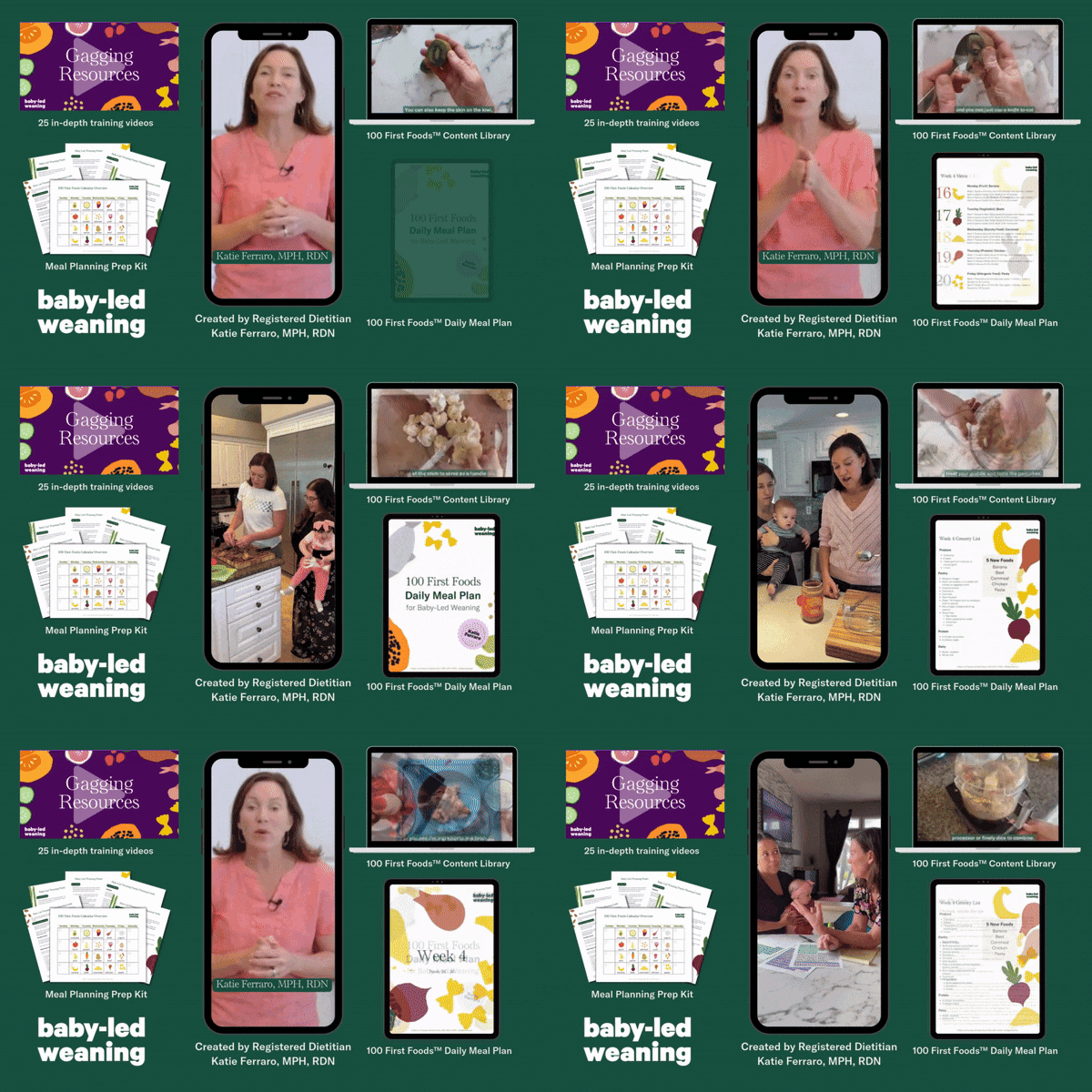
- Baby-Led Weaning with Katie Ferraro program with the 100 First Foods™ Daily Meal Plan, join here: https://babyledweaning.co/program
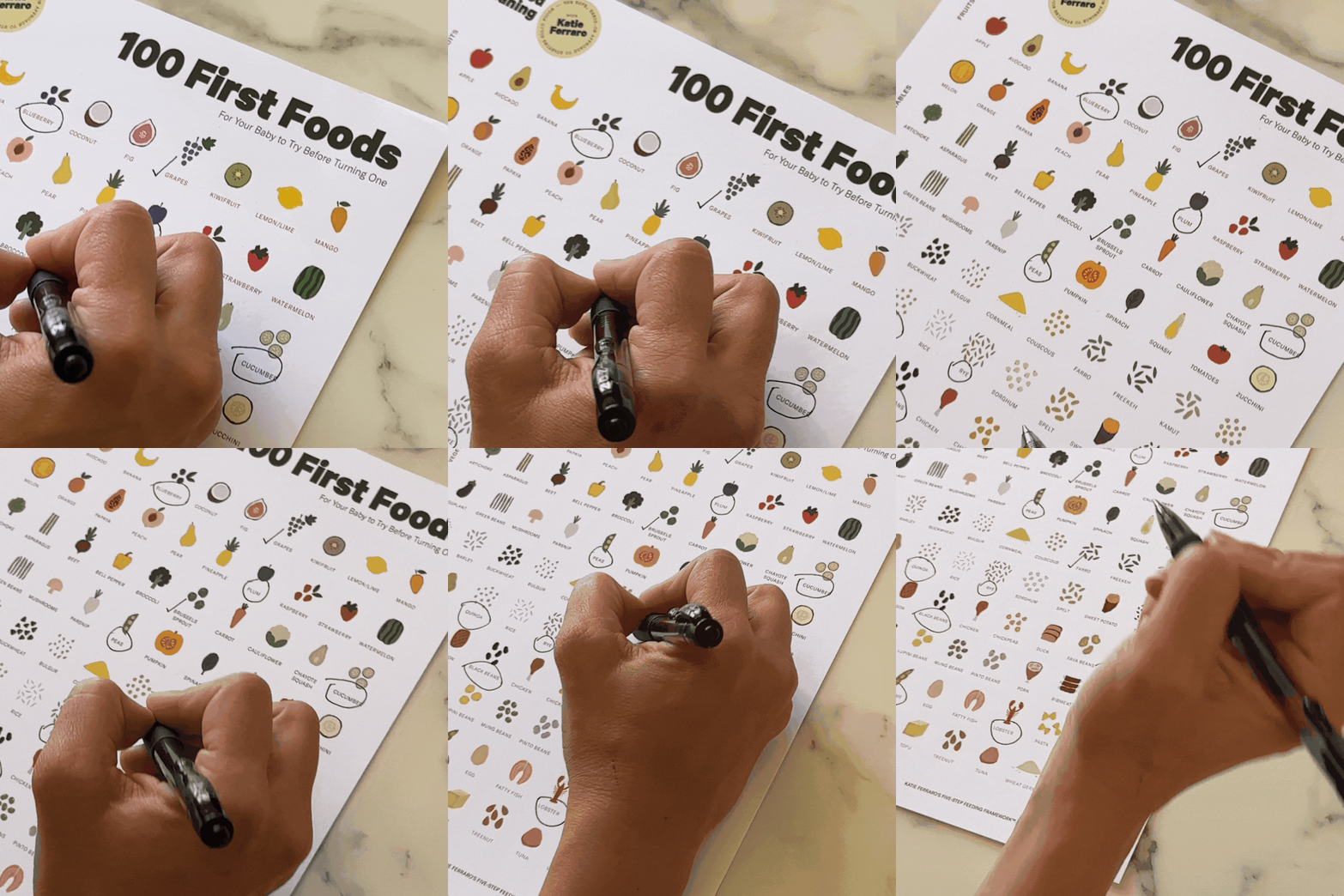
- Baby-Led Weaning for Beginners free online workshop with 100 First Foods™ list to all attendees, register here: https://babyledweaning.co/baby-led-weaning-for-beginners

Latest Episodes


Katie Ferraro (1m 22s):
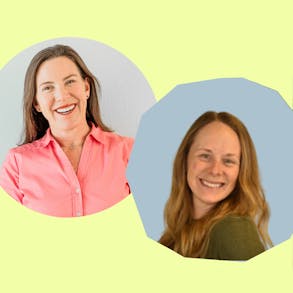
Hey. there. I'm Katie Ferraro, registered dietitian, college nutrition professor and mom of seven specializing in baby-led weaning here on the Baby-led Weaning Made Easy podcast. I help you strip out all of the noise and nonsense about feeding, leaving you with the confidence and knowledge you need to give your baby a safe start to solid Foods using baby-led weaning. Okay, one of my biggest pet peeves is when people spell dietitian with a C spelled with a T in the United States. But even more annoying than that is when they call me a Nutritionist and I'm really a dietitian, you guys, the term Nutritionist actually means nothing.
Katie Ferraro (2m 3s):
And in today's episode I wanna talk about this idea of like where should we be getting our infant Feeding advice and information from? Because as you know, there is no shortage of misinformation out there. So what's the difference between a dietitian and a Nutritionist? Now, I'm publishing this episode just ahead of registered Dietitian Day. March 8th is registered dietitian day in 2023. So if you guys know any registered dietitian or some RDS to be, those are the future dietitian who are in their dietetic internship. Give them a big shout out on dietitian day. And if you're listening to this on another day in March, the entirety of March happens to be National Nutrition Month. So we've got lots of great content as always lined up for you.
Katie Ferraro (2m 45s):
But like laying it on thick in March, which is National Nutrition Month. So I wanted to do this episode cause I realized we've never really talked about the difference between a dietitian and a Nutritionist and the conversation's kind of short cuz as I mentioned the term Nutritionist is not a legally enforceable term. It doesn't mean anything. And actually am a college nutrition professor. I teach nutrition at a number of colleges and universities and one of the things we always do in our introduction to nutrition science course when we're talking about, you know, where do people get nutrition and Feeding information from is one of the publishers of the primary textbooks for college nutrition many years ago, like when internet stuff was new got her cat a Nutritionist certificate and it's like one of my favorite pictures.
Katie Ferraro (3m 26s):
And literally students will tell me like, the only thing I remember from your class was the cat with the Nutritionist certificate. And the point was that the author of the textbook just went online and got their cat a quote unquote Nutritionist certificate. So the term Nutritionist, again, your cat or your dog could technically be a Nutritionist. Now, a few years ago, the registered dietitian credential, which I have had for, I hate saying this, I have been a dietitian more years of my life than I have not been a dietitian. I'm 44 years old and when I was 21 I became a dietitian. So I spent more years as a dietitian than not. But I started out, I got an RD registered dietitian and then a few years ago as a profession kind of upgraded the credential. Now it's called the registered dietitian Nutritionist credential.
Katie Ferraro (4m 7s):
So R D N. So it's important if you hear someone calling themselves a Nutritionist, actually sometimes dietitians will, they'll say Nutritionist. And then people who know what questions ask will be like, but are you a registered dietitian Nutritionist? And they're kind of trying to help this kind of gray area of like a Nutritionist on its own essentially means nothing but a registered dietitian. Nutritionist has had extensive and scientific training. And so we get a lot of inquiries, especially from listeners and from social media, from you know, responses to email newsletter. you know, I'm interested in becoming a dietitian. I'm, I'm a mom, this is a second career. Or I started it a long time ago, or I got a credential or I got a certificate rather in nutrition and realized there's absolutely nothing I can do with it.
Katie Ferraro (4m 48s):
So now I wanna do the registered dietitian path. And what does that entail? So if you meet someone who's a registered dietitian, just to give you a quick idea of what that entails, you have to have an undergraduate degree in nutrition science or a related area from an accredited program. And it's important that this, the idea of accreditation, cuz if you just go online and start searching, like learn about nutrition or nutrition, how to become a Nutritionist, everything that will pop up is not a credentialed program, right? They're all paid ads and trying to get in front of you for a certificate program where they'll take all your money and then give you a title that you won't be able to do anything with. And in the majority of states in the United States, it's actually illegal for anyone who's not a registered dietitian or a different credentialed professional from the healthcare space to provide what we call medical nutrition therapy.
Katie Ferraro (5m 29s):
So there's actually legal ramifications too. And the reason why is we wanna protect the health and the wellbeing of the general population that we're providing information for. And so when you meet a dietitian, that person has an undergraduate degree in nutrition starting in 2024. It's also required to have a master's degree. So at this point, most dietitians have a graduate level degree or higher. I have a master's in public health, in public health, nutrition and international health from uc, Berkeley, I did my undergraduate degree in nutrition. But all dietitians also have to complete over 1000 hours of supervised practice under the guidance of another credentialed dietitian, right? So you're learning from other credentialed experts as part of an accredited internship program. So you do your degree, you do your internship program.
Katie Ferraro (6m 10s):
If you get in, when you complete it, you sit for a registration exam, you pass the exam, you become a registered dietitian. And one thing I love about this field is that your credentials valid in the United States, at least in all 50 states. It's not like if you're, you know, in certain professions teaching or nursing, you might have to get re credentialed relicensed if you move from state to state. The registered dietitian nutrition credential is really the only nationally available credential. If you see someone who's an R D N Boom, no-brainer. They've done the work, they have the scientific background, they've done all of the supervised practice, they've passed a standardized exam to become a dietitian, and then they have to complete 75 hours of continuing education every five year cycle. and that's really important for those of you guys that have credentials, be it in healthcare or outside of healthcare in different fields.
Katie Ferraro (6m 55s):
If you have a science background, you need to have continuing professional education even outside of science. Continuing professional education is really important. Hey, we're gonna take a quick break, but I'll be right back.
Katie Ferraro (8m 12s):
So for those of you who are dietitians, I do have a continuing professional education course. my baby-led weaning with Katie Ferraro course is eligible for 15 continuing education unit credits. We oftentimes get moms in our program, we're like, I'm also a dietitian. I'm like, oh, you didn't know what you can get continuing ed for this program as well. And we're actually working on a lot of C E U offerings for other credentialed healthcare professionals who work in the Feeding space because it is important to be learning about food and nutrition from the credentialed feeding expert. So a lot of times people say, why did you decide to become a dietitian? And my mom is actually a dietitian as a, I'm the oldest of six kids and I always grew up with a mom who worked full-time, she had and still has a nutrition consulting practice working in long-term care.
Katie Ferraro (8m 54s):
So the other end, end of the lifespan with older adults in nursing home facilities and assisted living facilities all. And ironically, there's a lot of similarities between working in nutrition with old people and working in nutrition with Babies, being able to chew Foods without teeth, sometimes at hi slightly higher, elevated risk of choking, needing to learn how to swallow Foods safely, safe food preparations. It's kind of cool how our world overlap. Although I very quickly learned long-term care was not for me. Actually worked with my mom for a short period of time when I moved back to San Diego after I had sold my adult nutrition practice in the San Francisco Bay area. So I'm based in San Diego now, and I always was admiring the fact that my mom could work full-time, run her own business and still be able to be there for all of us kids.
Katie Ferraro (9m 34s):
So I got interested in nutrition and I did an undergraduate coordinated program at Texas Christian University. So I'm still very close with my nutrition professor, professor Van Bieber at tcu. And the coordinated program allowed me to do both my didactic work. So my four year degree and my 1000 hour internship as part of my undergrad. I was kind of in a hurry to get it done. And it can be a challenge sometimes for students when they finish their nutrition degree. You have to go on to get an internship after where you don't get paid for it. So I was into doing the undergrad and the internship together at the same time in a coordinated program. So I got my RD when I was 21 and I worked as a clinical dietitian for a while, learning about helping people in a hospital setting, which was very eye-opening.
Katie Ferraro (10m 17s):
And then I served as a Peace Corps volunteer in Nepal after college where I worked in international and reproductive health, which ironically I have seven children now. I used to teach family planning, basically. I was like, they could see me now. But I really fell in love with international health and nutrition and infant nutrition. And I went on to do my master's degree at uc, Berkeley with a specialty in international health and in public health nutrition. And then worked in adult for a while before I kind of fell into baby led weaning after having kids and really struggling with spoon Feeding my oldest. And so one thing I love about the nutrition profession is that you really have something of relevance to talk to to everybody, right? Everybody has to eat food. So in some, like at a dinner party, you can always talk about food like, oh, you're a dietitian, then they sometimes say funny things about, oh, I bet you don't eat this or you don't eat that.
Katie Ferraro (11m 1s):
And in reality, dietitians eat or don't eat all sorts of things. And they also work in lots of different areas. So when students come to us or interns or parents who are looking for a career change, like, you know, where can you work as a dietitian? And dietitians can work in so many areas in hospitals and healthcare facilities, in private practice community, public health settings. Every major league sports team has a dietitian in food and nutrition related businesses and public relations, university and medical centers. You have to have registered dietitian teaching other nutrition classes to different credentialed healthcare professionals. So lots of areas in research from the public sector to non-profit work. There's really something for everyone. If you're interested in food and nutrition, and for those of you who might be interested, I always ask people, you know, feel free to reach out.
Katie Ferraro (11m 46s):
I would love to talk to you about the career path if you are considering becoming a registered dietitian. And also just to raise awareness about what dietitians do, because again, there is so much misinformation about food and Feeding and unfortunately what we see, especially in the infant Feeding space, you know, really well-intentioned sites or different accounts that are run by bloggers or people who, to be honest, have no business teaching about infant Feeding are oftentimes giving outdated and dangerous information that's not based or steeped in science. And so what you'll learn from listening to my podcast, if you take any of my workshops or you're in any of my programs, is that all of the Feeding practices that I teach are evidence based. Hey, we're gonna take a quick break, but I'll be right back.
Katie Ferraro (13m 37s):
And so nutrition has a strong science background, which sometimes people say, oh, I didn't realize, or I'll get students an intro to nutrition. You're like, oh, I, I didn't realize it was a science. I, I just thought, you know, dietitians help people lose weight. And that's definitely used to be a majority of, you know, the things that dietitians may have done. But the field has really evolved. It's a wonderful career path if you are considering it. And for those of you who might be interested in, in the path or you're in undergrad nutrition, I know I love this now that in a lot of life cycle classes listening to the podcast, this podcast is actually required work for some graduate and undergraduate nutrition program. So if that's you and you're becoming a dietitian, if you're ever interested in doing part of your dietetic internship with our team here at the baby-led wean team, we have a full-time dietetic internship program.
Katie Ferraro (14m 23s):
We take dietetic interns 50 weeks out of the year. They're a very important part of our team. So for your community rotation or your pediatric rotation, private practice or entrepreneurial rotations, get in touch if you wanna work together. We love our dietetic interns. I love talking about the field of nutrition. I think becoming a dietitian is a really important career path. It's a lot of work, but it's certainly worth it. And I hope that you guys will turn to registered dietitians wherever you are in your health journey. Be that with, with your baby if you need help with. Oftentimes we talk to parents whose Babies are experiencing growth faltering, which what we used to call failure to thrive. You need a referral to a pediatric dietitian who can help you with fortification of your baby's milk because we do not use food to help early eaters with their ketchup weight.
Katie Ferraro (15m 7s):
And only a registered dietitian can help you with that. So it is important that you're turning to the right source. And if you need information on finding a registered dietitian, maybe you have an elderly parent who's struggling, or you have someone in your life who is a person with diabetes and they need to work with a certified diabetes educator on nutrition education for diabetes. There's lots of areas where a dietitian can help. Or maybe you yourself have gestational diabetes. A lot of you guys did. I have a, I'm a certified diabetes educator and I work a lot with parents with gestational diabetes. And it's amazing to see the changes that just a few, you know, nutrition tweaks can make and we can help our moms stay off of insulin if that's their goal and reduce their reliance on medications with diet and lifestyle changes.
Katie Ferraro (15m 48s):
So lots of areas where dietitians can help. If you think a dietitian could benefit you either personally or in your family, a good place to find a dietitian is if you go to the website eatright.org, that's the website of the Academy of Nutrition and dietetics@eatright.org. Right there on the homepage at the top is a big red button that says Find a nutrition expert. Many times your insurance will cover your dietitian, you can use your HSA funds. There's lots of ways where a lot of our families and who listen to our participants in the WIC program, they have access to degreed nutritionists and registered dietitian. And if you are looking for a resource to become a dietitian, always reach out to me by email. My email address is katie@babyledweanteam.com.
Katie Ferraro (16m 30s):
I love, love, love to hear from those of you who are considering this as a career path. Cause I think it's incredibly rewarding and I think it's worth every minute. And I hope you guys will continue to get your nutrition and Feeding information from a dietitian and happy dietitian day to all the dietitians out there, happy National Nutrition Month to everybody who's involved in Food and Feeding, and thanks so much for listening and being such an important part of this baby-led weaning community.
The Program Baby-Led Weaning with Katie Ferraro
A step-by-step digital program for starting solid foods safely and navigating the original 100 FIRST FOODS™ meal plan with baby-led weaning.
 EXPERT-LED, PROVEN APPROACH TO EATING REAL FOOD
 CONCISE VIDEO TRAININGS TO MASTER BABY-LED WEANING
 100 FIRST FOODS DAILY MEAL PLAN WITH FOOD PREP VIDEOS
Baby-Led Weaning for Beginners Free Workshop
Is your baby ready to start solid foods, but you’re not sure where to start? Get ready to give your baby a solid foundation to a lifetime of loving real food…even if you’re feeling overwhelmed or confused about this next stage of infant feeding.
Get baby-led weaning recipes and tips delivered to your email inbox.