
Dog Meets Baby: BLW Do's + Don'ts for the Whole (Furry) Family with Alexandra Parry, DVM
- Why even well-behaved dog should be kept away from your baby’s face during feeding - plus subtle warning signs that can help prevent dog bites before they happen
- Which everyday baby foods are dangerous for dogs (hint: it’s more than just chocolate) and how to keep dropped food from becoming a serious health risk for your dog
- How to include your dog in family life without compromising your baby’s safety at mealtimes - with practical tips from a vet mom doing baby-led weaning in real time!
LISTEN TO THIS EPISODE
Episode Description
Sure it’s cute to see a dog licking up the baby’s leftovers...but is that actually a good idea? In this episode veterinarian Alexandra Parry is sharing tons of tips for your whole (furry) family when it comes to mixing dogs with starting solid foods.
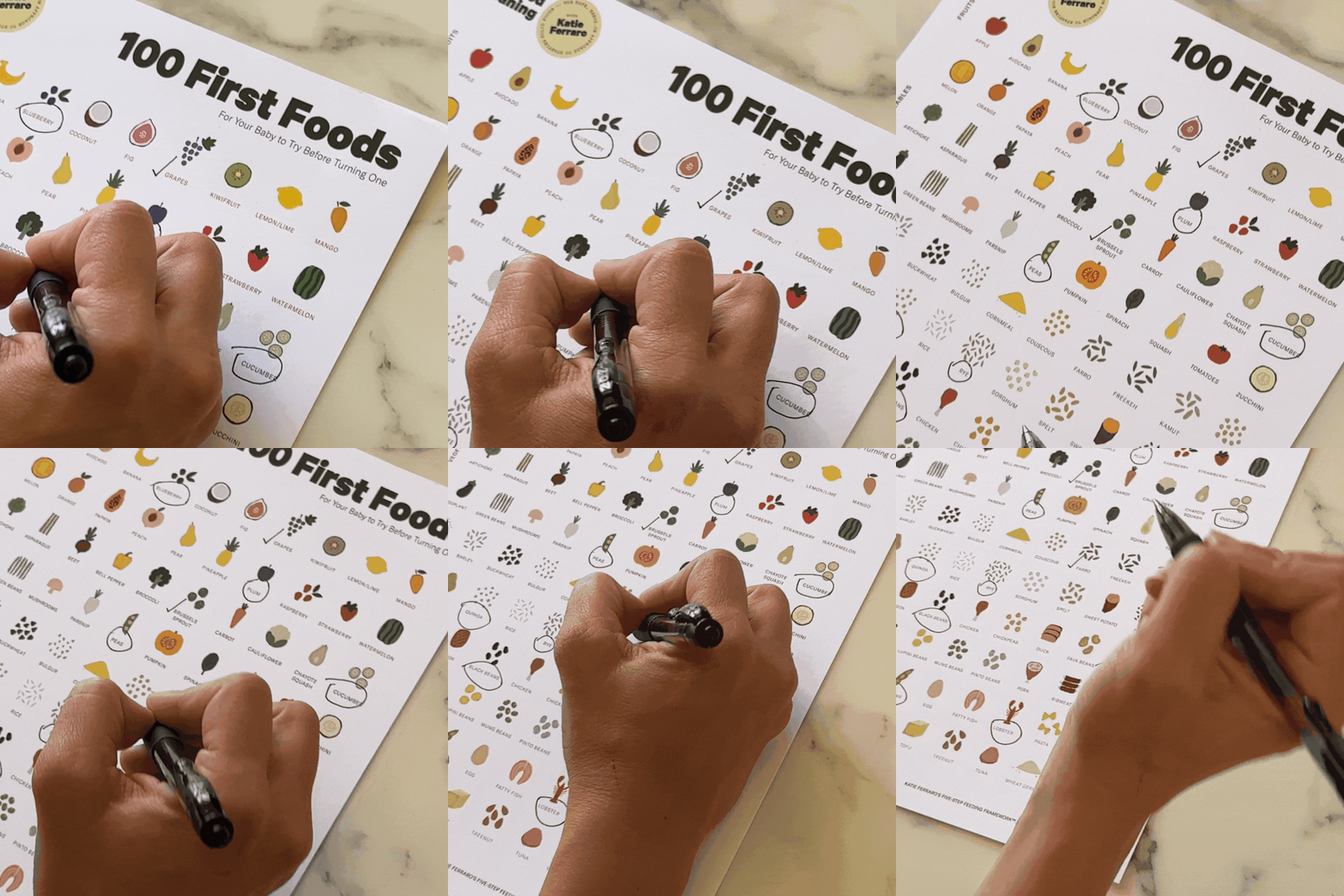
Dr. Parry is diving deep on all sorts of dog-related “Do’s and Don’ts”, some of which will surprise you. Like maybe you knew grapes were toxic to dogs and they shouldn’t have chocolate…but she goes through the 100 First Foods list with other foods that can be dangerous to dogs too.
As a mom of two who is doing baby-led weaning in real time, Dr. Parry understands the desire for parents to have their dogs involved at mealtimes; but as a vet who was also bit in the face by her own dog as a child, she shares some valuable insight about behaviors to avoid in order to protect your baby as they start solid foods while still fostering a good relationship with your dog.
About the Guest
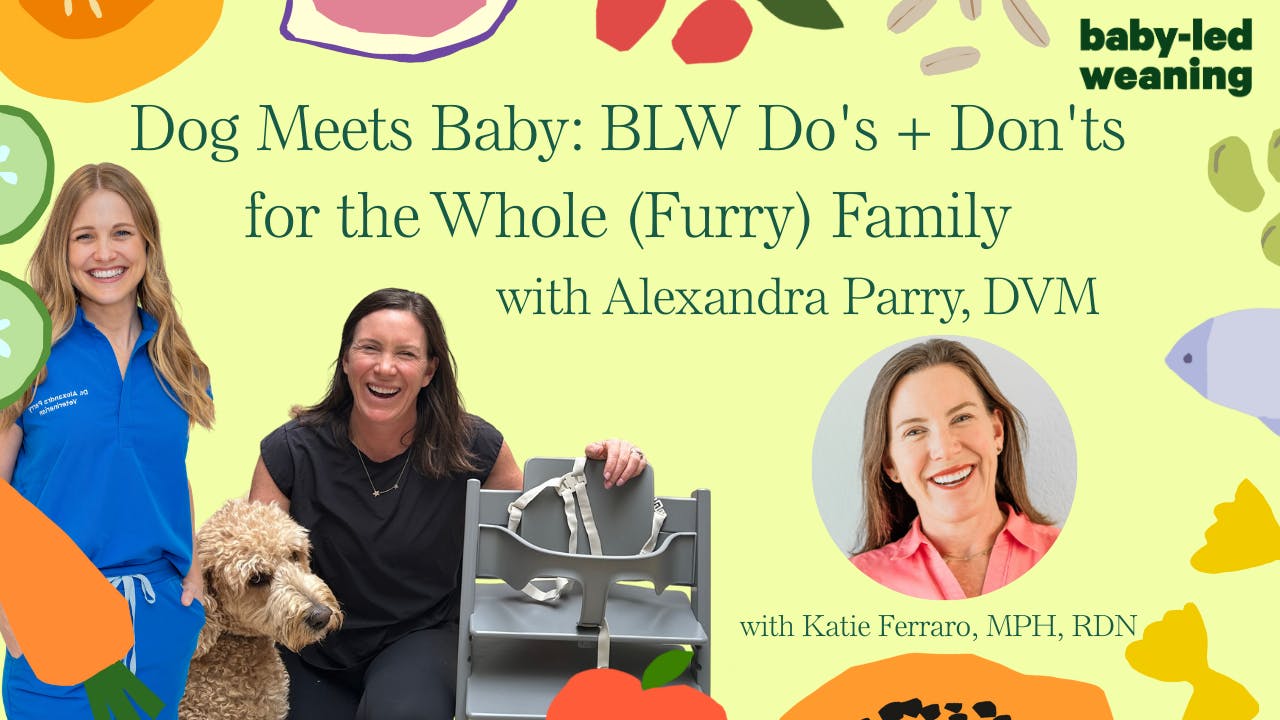
- Alexandra Parry is a veterinarian and mom of 2
- She is based in Canada and did baby-led weaning and the 100 First Foods program with both of her babies
- Dr. Parry shares valuable information about keeping your baby and dog safe as your baby starts solid food
Links from this Episode
- Follow Alexandra Parry, DVM’s baby Oakley on his baby-led weaning journey on Instagram at @oakes.eats
- Baby-Led Weaning with Katie Ferraro program with the 100 First Foods™ Daily Meal Plan, join here: https://babyledweaning.co/program and get $50 off when you sign up using the code BLWPOD50
JOIN NOW AT $50 OFF CODE: BLWPOD50
- Baby-Led Weaning for Beginners free online workshop with 100 First Foods™ list to all attendees, register here: https://babyledweaning.co/baby-led-weaning-for-beginners
Other Episodes Related to This Topic

Latest Episodes




Hungry Root (0s):
The dog days of summer are upon us and I thought that this was gonna be a super chill, relaxing time of the year, right? It's the waning days of the summer season, but somehow it's now the busiest time of year our kids fall. Sports seem to be starting earlier and earlier every year. Somehow I'm already behind with back to school stuff and we're not even back to school. And I know for you with a baby at home, you're probably feeling like your life is still very much not on a schedule, but this schedule stuff, this is where Hungry Root has been saving me because honestly, I don't have the brain space or the time on my schedule for grocery lists or recipe ideas right now on top of everything else that's going on. Hungry Root is not just another meal kit. Hungry Root is a personalized grocery and recipe service that actually gets smarter the more you use it. So Hungry Root fills your cart and plans your meals based on what you like, what your family eats and your health goals. There's Smart Cart technology totally gets me now. It knows I like high protein, family friendly meals that take less than 15 minutes to prep. It's literally like having a personal shopper and a private chef. My last box had these amazing mango shrimp tacos, a protein packed Greek salad kit, these chocolate tahini cookies that I will admit I hid from my children, not 'cause I don't let them have cookies because they were so good. I wanted them all for myself. So easy to prep even with all of the kids still at home, kind of driving me crazy here at the end of the summer. Plus Hungry Root has helped me cut way down on impulse grocery buys And we don't have any wasted produce problems anymore. Their best price program even saves me money on pantry staples and snacks that I was gonna be buying. Anyway, you can take advantage of this exclusive offer for listeners of our show. For a limited time right now, you can get 40% off your first box plus get a free item in every box for life. All you have to do is go to hungry root.com/weaning and use the code weaning. That's hungry root.com/weaning code weaning to get 40% off your first box and a free item of your choice for life hungry root.com/weaning code weaning
Alexandra Parry (2m 12s):
Dogs are great family pets and certainly will become great companions to our babies. But the most important takeaway is that when we are starting solids with our babies, when the children are feeding, really the dog should be in a separate area of the house.
Katie Ferraro (2m 27s):
Hey there, I'm Katie Ferraro, registered dietitian, college nutrition professor and mom of seven specializing in Baby-Led Weaning. Here on the Baby-Led weaning with Katie Ferraro podcast. I help you strip out all of the noise and nonsense about feeding, giving you the confidence and knowledge you need to give your baby a safe start to solid foods using baby-led weaning. Hello, welcome back. Today we're talking about dogs and what is the role in starting solid foods? Now I gotta be honest, I did not grow up with animals. I historically was not super fond of them. It's not that I disliked animals, I just didn't love them.
Katie Ferraro (3m 9s):
But when I started specializing in baby-led weaning as a dietitian, almost every person I encountered was like, wow, you really need a dog to clean up that mess. And I was like, I have seven kids. I cannot handle a dog. But I do get that lots of you love your dogs and in many cases you had that dog long before you had your baby and then you figured out how to coexist with the dog and the baby. But now the baby is starting to eat solid foods and the dog is playing a new role in your family. Like should the dog be allowed to lick the highchair tray? What foods can dogs have or not have? Is it chocolate? Is it grapes? What about raisins? So one of the moms in my Baby-Led Weaning program, she was doing our hundred First Foods program with her baby. She approached me a while back to talk about these things.
Katie Ferraro (3m 50s):
Her name is Dr. Alexandra Perry. She's a certified animal expert because she's a vet. So Dr. Perry is a vet who lives and practices in Canada. We recorded this interview a while back when her oldest Child Oaks was doing Baby-Led Weaning. So since then she's gone on to have a second baby who also did baby-led weaning. That baby did the 100 First Foods approach. Also, one of my absolutely favorite things about this line of work is getting to stay in touch with parents of the families as they're growing right? I'm totally done having kids, but watching you guys go on to have more children and seeing those children grow up to learn to love, eat real food, I love it. It just lights me up. So I touched base with Dr. Perry. I told her we're gonna rerelease this episode. She responded that the Instagram account that we referenced in the interview, which was Oaks Eats, that's where she was documenting Oaks is and then her second baby atlases 100 First Foods journey.
Katie Ferraro (4m 38s):
The account's not active anymore 'cause they're done with Baby-Led Weaning, but it's still public if you wanna see all their foods, that's at O-A-K-E-S.Eats on Instagram. Another timely mention, since I last interviewed Dr. Perry, I had a complete turnaround. I'm now a self-proclaimed dog lover. So we had a family friend whose son passed away unexpectedly as a family. We inherited his perfectly trained two and a half year old Golden Doodle named Lou. Lou has been a member of our family now for about a year and a half at this point. It has been like an absolute godsend for our family. My kids are older now they're school age so they can help with Lou's care, which would not have been possible when they were babies. I don't know very much about dogs, but I do know that I could never have had a puppy when I had seven kids age three and under.
Katie Ferraro (5m 19s):
But now that I have seven school age kids And we got an older dog who was already trained, dogs actually are my jam. I love Lou. So I want you to pardon any part of this interview where I maybe said that dogs were not my favorite because now they are and I see the light. Dr. Perry, she says that baby-led weaning was such an incredible experience for both of our kids. She recommends it to all of her friends and family. If you wanna check out my program that she did, it's called Baby-Led Weaning with Katie Ferraro. It's your one stop online shop for everything you need to give your baby a safe start to solid foods. I have a full 100 First Foods Daily Meal Plan in there now that parents ask me to make. So I did. I've got a 100 First Foods content library with all the videos and the recipes and the instructions on how to make all of the finger foods safe for your baby's age and stage.
Katie Ferraro (6m 3s):
And as one mom put it to me this week with how annoying social media has become and how overwhelming AI is, Katie, your program is more valuable than ever. I love having one place to go to see exactly how to prepare finger food safely for my baby. So if you wanna check out the program, it's online at Baby-Led Weaning.co/program. I'm gonna help your baby get to a 100 foods before they turn one just like we did with Dr. Perry's two babies. And if you're just getting started with baby-led weaning and you don't yet have a copy of my original 100 FIRST FOODS list, I want that printed out and put on your refrigerator so you can start knocking out all of these new foods with your baby. The best place to get started learning is my free online workshop. It's called BABY-LED WEANING FOR BEGINNERS. You can take this free workshop right now later today when your baby naps tomorrow whenever's convenient for you.
Katie Ferraro (6m 47s):
Everybody on this free workshop gets a copy of my original 100 First Foods list at the end of the workshop. You can sign up at baby-Led Weaning.co/Workshop. And so now with no further ado, I wanna bring on Dr. Alexandra Perry, doctor of Veterinary Medicine. She's here to talk to you about Dog Meets Baby, baby-led weaning dos and don'ts for the whole Furry family.
Alexandra Parry (7m 12s):
Well thanks for having me Katie.
Katie Ferraro (7m 13s):
Alright, so as a mom of a baby-led weaning baby, I know he's nine months this week and you're a veterinarian. I am so grateful that you're here to talk about the dos and don'ts of feeding babies with dogs in the family. So in our household We have seven kids but no dog. And in all honesty, that's because I'm actually quite scared of dogs. So I know you have a personal story about being bit by a dog when you were younger and I was wondering if you could share a bit just about general safety regarding dogs for families with babies please. Is there like anything that you recommend that we know?
Alexandra Parry (7m 43s):
Absolutely. I mean I would say the number one thing put simply is really a child should never be at an animal's eye level. Basically as soon as you get down to a dog's eye level, you kind of become their equal. And when we're talking about babies, they're using their hands, their feet, their mouths to explore the world around them. And ultimately that includes the dogs in their world too. And really as nice, loving and gentle as a dog may be, there is a chance that one day that you know that dog might not be feeling well, they might be getting a little bit older or they just had enough of that baby exploring all over them. And typically when that happens, dogs will give some sort of warning signs or thought that behavior, sometimes it's as obvious as a growl or a bark.
Alexandra Parry (8m 30s):
Sometimes it may just be them getting really quiet or hunching their back up, putting their tail between their legs. But there are those signs that we can watch for as parents, as responsible pet owners. However, at the very minimum, parents really should be aware of those signs that their specific dog tends to give. Unfortunately, and I see it too much in my line of work is a lot of people aren't able to recognize some of those more subtle cues and a lot of dogs end up getting pushed past their comfort zone In extreme cases, this can actually result in the dog resorting to biting just to get that behavior to stop. And when we're talking about our sweet little babies, that's just the last thing that we wanna see happen.
Katie Ferraro (9m 13s):
Okay, that's so interesting 'cause there's something totally different from feeding infants as far as your relationship with your baby versus your dog and something totally similar that I heard. So with babies, we wanna get right at their eye level when we're feeding them. So we always tell parents, you know, get down there you have to hunch down, get right at your baby's eye level, you demonstrate how you bring the food to your mouth, be dramatic with your chewing so you're right up there in their face. But it sounds like what you're saying is we don't want the dog right up in your baby's face. Right,
Alexandra Parry (9m 38s):
Exactly. And although we might be getting up to baby's face and I do it myself, especially when I was first starting baby led weaning with Oakley and doing those exaggerated chews right up in his face, we don't want our dogs getting up in those baby's faces And we know it comes back to those cues that the dogs might be showing or giving us, telling their owners that they want something to stop. So really the number one thing that we do want to remember is to always really respect these cues that our dogs are giving us when they want a behavior to stop. And for example, if a dog is growling at a baby from them pulling their tail, the average dog, if they get scolded doing that, they'll learn not to growl.
Alexandra Parry (10m 23s):
You know, an obedient dog, if they're told not to do something, they'll learn not to do that behavior. Unfortunately, and I see this all too often, is many people will take that to mean that the dog is now tolerating the baby. Oh look how cute they're together, he's not growling anymore, now they're friends. But what parents really need to be aware of is that this apparent tolerance may actually be setting your baby up for a traumatic experience in the future, whether it is as a baby or even as they become a older child. Myself, for example, I was actually 12 years old when I was by my own dog at home. So it, it really is something that does touch quite close to home for me.
Katie Ferraro (11m 6s):
So you were 12 so that we can learn. If you don't mind sharing, was there something that you did to provoke that or I would assume sometimes the the behavior can't be explained.
Alexandra Parry (11m 14s):
Alright. And so when dogs are not allowed to express those warning signs anymore and when they've been taught and learned to not growl, if a baby is pulling on their tail, yanking on their furry, what happens is when a dog has had enough and they know they're not supposed to growl, that apparent tolerance is actually gonna turn very quickly from them lying down, apparently tolerating a baby to suddenly turning and biting to get that behavior to stop. So as scary as sometimes it can be to see a little growl from a dog, in all honesty that is what we want them to do. It's their way of communicating with us us that they want something to stop.
Alexandra Parry (11m 55s):
We can really use that as a cue to remove the dog from a scenario that they're not liking, especially when the baby's involved because we don't want those babies to get caught in the crossfire. Really, to put it simply, the best way to completely stop that is to not have a baby at a dog's eye level, whether it's on the ground on a bed. But what I do wanna emphasize is not holding a dog for showing those warning cues because they stop doing those cues one day they might seem like they're tolerating it and suddenly the next step will turn from quietly tolerating it to a bite and that's the last thing we want.
Katie Ferraro (12m 32s):
Wow, that's fascinating because there's so many similarities there with infant feeding in that as parents we need to learn to recognize and be able to respond to our baby's fullness cues. So when our baby is giving us really subtle signs that they're getting full or even that they're getting hungry too, but knowing those cues for your own baby's hunger and fullness, another cue you need to recognize it sounds like is knowing your dog's cues for when they're becoming agitated or I don't know what, what emotions dogs have, not being a dog person, but cues seem to be important for animals as well.
Alexandra Parry (13m 5s):
Absolutely. And I mean really they can have all the same emotions as we view. And that's funny, you know, you touch on sort of the similarities to baby feeding and babies in general with dogs because that's something I say quite regularly. And I actually, before going into veterinary medicine, had considered pediatrics and I always kind of draw on the similarities because you know with dogs when we practice medicine there, you know, they can't tell us what's wrong either. And we need to rely a lot more on sort of our physical exams and our skills to sort of deduce what is going on with the dogs. And it's quite similar with babies, whether it's in the medical world or at home watching their kids.
OSEA (13m 44s):
Hey, we're gonna take a quick break, but I'll be right back. As a dietitian with chronically dry skin, I'm also a big believer that what you put on your body is just as important as what you put in your body. And you know how some days your skin just feels thirsty, like it's begging for something more than lotion. I have that kind of skin where lotion just isn't gonna cut it. Actually, I remember when I was in high school, there was this girl in my current events class and she leaned across the aisle to my desk and She said, you know, if you put lotion on your hands, they wouldn't look like that. And I was like, I do put lotion on my hands, I just need more than lotion and I now use something more than lotion. I've recently been using O'S Hyaluronic Body Serum. Now this is not your average skincare product, it's literally like a tall glass of water for your skin and it soaks in immediately. So I put it on right after I shower. I do it every morning and every night and my skin just drinks it up. It's very lightweight, it's cooling honestly, it makes my skin feel refreshed in a way that no lotion I've ever met can do. So this is like very fast absorbing. It's this lightweight body serum. And what's cool, it's been clinically shown to instantly boost your skin's hydration by 161%. So it improves your natural moisture barrier. And I've got visibly smoother skin. The hero ingredient here is the hyaluronic acid. So OSEA blends three different weights of it, so it hydrates deep and locks in moisture all day. I've been using it under the aria algae body oil and that combo total game changer for my skin. As always with OSEA products, they're clean, vegan, cruelty free and climate neutral certified ingredients come from the ocean and they take care to protect it. I love knowing that what I'm putting on my body is good for me and for the planet. You can get healthy glowing skin for this season of your life with clean vegan skin and body care from OSEA. Get 10% off your first order sitewide with the code weaning. If you head to OE a Malibu, that's OSEA malibu.com, you're gonna get free samples with every order and you get free shipping on orders over $50. So again, head to OSEA malibu.com and use the code weaning for 10% off.
Katie Ferraro (16m 13s):
Let's talk a little bit about the mess because as a mom who's in the thick of it, I know you know that baby-led weaning is messy and as a dietitian specializing in baby-led weaning, I always try to remind parents and caregivers, our goal is not to eliminate the mess, it's to allow the baby the opportunity to learn how to eat during the weaning period, but we can minimize the mess. And so whenever I do a post about minimizing the mess or write an article, I'm talking about things like use a splash mat and a full coverage bib. But like 50% of the comments I get no, Jehovah are why don't you just get a dog? So I'm curious, in your professional opinion, is it even safe to have dogs licking food off the baby's fingers or face or after they eat? Could you talk a little bit about the dogs as it pertains to the mess?
Alexandra Parry (16m 54s):
Absolutely, and I mean to answer that question in one word, I would say no. It's something that, you know, I often see those comments as well on those types of posts about getting a dog to clean up the mess. And unfortunately I would have to professionally, you know, see that it really isn't the best way and I am much more on the camp of enjoying a flash mat and full coverage instead of sending the dog in. And there's kind of a few reasons for that. I mean we touched a little bit on the safety of babies getting down at dog level. So certainly if a dog is licking food off of a baby, I mean it doesn't take long for them to get carried away with licking food off of a baby.
Alexandra Parry (17m 36s):
Or even if a noise has gone off in the background or something has bumped the dog, it can only take a second to spook a dog. And the last thing you want is for your baby's fingers or face full of food to be near a dog's mouth if that does happen. So certainly baby safety is one thing that I do worry about when the dog is potentially licking food off of whether it's the baby's fingers or the face. But in addition to things just like a bite that we're talking about, the other thing we do really need to recognize is that there is understandably a lot of bacteria found in dog's mouth. So you know, we have kind of the average bacteria just like in our own mouth that is sometimes found, but a lot of dogs can actually have intestinal worms or parasites and some of these things can actually be carried in their saliva.
Alexandra Parry (18m 28s):
So one thing that we'll often see for example, is a parasite called Jara. And this is a zoonotic disease, which means that it can be spread from animals to people and a lot of dogs can actually not be showing any symptoms but be carrying this disease. And if they are licking themselves And we all know where dogs might be licking before they come and see us if they're licking themselves and then go to lick your baby after that, whether that's directly onto your baby's face or if they lick your baby's hands, if they're getting the food off, we know all too well that your baby scan are very shortly going to go in their own mouth. It's a very easy way that dogs can transmit those zoonotic diseases.
Alexandra Parry (19m 13s):
And certainly a common one is the parasite jara and that's something that can cause severe intestinal and that's certainly not anything that we want our babies to be going through, especially when they're just learning and being exposed to new foods as well. So another concern that we do have with our dogs getting into any food that might be dropped from the baby's highchair other than toxicities are either them getting into foods that may be different from their regular diet. Certainly many dogs that have allergies actually eat hydrolyzed protein diet. So just like our babies who are on a hypoallergenic formula and getting into just the smallest amount of food that is not their prescription diet can really mess up their management of those medical conditions.
Alexandra Parry (20m 0s):
Another thing we will commonly see are what's known as foreign bodies, and this is basically a dog ingesting something they're not supposed to and it can get stuck in their stomach or intestine creating a blockage which actually might require surgery to remove it. Honestly Katie, this is probably one of the most common non-routine surgeries I do. And with all the toys that come along with kids and babies, when we're talking specifically about baby-led weaning, there are lots of tools that get used there as well, whether it is a spoon or a bib. But with either of those items, especially if they have a little bit of food leftovers, it would not take much encouragement for a a dog to try to swallow that hole.
Alexandra Parry (20m 49s):
And one breed will commonly see that with our Labrador retrievers, they're notorious foreign body dogs as anybody with a lab will attest, they eat pretty much anything and I can just about guarantee that a lab would swallow a tiny spoon in a heartbeat if they had the chance. So certainly another reason that we do wanna keep the dogs away from the feeding table or away from the high chair while babies are eating.
Katie Ferraro (21m 16s):
Okay, something I've also always wondered is can dogs have food allergies?
Alexandra Parry (21m 21s):
Absolutely. And to be honest, it's probably one of the most common conditions I treat in dogs. The food allergies in dogs are a little bit different than in babies in that we don't tend to have anaphylactic reaction. We can get anaphylactic allergic reactions to insects and these things in dogs, but when we talk about food allergies, it more commonly causes skin issues. And one of the most common symptoms ends up being itchiness. And a lot of dogs will have a varying degree of this with mild food sensitivity. They might just have some very minimal itching, but with severe cases it can be so bad that the dogs end up getting skin infections from scratching themselves so badly.
Alexandra Parry (22m 6s):
And we often then reach for prescription hypoallergenic foods. So just like babies who go on a hydrolyzed protein formula, we actually use hydrolyzed protein diets in dogs with food allergies as well.
Katie Ferraro (22m 19s):
Is it even safe for dogs to be eating human food or are there toxicities that from our food, like you said, the babies can get illnesses from the dogs, but could we be harming the dog from our food, transferring it that way?
Alexandra Parry (22m 31s):
Absolutely, and I mean that is obviously kind of more so my area of expertise, but there are a few toxicities like you said. I mean pretty much every dog owner and everyone that is not a dog owner does know that chocolate is toxic to dogs. But there are lots of other ones that most pet owners I would say don't know about. And a common one is actually grapes. So grapes can cause a life-threatening acute kidney failure in dogs. And the interesting thing about this toxicity or rather unfortunate is that we still don't quite understand the way in which this toxicity happens or even what the toxic dose is.
Alexandra Parry (23m 13s):
And so what I mean by that is we don't know how many grapes it will take to cause a dog to go into this kidney failure and it varies between dogs, not just based on their size as well. So a small chihuahua may eat a handful of corded grapes prepared safely for your baby and not go into kidney failure. And we might have a large great vein eat just one or two and they could go into severe kidney failure. And with that, sometimes a dog might not even recover after multiple tests in the hospital, multiple days in the hospital on supportive care.
Alexandra Parry (23m 55s):
And it's really something that can be avoided simply by not having the dog in the area where the baby is eating. Because as you know, all too well with seven kids, food does inevitably get dropped on the ground and grapes are something that easily can fall on the ground and have the dogs get into when that does happen too.
Katie Ferraro (24m 15s):
So besides grapes and chocolate, are there other foods that we should definitely make sure dogs don't get? Yeah,
Alexandra Parry (24m 20s):
Absolutely. So I mean the other one that comes to mind when we're talking about foods that our babies are likely to eat eating is also onions and garlic. And in that same family, I mean we do have leaks and chives, but they don't tend to carry the same toxic compounds or for the same amount that we have in garlic and onion. So I don't worry as much about those two. But garlic and onions are something that can cause a severe anemia in both our dogs and cats and this toxicity is actually a lot worse than cats. So I mean most people you know, kind of think sending their dog in to clean up after the baby is done eating.
Alexandra Parry (25m 4s):
But myself, you know, I have a cat at home and he often will try to come by if we don't have them in a separate area of the house. And the last thing we want is either types of those animals getting into drops, pieces of garlic or onion when we talk about the toxic dose for that too, for example, looking at onions, it can only take about one and a half tablespoons of chopped onion for the average cat to actually experience the toxic dose and start having cell damage causing this anemia. So it's really not much before they will get quite sick.
Katie Ferraro (25m 40s):
And you might be wondering if you're just starting out with solids like, oh big deal, my baby doesn't eat onions and garlic. But in the first few weeks and months you do single solitary foods. But usually around the eight month mark when babies get their pinch or grasp they're comfortable with different textures, you move onto those combination foods, a lot of the foods that you're preparing may have onions and garlic. So that's a really important consideration and I think a lot of parents are not aware of. So thank you for sharing that. So in the content I create for baby led weaning, I really try hard not to come across as anti-D dog, but it is important when a baby is learning how to eat that we minimize distractions to the greatest extent possible. We wanna reduce choking risks. And secondly, we want the baby to have the opportunity to focus on learning how to eat.
Katie Ferraro (26m 20s):
So I usually say, you know, no iPad, no electronics, no toys at the table, but even a dog at the baby's feet can be very distracting. How do you personally and professionally feel as a mom of a baby-led weaning baby, but also as a veterinarian? How do you feel about the dog being in the room where the baby's actively eating?
Alexandra Parry (26m 37s):
Absolutely. I mean, I know what you mean and I have a hard time because I certainly don't wanna come across as dogs and babies don't mix because the truth is they're great family pets, but when it comes down to dogs and baby led weaning, they just really aren't the great combination that many people see them as. So I certainly can understand the draw and just having the dog come and clean that up. But when we're talking about distractions at the table, just in the same way that you say an iPad or toys can cause distractions, I would almost argue that dogs or cats for that matter may cause even more of a distraction at the dinner table or at the high chair, but we don't have a dog at my house, but our cat will actually come up to the dining room table on occasion and I can see the change in my son instantly as soon as he shows up in the room, even if he's not that close to my son's highchair, he'll be drawn to whatever the cat is doing and become too mesmerized by our cat to even pay attention to eating or he'll start dropping food on the floor and probably more so with dogs than with cats, they'll instantly become that baby's new best friend if it means new treats coming their way.
Alexandra Parry (27m 51s):
So certainly the distractions that they are for the baby really does affect the child safety as well if the dog is preventing them from focusing on eating. And you know all too well, especially in those early days of baby-led weaning, we really need our babies to focus on eating to prevent any choking episodes as well.
Katie Ferraro (28m 11s):
And I have to give it to you straight because your baby is nine months of age and you're in like the golden age of baby led weaning. But next month, usually when babies hit about the 10 month mark is when they start messing with you, their intake will go down a little bit. They're not growing as rapidly as they had been a few months ago and they start doing things to get your attention, to get your goat. So they will start dropping food on the floor, feeding the food to the dog. So it might get a little bit rocky in the next month or two, just know it's around the corner. And I think you're right, not having the dog or the cat there during the active feeding is ideal from a safety standpoint and from a learning how to eat standpoint. I wanna ask if you could share with us, I don't know if it's the same for like all types of dogs, but are there some standard warning signals or signs that dogs put out when they're uncomfortable?
Katie Ferraro (28m 53s):
Like what should we look for if they're getting uncomfortable? You mentioned growling, but beyond that.
Alexandra Parry (28m 58s):
Yeah, so growling is certainly the number one, and I mean it really does vary between dog and it wouldn't be something that is specific to certain breeds. Some breeds are more vocal than others. You know, our hound dogs do tend to be loud in general, so they might be more inclined to give out a bark, but I would say it more so depends on your dog's temperament. So those quiet, sort of calm dogs might be less likely to give a growl and instead they might just need to get really, really quiet. Or what we'll commonly see is their tail go between their legs, their ears go down, their back, get hunched up, and those are similar things you can look for with a cat as well.
Alexandra Parry (29m 38s):
So we talk about babies getting down to dog face level. The same applies to cats. So it really is interchangeable there. With cats, you know, we'll often see their tail get really bushy too, but certainly growling is the number one, but it's really important to pay attention to those quiet, more subtle signs, whether it's getting calm and quiet, getting their back hunched up, sort of backing away or almost towering from what's happening. Tail going between the legs, ears down. I'd say those are kind of the number one things for most dogs, but it varies a little bit between each one. So knowing your own dogs cues is very important. So ultimately, I mean dogs are a great family pet and certainly will become great companions to our babies.
Alexandra Parry (30m 20s):
But the most important takeaway I think I would emphasize is that when we are starting solids with our babies and kind of continuing on into their toddlerhood years as well, is that when the children are feeding, really the dogs should be in a separate area of the house. And the most important thing there is that the dog does not see this as a form of punishment. And so what I would recommend is really focusing on what I like to call positive reinforcement with the dog during this time. So if you have a separate area of the house that the dog can go while the kids are eating, and ideally this would be somewhere where they can't see the children at the table, whether it's the baby at the high chair or pulled up to the table itself so that the kids aren't distracted looking at the dog beyond the baby gate, for example, if the dog can be in a separate area of the house, this will prevent both the baby from getting distracted watching the dog and prevent the dog from getting into food that they should not, that may cause a toxicity from swallowing items that they shouldn't, like a small baby soon or a bib covered in food, but that will keep the dog much safer.
Alexandra Parry (31m 35s):
But in order to do this really safely for the dog, or rather to have it be a positive experience, what we do want is for the dog to have positive reinforcement throughout this. And so what I suggest with that is having a special treat or a special toy that the dog gets only during baby feeding time. If you're able to have the dog in a separate area of the house bringing in this high value reward that they only get during this time, they will start to make this positive association and they will not see it as a punishment because the last thing we want is the dog to associate the baby with any sort of punishment or draw a negative association with the baby.
Alexandra Parry (32m 20s):
So really having that positive reinforcement for the dog can be very helpful during the transition period when a new baby is in the home.
Sierra (32m 27s):
Hey, we're gonna take a quick break, but I'll be right back At Sierra. Discover great deals on top brand workout gear, like high quality walking shoes, which might lead to another discovery. 40,000 steps baby who's on top now? Karen, You've taken the office step challenge a step too far. Don't worry though Sierra also has yoga gear. It might be a good place to find your zen, discover top brands at unexpectedly low prices. Sierra, let's get moving.
Katie Ferraro (33m 5s):
Alright, so switching gears, I know you're a vet, but not talking about animals. How is it going with baby-led weaning with your own son Oakley?
Alexandra Parry (33m 12s):
It's been going really well. We've been having a ton of fun with it. He's been officially doing baby led weaning since he was about 29 weeks adjusted age and self feeding since then and he's been loving every step of it. So we're about to do our 54th food today. So we've already reached a halfway mark, which is quite hard to believe to be quite honest. He has actually been enjoying the journey as much as I have, probably more. He does seem to be very food motivated and there actually has not been a food that he hasn't liked yet. So he's kind of goggling up everything we'll put down. And right now we're kind of working on introducing some baby sign language so that he can communicate when he does want more.
Alexandra Parry (33m 60s):
So this morning at breakfast, actually, he asked for more food, so he ended up getting a third muffin after already finishing two muffins, two pancakes and four strawberries.
Katie Ferraro (34m 10s):
See you're following all of his cues. That's fabulous. What's the food of the day gonna be? The new food, if you don't mind me asking?
Alexandra Parry (34m 16s):
We are doing couscous today, so I think actually we're gonna try some fritters. I had seen you had done those as well too. So we've done some Panko breadcrumb fritters before and we've done king one nuggets, so I think we'll kind of try to put the couscous in some sort of delivery mechanism. Making the cleanup slightly less me. Yes,
Katie Ferraro (34m 36s):
I couscous, I love it. Now this really couscous is a little bit bigger, but it's still pretty small for babies to pick up. So I'm a full fan of couscous fritters, kedah fritters. Cleaning that stuff up by itself is such a pain. But you know, it comes with the territory. So thank you again for all of this fabulous info. Could you just tell us where we can learn more about Oakley's baby-led weaning journey?
Alexandra Parry (34m 59s):
Absolutely. Yeah. So we've kind of been documenting his journey on our Insta account. The tag is @Oakes.Eat and that's Oaks OAKES. So we've kind of been posting one new post with each food item that he's been trying as we go along. And
Katie Ferraro (35m 17s):
You guys, you have to check out Oakley's Instagram, well it's really mom's Instagram, but it's all about Oakley eating. It's fabulous. She has a highlight up top with info about baby-led weaning and also the Eat the eight. So they did all the allergenic foods, just really great photos of the different foods that he's eating. Totally perfect, like size, shape, everything. You guys are crushing it and I love that you also posted a list of the first 40 foods. If you guys are also interested in doing the 100 First Foods approach to Baby-Led Weaning, you can grab my list of a 100 First Foods on my free online workshop, which is called BABY-LED WEANING FOR BEGINNERS. It's all about how to get your baby to eat 100 foods before turning one without you having to spoonfeed, purees or buy pouches.
Katie Ferraro (35m 58s):
So I'll go ahead and link to this week's workshop times where you can sign up as well as Oakley's Instagram and some more information about our guest today, Dr. Alexandra Perry. That'll all be on the show notes page for this episode. To get there, you go to BLW.podcast.com/54. So thank you again, Dr. Alexandra. This has been fabulous. I really appreciate all of the insight to help us be safe when we're doing baby led weaning And we also have a dog in the house.
Alexandra Parry (36m 27s):
Absolutely. Thanks for having me, Katie.
Katie Ferraro (36m 29s):
Well, I hope you guys enjoyed that interview with Dr. Alexandra Perry. She is a vet from Canada, a baby-led weaning mom of two and full of a lot of great information. So I'm gonna put all the resources that she mentioned on the show notes page for this episode, which you can find@blwpodcast.com/56, and a special thank you to our partners at AirWave Media. If you guys like podcasts that feature food and science and using your brain, check out some of the podcast from AirWave Media. We're online@blwpodcast.com. Thank you so much for listening. I'll see you next time.
Disney (37m 8s):
Want to live better? We've got a lot of work to do. Join Chris Hemsworth in National Geographic new Disney plus original series, limitless Live Better Now I'm diving head first into cutting edge science to uncover three powerful secrets to living better right now. The growth that occurs through any challenging experience is really what we see. Chris Hemsworth stars in Limitless Live better now, now streaming on Disney Plus and Hulu. It's Showtime.
The Program Baby-Led Weaning with Katie Ferraro
A step-by-step digital program for starting solid foods safely and navigating the original 100 FIRST FOODS™ meal plan with baby-led weaning.
 EXPERT-LED, PROVEN APPROACH TO EATING REAL FOOD
 CONCISE VIDEO TRAININGS TO MASTER BABY-LED WEANING
 100 FIRST FOODS DAILY MEAL PLAN WITH FOOD PREP VIDEOS
Baby-Led Weaning for Beginners Free Workshop
Is your baby ready to start solid foods, but you’re not sure where to start? Get ready to give your baby a solid foundation to a lifetime of loving real food…even if you’re feeling overwhelmed or confused about this next stage of infant feeding.
Get baby-led weaning recipes and tips delivered to your email inbox.