
Sugar and Why Your Baby Should Avoid it with Robert Lustig, MD, MSL
- How to spot hidden sugars in common baby foods, pouches and yogurts - and then which real food alternatives you can swap in instead.
- Why Dr. Lustig believes pureeing vegetables for your baby does not convey the same health beliefs as eating the intact versions of these foods
- What the difference between apples, applesauce and apple juice is when it comes to fiber and carbohydrate load and impact on blood sugar levels
LISTEN TO THIS EPISODE
Episode Description
We all know babies don’t need added sugar—but avoiding it is harder than you think. In this episode, I’m joined by Dr. Robert Lustig, one of the world’s leading experts on sugar and metabolism, to uncover the hidden ways sugar sneaks into baby foods and what parents can do to keep it out.
Dr. Lustig—professor emeritus of pediatrics at UCSF and author of Metabolical—explains how processed foods, purees, and fruit pouches condition babies’ palates early on, and why real, intact foods are key for developing healthy eating habits and proper oral growth.
If you’ve ever wondered how to protect your baby from added sugar and help them build a lifetime of positive food preferences, this conversation will open your eyes to what’s really going on in our food supply—and what you can do about it.
About the Guest
- Robert H. Lustig, M.D., M.S.L. is Professor emeritus of Pediatrics, Division of Endocrinology at the University of California, San Francisco (UCSF). He specializes in the field of neuroendocrinology, with an emphasis on the regulation of energy balance by the central nervous system.
- His research and clinical practice has focused on childhood obesity and diabetes. Dr. Lustig holds a Bachelor’s in Science from MIT, a Doctorate in Medicine from Cornell University. Medical College, and a Master’s of Studies in Law from U.C. Hastings College of the Law.
- Dr. Lustig has fostered a global discussion of metabolic health and nutrition, exposing some of the leading myths that underlie the current pandemic of diet-related disease. He believes the food business, by pushing processed food loaded with sugar, has hacked our bodies and minds to pursue pleasure instead of happiness; fostering today’s epidemics of addiction and depression. Yet by focusing on real food, we can beat the odds against sugar, processed food, obesity, and disease.
Links from this Episode
- Dr. Lustig’s personal / professional website is located at www.robertlustig.com
- The non-profit Eat Real that Dr. Lustig is the Chief Medical Officer of is located here: https://eatreal.org/about/
- Dr. Lustig’s UCSF Sugar Science resource (...the one that vetted 8,000 clinical research articles down into a few infographics for you :) is located here: https://sugarscience.ucsf.edu/
Dr. Lustig’s books on Amazon (affiliate links)
- Fat Chance: Beating the Odds Against Sugar, Processed Food, Obesity and Disease
- Metabolical: The Lure and Lies of Processed Food, Nutrition, and Modern Medicine (release May 2021)
Movies that Dr. Lustig has been featured in that were mentioned in the podcast episode
- Fed Up
- Sugar Coated: How the Food Industry Seduced the World One Spoonful at a Time
- Sugar the Bitter Truth (...Dr. Lustig in the longest viral video you’ll ever watch!)
Baby-Led Weaning with Katie Ferraro Links
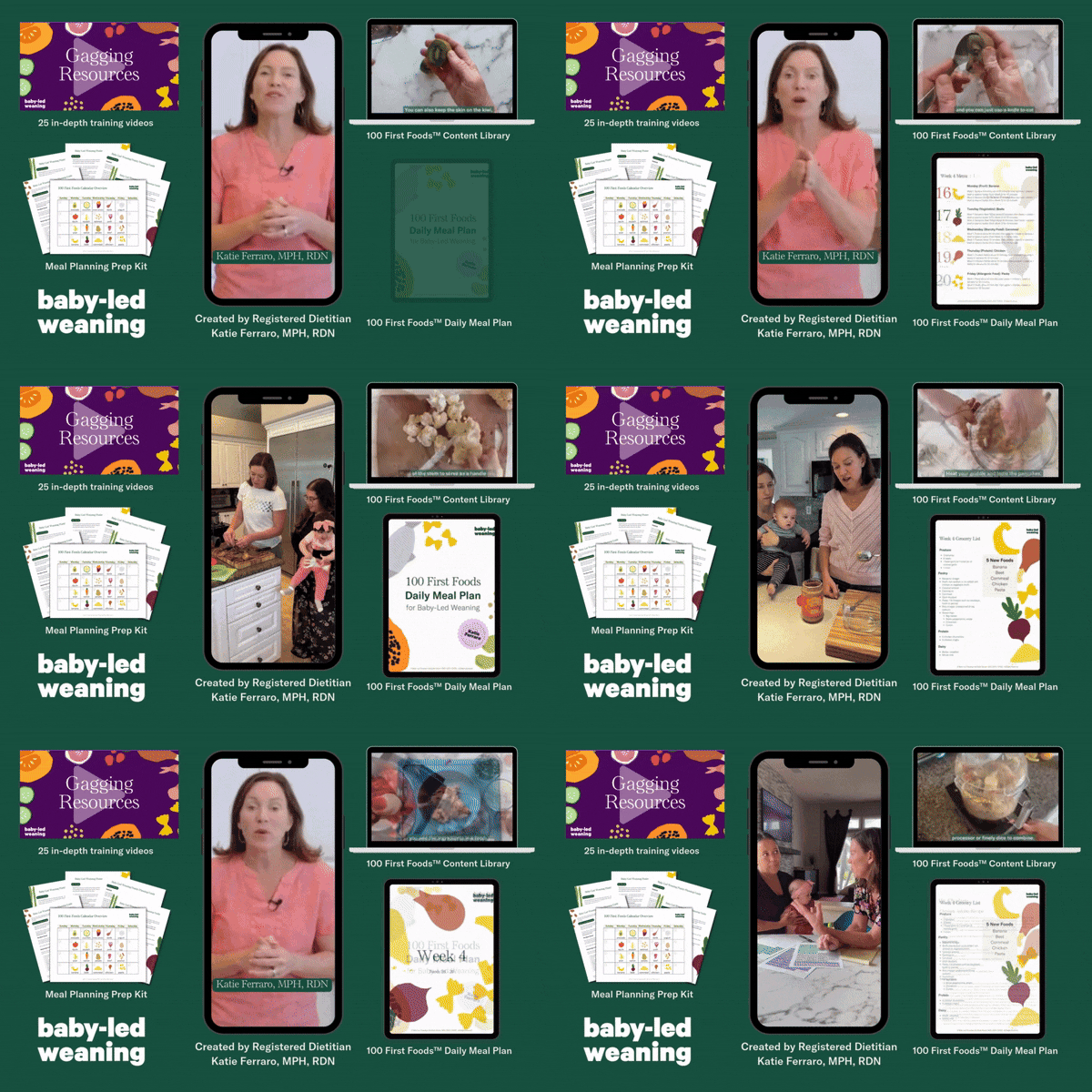
- Baby-Led Weaning with Katie Ferraro program with the 100 First Foods™ Daily Meal Plan, join here: https://babyledweaning.co/program and get $50 off when you sign up using the code BLWPOD50
JOIN NOW AT $50 OFF CODE: BLWPOD50
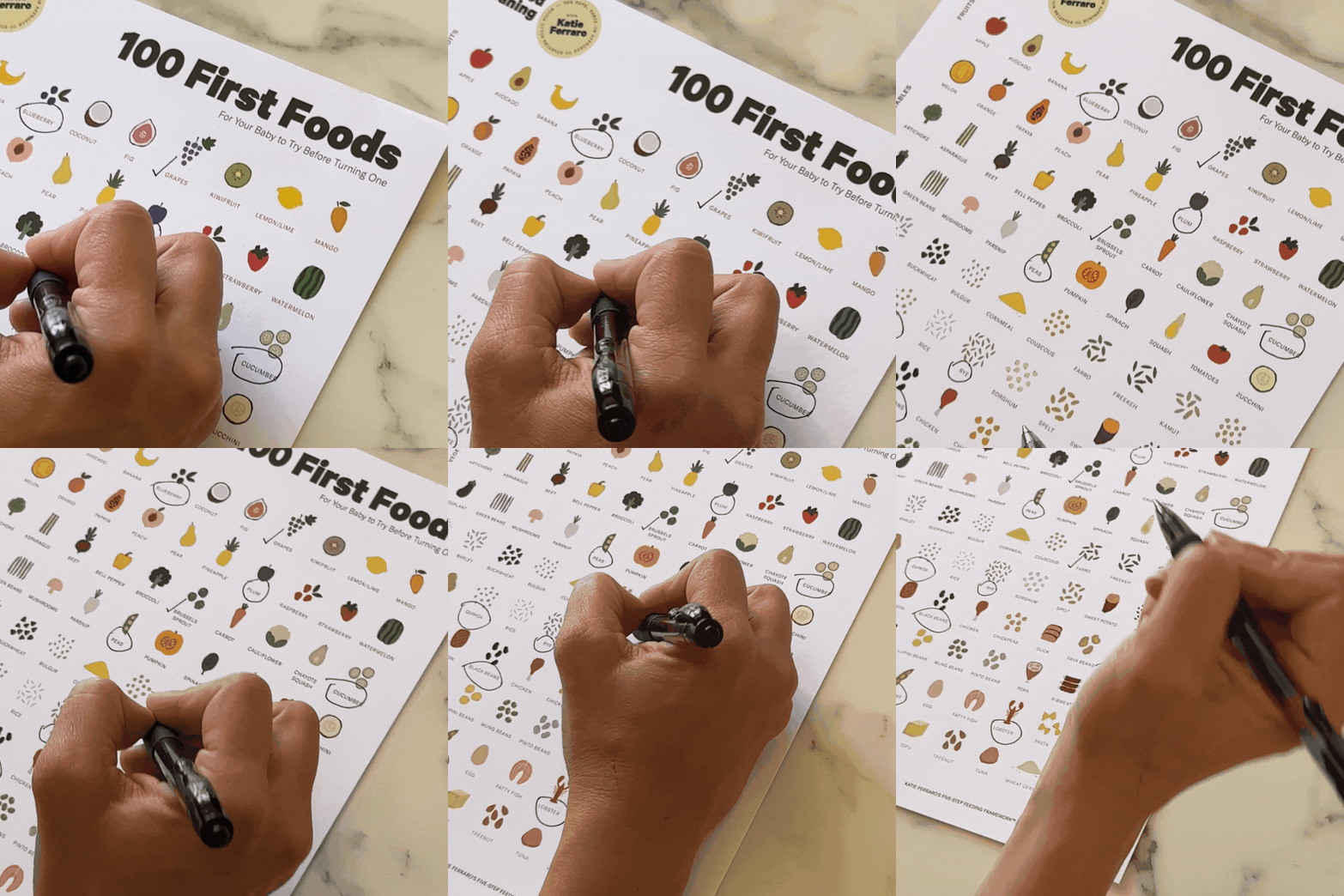
- Baby-Led Weaning for Beginners free online workshop with 100 First Foods™ list to all attendees, register here: https://babyledweaning.co/baby-led-weaning-for-beginners
Other episodes related to this topic

Latest Episodes






Rula (0s):
While Telehealth has made mental health care more convenient and accessible for millions of people, there are still critical challenges that remain like finding a suitable therapist or scheduling appointments or dealing with the expensive out of pocket cost. It still keeps many from getting the care that they need. Rula is on a mission to make high quality mental healthcare from a licensed professional. Easy and affordable for everyone. Rula has you covered. They take most major insurance plans and the average copay is only $15 per session. So you can now get the quality care that you need when you need it at a price you can afford. One thing I really admire about Rula is they're not just affordable. They also stick with you throughout your journey, making sure that you get the best therapy and that you're making progress. With Rula, every provider is carefully vetted and chosen for their expertise. So taking that important first step on your journey towards mental wellbeing is easy. Rula starts by asking you a few questions about what's important to you. Then they provide you with a list of licensed in-network providers who match your preferences. You can schedule your preferred time and meet with your therapist as soon as the next day. Go to Rula.com/weaning to get started today. And after you sign up, they ask where you heard about them. Please say the baby-led weaning podcast. Go to RULA.com/weaning and take the first steps towards better mental health today because you deserve quality care from someone who cares.
Hungry Root (1m 29s):
Is your holiday stress levels starting to tick up just a little bit? Can you feel it? This is the time of the year when the calendar starts to fill up the to-do list triples and the what are we having for dinner? Comments. I'm like, dinner becomes, oh my gosh. Whatever I can grab while we're standing up. Hungry Root is my secret weapon right now. Hungry Root takes the stress out of mealtime by filling your cart with personalized picks and planning your week of meals. It gets smarter with every order. So with over 15,000 recipes to choose from each week, many of which are ready in just 15 minutes or less, plus a wide grocery selection. I mean we've got things like smoothies and kids snacks, sweets salad kits, ready to eat meals and supplements. It is so easy to find options that fit your whole family's tastes and nutrition goals. So Hungry Root handles the grocery shopping, the meal planning, and even restock snacks with no stress on your part. I told Hungry Root recently, I need quick meals with clean ingredients, high fiber plant-based. My last box came with these, this amazing like tofu dish, which I thought my kids wouldn't love tofu and they absolutely devoured it. We had a cauliflower mac and cheese, which is amazing. These addictive chocolate chia bites that are definitely mine and not for sharing because they were so amazing. It's like Hungry Root knew that I was heading into holiday survival mode and then planned accordingly. Their best price program also helps me stay on a budget while still getting high quality hormone free meats 'cause we we're still doing some animal foods. Even though we're trying to do a lot more plant stuff, we're getting organic produce and trusted brands and everything is so fast, like dinner in 15 minutes fast, which I know that you also need in your household. If you'd like to check out Hungry Root, I'd love If you could take advantage of this exclusive offer for our listeners for a limited time. You can get 40% off your first box plus get a free item in every box for life. So go to HungryRoot.com/weaning and use code weaning. That's HungryRoot.com/weaning code weaning to get 40% off your first box and a free item of your choice for life. Again, that's HungryRoot.Com/W-E-A-N-I-N-G. And use that same code weaning and check 'em out for your holiday survival guide. When it comes to streamlining mealtime prep for your family,
Dr. Robert Lustig, MD, MSL (3m 57s):
When you look at baby food, it's all been spiked with sugar. Basically what they're doing is they're hooking these kids early. We have been feeding babies semi-solid food for millennia. Okay, and they're still here.
Katie Ferraro (4m 11s):
Hey there, I'm Katie Ferraro, registered dietitian, college nutrition professor and mom of seven specializing in baby-led weaning. Here on the baby-led weaning with Katie Ferraro podcast. I help you strip out all of the noise and nonsense about feeding, giving you the confidence and knowledge you need to give your baby a safe start to solid foods using baby-led weaning. Hello and welcome back baby-led weaning fans. Today we're talking about sugar. Okay? More specifically why your baby should avoid sugar, which is kind of a no brainer. Everybody knows babies don't need sugar. I am so excited today though 'cause we're taking like a totally different take on it.
Katie Ferraro (4m 53s):
We're gonna be chatting with the big daddy of sugar research himself, Dr. Robert Lustig. He's here to talk specifically about babies and sugar. So Dr. Lustig is going to be chatting about why it might be surprising, but babies are actually still getting exposure to Added Sugars even when we might think they're not. And then what we can do to help prevent this. So Dr. Lustig is a very well known in the world of Sugar Science. He is a professor emeritus of pediatrics in the division of endocrinology at UC San Francisco. He specializes in this field called neuroendocrinology. He has an emphasis on how energy balance is regulated by our central nervous system.
Katie Ferraro (5m 33s):
So the long and the short of it, he's done all of this research in clinical practice focused on childhood obesity and diabetes, but he really, really, really started to like hone in on the effects of sugar. He is one of the, seems obvious at this point in the era where we talk about like, you know, overprocessing and like, I think everyone's hyper aware about sugar. But Dr. Lustig really, really kind of set the stage for a lot of the research that's being done today. And he strongly believes that the food business is pushing processed foods that are loaded with sugar and it kind of hacked our bodies and our minds to pursue pleasure instead of happiness. So this one of kind of the underlying causes for, you know, fostering some of today's epidemics of addiction and depression. And I don't want to leave you guys depressed because it's kind of, it sounds like a lot of heavy stuff.
Katie Ferraro (6m 17s):
This conversation is really important because the underlying message is focusing on real food. But we all talk about like, oh, I want to eat real food and then we go to a grocery store that's absolutely full of Processed Food. So the kind of the odds oftentimes are stacked against us. I know personally I have been a huge fan of Dr. Lustig's work. I started teaching in the nurse practitioner program at UCSF where Dr. Lustig also has taught for many years. I first met him when I started teaching there over 20 years ago. Now I no longer teach at UCSF. Dr. Lustig is now professor emeritus there. I've interviewed him a number of times over the years for different like adult sugar situations. This interview was the first time I had a chance to sit down and chat with him about sugar and how it pertains to babies.
Katie Ferraro (7m 0s):
So I recorded this interview with Dr. Lustig a while back, but I wanted to re-release it because so much of what Dr. Lustig shares here is still very, very relevant. And I think it's very important for parents to hear, especially given the conversation that we're having in today's environment and the heightened awareness around ultra processed foods. So with no further ado, here is Dr. Robert Lustig talking about sugar and why your baby should avoid it. Hello, Dr. Lustig. Thank you so much for joining me today.
Dr. Robert Lustig, MD, MSL (7m 34s):
My pleasure Katie. Thanks for having me.
Katie Ferraro (7m 36s):
Now I know that sugar is confusing enough for an adult, let alone babies and your resource Sugar Science is the authoritative source for evidence-based scientific info about sugar and its impact on health. I was curious If you could tell our audience a little bit the research and the education that you do surrounding sugar.
Dr. Robert Lustig, MD, MSL (7m 55s):
Well, once upon a time I thought that all calories were the same. And the reason I thought that was because that's what they taught me in medical school. However, doing research in nutrition and obesity, it became very, very clear and very obvious that in fact calories were not the same. Different calories were metabolized different ways in the body and therefore had different effects on disease. And one of the most notorious was sugar. When I opened up my biochemistry text back in 2006, what I noticed was that sugar was metabolized just like alcohol and the two diseases that children were now getting, type two diabetes and fatty liver disease used to be the diseases of alcohol, but children don't drink alcohol.
Dr. Robert Lustig, MD, MSL (8m 41s):
So I put together a talk for the National Institutes of Health, basically equating sugar that is specifically the molecule, fructose and alcohol. And ask the question, could it be that sugar is the alcohol of the child? To, to my amazement, these were toxicologists I was giving the talk to. They went, oh my god, you're absolutely right and this makes perfect sense. You need to tell everybody about this. And so I basically started giving talks about this issue and basically altered my research program to look at this question. And I have been following the leads ever since.
Dr. Robert Lustig, MD, MSL (9m 22s):
I have been investigating this now for about 13 years and virtually all the data has fallen into place and it has enormous implications for policy as well. Of course as for personalized nutrition and obviously for babies because when you look at baby food, it's all been spiked with sugar on purpose by the baby food industry because they know that babies love sugar. In fact, babies prefer sugar for all sorts of evolutionary reasons. And basically what they're doing is they're hooking these kids early in the same way you'd be, you know, loath to give your 2-year-old the key to the liquor cabinet.
Dr. Robert Lustig, MD, MSL (10m 4s):
Well it doesn't matter 'cause you're giving it to 'em in baby food.
Katie Ferraro (10m 7s):
So when you say that about, you know, you'd be loathed to give it to your babies. I always think about some of the foods that are marketed directly to kids. One of the easiest, like the low hanging fruit are these yogurts that are for kids because they have so much added sugar to a product that already has natural sugar and it milk sugar. And I say like, would you take plain full fat yogurt and go to Starbucks and take four packets of sugar, open it up and pour it in your baby's yogurt and serve it to your baby? And every parent says no, you know, like they call CPS on you. Like that's exactly what you're getting when you're serving your child a product that has 12 or 16 grams of added sugar in it. So in addition to yogurts, could you just give us some insight as to what other foods that babies are prone to eating that have hidden sugars in them?
Dr. Robert Lustig, MD, MSL (10m 47s):
How about fruit loops? You know, fruit loops are finger foods for kids. You know, along with Cheerios and every, you know, all these other,
Katie Ferraro (10m 53s):
Well, honey nut Cheerios, I mean parents don't know the difference between regular Cheerios and Honey nut Cheerios and right. Not to mention children shouldn't have baby shouldn't have honey, but the honey nuts are not the basic Cheerios. If you look at the, there's less iron, there's more sugar. And I think a lot of times there's just confusion on the pot of the parents. They hear, oh, Cheerios are a good finger food. Which is not even true because at six and seven months of age when babies start solids, they don't have their pinch or grasp, they can't even pick up Cheerios yet. So it's actually a food for older babies
Dr. Robert Lustig, MD, MSL (11m 18s):
And not really a very good one either. It's sort of the prototypical first food for babies. I think that that really needs to change.
Katie Ferraro (11m 26s):
I do too. And I think it's frustrating to parents. They see the baby if they can even get the food in their hand, they can't get it outta their fat little baby hand before they have their penta grasp and parents say, oh well I guess the baby can't feed themselves. I'll just go ahead and shove this arbitrary amount of pureed baby food into their mouth.
Dr. Robert Lustig, MD, MSL (11m 41s):
So I mean basically virtually every baby food under the sun has been spiked with added sugar on purpose So that the baby will accept it. So a simple quiz, how often do you have to give a a savory food to a six month old before they will accept it?
Katie Ferraro (11m 59s):
We generally say between 10 and 15 times a baby may need to see a food before they like or accept
Dr. Robert Lustig, MD, MSL (12m 5s):
It. Exactly right. 13 is the medium. That's exactly right. Good for you Katie.
Katie Ferraro (12m 9s):
Thank you. Glad I passed you
Dr. Robert Lustig, MD, MSL (12m 10s):
Do this job for a reason. Okay.
Katie Ferraro (12m 12s):
It's so nice to hear someone else say it besides myself. It's really why you're here to reinforce the messages.
Dr. Robert Lustig, MD, MSL (12m 17s):
But how often do, how many times do you have to give a sweet food to a six month old before they will accept it? Only one
Katie Ferraro (12m 24s):
Like negative times they're gonna reach out and take it from you. Indeed.
Dr. Robert Lustig, MD, MSL (12m 28s):
And the reason is because number one, there are lots of T one CR taste receptors on the tongue that are specific for sugar. And in fact kids, the younger, the more prone they are to like it. And there are specific studies looking at this question. So the baby food industries, you know, they know and so they're very specifically spiking their foods with added sugar specifically. So the baby will accept it on the first try. So the mother goes, oh, he likes it. Let me give up more of this. And you know, then the kid's branded for life.
Katie Ferraro (13m 3s):
Well, and the parents feel good. Like if they're feeding a pouch for example, that says it has kale in it, it's essentially green colored applesauce and the parents feel empowered, oh, I'm giving my baby a health food. It's kale, but it's essentially applesauce with some green food coloring in it.
Dr. Robert Lustig, MD, MSL (13m 16s):
Exactly right. These are some of the industry tactics that we are trying to battle back. And I will also tell you that that pureed food is a problem in and of itself, even if it didn't have sugar in it because it's pureed. So this is a new line of research that I am embarking on along with a long-term colleague of mine. He's the world's first paleo dontist. His name is Dr. Kevin Boyd and he's at Northwestern in Chicago. And what he has demonstrated is that the tongue, you know, that is say breastfeeding the tongue is the primary stimulus to growing the palate.
Dr. Robert Lustig, MD, MSL (13m 58s):
So there's pressure by the tongue on the hard palate during sucking, which actually expands the palate and increases therefore the the area of the airway. And thereby you are growing the airway If you don't suck as hard. And there are many different diseases that cause decreased sucking or where you don't allow sucking, like for instance, If you have had surgical diversions of the intestine because of, you know, congenital abnormalities, et cetera, these kids don't grow their hard palate and they end up with malocclusion and obstructive sleep apnea later on
Katie Ferraro (14m 35s):
And they get diagnosed as having extreme picky eating because they can't tolerate different textures.
Dr. Robert Lustig, MD, MSL (14m 40s):
That's exactly right. All of these things are associated together. So the question I'm asking and that Dr. Boyd is asking is, how did we used to feed babies before the baby food industry entered our world? You know, the very first baby food was available in the Netherlands in 1927. Okay. And ever since then, you know, we've got Gerber and Carnation and all the usual suspects, but you know, we've had babies on this planet since, you know, time immemorial. How did babies get fed after breast milk from, you know, whenever till 1927 perhaps
Katie Ferraro (15m 22s):
Modified versions of the same foods the rest of the family ate?
Dr. Robert Lustig, MD, MSL (15m 25s):
Exactly. So what happened is the same thing that birds do, the mothers would preach you and you know, sort of do some mastication and some maceration of normal table foods and then plop it into the baby's mouth. And the baby, whether the baby had teeth or not is irrelevant. They would gum it to death. And what that did was it exercised the masseter and tego muscles, thereby increasing the strength of the bite. And that grew the maxilla So that you didn't end up with baby overjet, which is a form of malocclusion. And what that also did was it increased again the palatal vault, thereby increasing the airway.
Dr. Robert Lustig, MD, MSL (16m 9s):
So what we have been doing by feeding our kids pureed food, ostensibly with the notion that we're gonna prevent them from choking, is we've actually instead given them a new set of diseases.
KiwiCo (16m 21s):
Hey, We're gonna take a quick break, but I'll be right back. When I was a kid, my siblings and I used to spend a lot of our holiday break building forts out of the boxes that our Christmas presents and toys came in. I mean I love the gifts, but really I remember the building, the pretending, the creating something together with those boxes. Like that's what really made those memories stick. And now as a mom of seven, I love watching my kids get that same spark of creativity doing projects that teach them how to do things. And that's why I'm such a huge fan of KiwiCo. Their crates make the perfect holiday gift because KiwiCo crates don't just sit on a shelf, okay? They're hands on fun and educational. And when you give a KiwiCo crate, you're not just giving a toy, you're giving kids the tools to create their own fun. So in our house we've been doing the tinker crate, which is for our kids ages nine to 12. My daughter recently built a working pinball machine. She could not stop playing with it, but what I loved most was watching her understand how it worked to get the levers and the springs and the tensions and like all those science concepts just came to life right in front of her for younger children. The panda crate that's for ages zero to 36 months, has researched backed activities that engage all five senses for your baby and your toddler. For those of you with other children, age three to six, the koala crate helps your little scientists explore the world through pretend play. Another thing I love about KiwiCo is that all these projects are screen free. So they spark that same sense of wonder that we all felt as kids, that joy of discovery and trying and failing and then figuring it out with eight different crate lines for every age and interest from art to engineering, KiwiCo makes gifting easy crates ship right to your door. So even If you can't be there in person, you can still give something thoughtful and fun. So this holiday season, tinker, create and celebrate with KiwiCo you can get up to 50% off your first crate at KiwiCo.com promo code weaning, that's K-I-W-I-C-O.com promo code weaning for up to 50% off your first crate.
Katie Ferraro (18m 37s):
Okay, can we talk for a second about juice? I feel like most parents know the American Academy of Pediatrics guidelines about no juice for babies and super small amounts for toddlers. So I also think it's funny, If you look at the guidelines, four ounces max for a one to 3-year-old, which If you look at your typical size juice box, it's six or seven ounces. Like what are you gonna do? Take the juice box away from a toddler halfway through it. Like you can't do that. But for older kids, a lot of parents mistakenly think that kids need juice. Could you please tell us why they don't need juice.
Dr. Robert Lustig, MD, MSL (19m 6s):
They don't need juice, they need the vitamins, minerals, and fiber of fruit. Now the question is, what happens to fruit when it goes from fruit to juice?
Katie Ferraro (19m 17s):
I always conjure up your orange analogy. I do it for the college students all the time. Like If you were to take five oranges and mash 'em down into orange juice and throw the pulp away, that's where all the fiber is. Quickly ingest approximately five times more fruit sugar than you would If you had just eaten one orange. You wouldn't sit down and gobble five oranges. So you're eating more fiber by eating the fruit and eating less sugar. Is that correct?
Dr. Robert Lustig, MD, MSL (19m 41s):
Exactly. So my colleague and cookbook co-author Cindy Gersin, who is a nutrition teacher in the Mount Diablo Unified School District over in East Bay in Contra Costa County, every single year, first day she does an experiment. She picks two kids outta class, she hands each kid six oranges and she says to the first kid, okay kid, here's six oranges make juice. Then the kid squeezes the six oranges, gets 12 and a half ounces, downs the entire glass and says, okay, what's for breakfast? Second kid, she says, here kid, here's six oranges, eat the six oranges, kid eats orange, number one, orange number two, orange number three gets to orange number four and throws up always on orange.
Dr. Robert Lustig, MD, MSL (20m 29s):
Number four, Cindy's got the vomit basin ready and the kid goes, oh my god, I'm gonna die. And then the kid doesn't eat lunch or dinner either. So what happened? The fiber happened, the fiber. And there are two kinds of fiber and fruit soluble and insoluble. Soluble fiber is like pectins, like what holds jelly together. Insoluble is like cellulose, like the stringy stuff in celery. You need both. And the reason you need both is because what happens is when you have the two together, you form an impenetrable secondary barrier on the inside of your intestine, inside of your duodenum, the early part of your intestine where the sugars, the glucose, the fructose, the lactose, et cetera, all get absorbed in that early part of the intestine.
Dr. Robert Lustig, MD, MSL (21m 19s):
So you might like, think of it like a fishnet with kelp, you know, lining it. It's a lot harder to, you know, catch fish when you can't drag the net behind you because it's gotten all full of seaweed. Another example, let's take a spaghetti colander, you know, metal do hickey with holes. Okay, you run the water goes right through, okay, now take a blob of petroleum jelly and throw it into the center of the colander. Run the water still goes right through, bounces off the jelly. But so what now take your finger and rub, rub the petroleum jelly all the way around the inside of the colander.
Dr. Robert Lustig, MD, MSL (22m 1s):
Now run the water. Now you have an impenetrable barrier. So imagine that the colander is like the insoluble fiber, the fishnet, imagine the soluble fiber is like the petroleum jelly, like the kelp. Okay? And what you can see is that both the soluble and insoluble fiber and the geometry of these two things together actually restrict and reduce the rate of carbohydrate, particularly sugar absorption from the gut into the bloodstream So that the liver doesn't get overwhelmed. And are we
Katie Ferraro (22m 37s):
Talking about fiber from naturally occurring foods or does this include like the functional fibers like inulin and the ones that are added to a lot of diet foods that parents might inadvertently be feeding to their babies and not realize they're not good for them.
Dr. Robert Lustig, MD, MSL (22m 49s):
So those fibers like inulin, cilium, et cetera, are all soluble fiber. Now, soluble fiber is not necessarily bad. Metamucil is an example. I mean that's cilium, but they can't set up that gel alone. They cannot make that barrier without the fishnet, without the spaghetti colander. So adding fiber to foods like fiber one bars or like you said, adding inulin, okay, is not doing the job by itself. You need both the soluble and insoluble. The problem is that once the fiber has been stripped out of the food, and it's primarily the insoluble fiber that's stripped out of food, the pulp that goes into the wastebasket, when you juice a fruit or when you smoothie it, you know, basically what you're doing is you're taking the insoluble fiber and shearing it to smithereens with the blades of the Vitamix or the brel.
Dr. Robert Lustig, MD, MSL (23m 40s):
So now you can't set up that gel. Now you can't make that in secondary barrier. And so adding soluble fiber is not going to fix that problem. So in essence, those added fiber food stuffs are somewhat disingenuous because they're not really recapitulating the fact that the fiber's has been taken out of the food and you can't add insoluble fiber back to food 'cause it's not missable, it won't dissolve. So you really need real food. It's really about real food. And I actually have a new book coming out in May called Metabolic the Lure and the Lies of Processed Food, nutrition and Modern Medicine, which will explain that it's not what's in the food, it's what's been done to the food that matters.
Dr. Robert Lustig, MD, MSL (24m 25s):
And that's not on any food life.
Katie Ferraro (24m 26s):
And one thing I like to remind parents, like they sometimes get bogged down in the details of soluble insoluble. It's like take a half a cup, an oatmeal or take an apple. They have four grams of fiber too soluble and too insoluble. If you eat a variety of foods that are naturally occurring sources of fiber, you're gonna get both the soluble and the insoluble and the benefits from both. Don't overthink it and don't go selecting foods that have more or less added to it. But I wanna go back to what you said about the Vitamix because I, I think that's an important concept is that a lot of parents, especially with older kids who quote unquote don't eat vegetables, they'll throw it all in a blender, puree it to Smith rains, put it with something like applesauce or sweetened yogurt and then say they're feeding their babies vegetables. But is that something that you would essentially advise against because they're not gonna be getting the same nutritive benefits as if they had had perhaps the semi-solid soft cooked butternut squash versus a pureed pasta sauce of butternut squash?
Dr. Robert Lustig, MD, MSL (25m 15s):
Exactly. So basically what you are doing is you are getting rid of one of the primary components of the food that is helping not feed you, but rather feed your bacteria, feed your microbiome, feed your intestinal bacteria. And what we have learned is that in order for a food to be healthy, it needs to do two things, two things, protect the liver, feed the gut. Those two, any food that does both is healthy. Any food that does neither is poison. Any food that does one or the other, but not both is somewhere in the middle.
Dr. Robert Lustig, MD, MSL (25m 55s):
All of these pureed and Vitamix foods are somewhere in the middle because you're feeding the gut because you still have the soluble fiber, which the gut will use to make short chain fatty acids, which are anti-inflammatory and anti insulin, which are good. But you have destroyed the insoluble fiber so you are not protecting the liver. And so the liver still gets the tsunami of all of that extra sugar. And we have shown that with, you know, blood glucose excursions. Let's take three separate items. Apples apple sauce and apple juice, okay, same number of calories you give them to a person and you measure the blood glucose rise after each of them.
Dr. Robert Lustig, MD, MSL (26m 40s):
So obviously with the apple juice you get a big glucose rise with the apples, you get a very little glucose rise. What do you get with the apple sauce? Probably same as the juice. Same as the juice, exactly right. Same as the juice. And that's the point of this is that you're not protecting your liver the higher the glycemic excursion, okay? Basically the more your liver has to deal with, and that's where the chronic metabolic disease comes in because the liver's gonna take that extra sugar and turn it into liver fat. And that's why all these kids are now getting fatty liver disease. And when you get fatty liver disease, you know it's just a matter of, you know, when you're gonna get type two diabetes and
Katie Ferraro (27m 21s):
Your apple analogy is very appropriate for this audience because we talk about apples. If you look at emergency department admission data for non-fatal choking incidents in children and infants, apples are way up there. We can't feed babies six to 12 months of age raw intact apples, but we can show them how to par boil and cook them so they're just soft enough So that then from a texture standpoint, it's safer for babies to eat. And sometimes parents say, well why don't you just blast into smithereens and do applesauce or do apple juice. But you're saying that the more cooked it is that it would essentially be less helpful for the baby. And is it okay then to do the soft cooked apples because obviously we need to prevent choking risk.
Dr. Robert Lustig, MD, MSL (27m 59s):
Yeah, you know, look, no one's for choking, you know, and if anybody's ever seen their baby choke, it's pretty awful. I don't argue that. The fact of the matter is we have been feeding babies, you know, semi-solid food for millennia, okay? And they're still here. And this whole pureed pouch phase that the processed baby food industry is going through is clearly contributing to the problem. And we need to revert back because now we understand it. It's very clear in developing countries that are adopting our way of life, the data are, are really, really robust in China.
Dr. Robert Lustig, MD, MSL (28m 39s):
And If you look at the incidence of malocclusion in China, back in 1990, it was virtually non-existent and now it's like 10% of the population and obesity's gone up commensurately, I mean they back basically follow the exact same. And we're talking about obesity and toddlers, they're following the exact same trajectory. And you know, we also have now the data on obstructive sleep apnea as well. So we know that this is what's going on. The question is what are we going to do to fix it? And we have to rethink how we feed our babies
Katie Ferraro (29m 15s):
And we're pretty set on why babies definitely do not need any Added Sugars. But the parents and caregivers who are listening, they're adults faced with many of the same dilemmas, like the food place is confusing. And I love the subtitle of your book. It's not, you know, what's in the food is what we do to the food. So when parents are cruising aisles at the grocery store and all these foods are stuffed with added sugar, do you have any tips for parents as the purchasers of food in our households, what they can do to minimize Added Sugars?
Dr. Robert Lustig, MD, MSL (29m 41s):
Yeah, it's really easy. Stay out of the, the grocery store.
Katie Ferraro (29m 43s):
That's very easy to do during the pandemic. But what do you eat then?
Dr. Robert Lustig, MD, MSL (29m 45s):
The fact of the matter is If you go into the aisles, you've gone off the wrench, all of the food that you should be eating is on at the perimeter of the grocery store and most of it is in refrigerator aisles. So If you stick to the meats and the chickens and the pork and the produce, you are in fine shape. If you start looking for canned or tinned or boxed or wrapper food and they're all, you know, shelf stable and that's on purpose, now you've got a problem. So there's plenty to eat. Okay, about 25% of the grocery store is still edible.
Dr. Robert Lustig, MD, MSL (30m 28s):
I haven't taken that much away. Okay? The problem of course is that's where all the added sugar is, and that's also where all the, where the lack of fiber is, is on those shelves because you can't freeze fiber, you know, and I'll prove it to you. Take an orange, put it in your freezer overnight, take it out the next day, put it on the counter, let it thaw, try to eat it, see what you get. You get mush. Why do you get mush? The ice crystals that form macerate the cell wall. Allow all the water to rush in. Hey, food industry knows that. So what do they do? Squeeze it and freeze it. Now it lasts forever. They've turned a food, an orange into a commodity, frozen, concentrated orange juice. You can sell it on the commodities exchange.
Dr. Robert Lustig, MD, MSL (31m 10s):
Anybody ever see the movie Trading Places? That's what it was all about at the end. The commodities exchange and the frozen concentrated orange juice along of course with the pork bellies and things like that. So bottom line, the food industry makes boatloads of money poisoning us by altering the food, adulterating the food in such a way as to actually make us sick us.
Katie Ferraro (31m 34s):
Hey, we're gonna take a quick break, but I'll be right back.
Peacock (31m 43s):
The detective said missing kids usually come home. What happens when they Don't? Based on a true story police looking for John Gacy, We discovered bodies by the looks of that they're younger men. The things he did to it was kids, he's sick. The system failed. These families, Devil in disguise, John Wayne Gacy streaming now only on peacock. Do you know how Many there are? Up to you to find out.
Katie Ferraro (32m 16s):
Okay, back to the grocery store. What about legumes in the middle aisle? I'm not playing devil's advocate, I'm just like, I know pairs are gonna write me like a million messages about potentially helpful foods that are not on the perimeter. How do you feel about legumes? Like we recommend them for babies once they have their pinch crafts because good source, it is plant-based iron, but there's iron, there's protein, there's fiber, they're affordable, different texture tastes. Are you anti leggo? They have
Dr. Robert Lustig, MD, MSL (32m 36s):
Fiber. Peanut know loads of fiber go for it. In fact, the, we now know that the earlier you introduce peanut into a baby's diet, the less likely they are to get peanut allergy correct.
Katie Ferraro (32m 46s):
And our parents know that as well. But one thing we have to caution 'em about is don't go overboard on fiber because you can inadvertently do is cause the baby to be inadvertently full or artificially full from all that fiber, at which point they're then displacing other helpful foods and the ability to learn how to recognize and respond to their hunger and fullness cue. So again, don't go pushing tons and tons of fiber, but you're saying choose foods that aren't naturally occurring Sources of fiber.
Dr. Robert Lustig, MD, MSL (33m 10s):
Yeah, I mean, you know, I, I certainly wouldn't stick Metamucil down a kid's gullet, But if you just eat real food and you know, peanuts are fine, you know, obviously everybody's worried about kid aspirating a peanut. You could even grind them up If you want, if you're that concerned. But the fact of matter is try to stick to fiber containing foods. And legumes certainly have 'em, you know, beans, lentils, you know, quinoa, Pharaoh, et cetera are all fiber containing. They are shelf stable, but you have to cook them in order to get them to be edible. But they provide both carbohydrate and fiber. They have loads of micronutrients, they have loads of vitamins and minerals as well.
Dr. Robert Lustig, MD, MSL (33m 54s):
So they're highly nutrient dense foods and as long as they still have the external fiber, you know, the insoluble fiber, they are good choice because they're protecting the liver and feeding the gut.
Katie Ferraro (34m 5s):
Dr. Lustig, I can't thank you enough for sharing all of this information. Not only just about sugar, but about fiber. I think it's so important for parents and caregivers to hear and to know, you know, we need to be a little bit more discerning as customers at the store, especially when we're buying foods for our early eaters. So If you could tell us where the audience can go to learn more about your work, your research surrounding sugar, as well as your books as well, because that, especially the new book, sounds really interesting. Sure.
Dr. Robert Lustig, MD, MSL (34m 27s):
The last thing I wanna leave your audience with is just remember that real food is low sugar, high fiber and Processed Food is high sugar, low fiber, Processed Food is killing us. It's that simple. In fact, I've just written an article called Ultra Processed Foods Addictive, toxic, and Ready for Regulation. So my website is Robert Lustig.com. I also am the Chief medical officer of a nonprofit here in the Bay Area called Eat Real, where we are getting real food into California unified school district schools in the East Bay. We have removed 270,000 pounds of sugar from the Mount Diablo Unified School District in one year.
Dr. Robert Lustig, MD, MSL (35m 11s):
That's 10 pounds of sugar per kid for an entire year by getting real food into the schools. And there's a method and madness to what we do. And you can find us on eatreal dot org. My new book is called Metabolic and you can find it @metabolic.com. It's on Amazon, it's not available yet. It will be available on May 4th, but you can pre-order. And what I do is I take the medical profession to task 'cause we screwed up big time because we let the food industry and big pharma dictate our policies and I basically take those all apart and deconstruct them for the reader and for the politicians.
Dr. Robert Lustig, MD, MSL (35m 52s):
There are several resources that UCSF sponsors, for instance SugarScience dot org, which is a group of 12 independent scientists at UCSF and Emory and a few other institutions who have vetted 8,000 clinical research articles and distilled it into five messages for the general public with infographics and posters and things that you can put up in class, et cetera. I was in the movie Fed Up, which is a documentary about how we got to where we are today in terms of our Processed Food tobacco. I was in a documentary called Sugar Coated, which explains why we got to where we are today in terms of our Processed Food, tobacco, and I'm around YouTube.
Katie Ferraro (36m 34s):
Yeah, you are. You have one of, I'm sorry, but the longest, most viral videos ever. Like it's so long and yet people watch it to the end. Can you tell them just a second, I'll link to it in the show notes for this episode. Can you give us the rundown on that? To be honest, I've never made it to the end, but I know a lot of millions of people have. It's called
Dr. Robert Lustig, MD, MSL (36m 50s):
Sugar the Bitter Truth. It's a UCSF mini med school for the public lecture I gave in 2009 and it is 90 minutes of carbohydrate biochemistry. I never thought even my mother would watch it, let alone 11.2 million people and still going strong. And I gotta tell you, Katie, I have no idea why it caught on, but it did and it's viral and you know, everything in it is still true.
Katie Ferraro (37m 19s):
I've done a few of the MiniMed school presentations as well and I still get questions like I started doing them maybe 10 years ago and people go back and watch them. People really love that content. Nowhere near the views that your people have, but it's amazing that like people will find this, watch the whole thing and then send you very detailed emails to your UCSF email. I'm sure you get them all the time too.
Dr. Robert Lustig, MD, MSL (37m 38s):
So you know, I know that it's still out there and I know people still care. And you know, what we're seeing is a cultural tectonic shift in food. People say, how can you change something that's so embedded and so ingrained? Well, you know, there have been four count them, four separate cultural tectonic shifts in the last 30 years in America and here they are. Number one, bicycle helmets and seat belts. Number two, smoking in public places. Number three, drunk driving. Number four, condoms and bathrooms 30 years ago, every single one of those was anathema. If a legislator stood up in a state house or Congress or parliament or anywhere in the world and proposed legislation for any of those, they'd have gotten laughed right out of town, been ridden out on a rail nanny, state liberty interest, you know, get outta my kitchen, get outta my bathroom, get outta my car today.
Dr. Robert Lustig, MD, MSL (38m 33s):
They're all facts of life. And If you don't click your seatbelt, when you pull outta your driveway, your kids will scream at you. Why is that? How'd that happen? And why'd it take 30 years answer. We taught the children and the children grew up and they vote and the naysayers are dead. This is why these are cultural tectonic shifts. And it also explains why it takes 30 years. Well, we are in a cultural tectonic shift around food, but we're only about seven to eight years into it. So we have a little bit more work to do, but we're doing it well. Thank
Katie Ferraro (39m 12s):
You so much. This was amazing.
Dr. Robert Lustig, MD, MSL (39m 14s):
My pleasure, Katie. Anytime.
Katie Ferraro (39m 15s):
That's Amazing. You're a walking, I mean, I know you do the points over and over, but it's, I think the visuals you do are so great too. Like the orange one that always gets parents, I literally remember, like I knew how that story would end, that the kid is gonna vomit. Like I've heard you say that story like that really sticks with parents. And I love the infographics on the SugarScience website. I think no one's gonna read 8,000 articles, but I'll look at five infographics. So thank you for making it digestible for us.
Dr. Robert Lustig, MD, MSL (39m 37s):
Not a problem, not a problem. Happy to do so, you know, hope it gets out there. Hope people digest the message. Awesome.
Katie Ferraro (39m 43s):
Well thank you so much Dr. Lustig, I really appreciate it. Well, thank you guys for listening. I hope you enjoyed that interview with Dr. Robert Lustig. I loved re-listening to it. Any chance I get a chance to learn from him, I always kind of hear something new, learn something new, start looking something up, go down a rabbit hole. I'm gonna put a link to all of the different references and resources that Dr. Lustig mentioned on the show notes page for this episode, which you can find@bwpodcast.com/68. I wanna say a special thank you also to our partners at AirWave Media. If you like podcasts that feature food and science and using your brain, check out some of the podcasts from AirWave Media. We're online@blwpodcast.com. Thank you so much for listening, and I'll see you next time.
Rula (40m 33s):
You know how if your baby gets sick, they spike a fever or they get a rash, you can, in most cases, call up your pediatrician's office, hopefully get in to see someone that same day. And best case scenario, your insurance covers most of it. Now imagine that kind of access, but for your mental health, that's what Rula is doing. They are making it that straightforward to get the therapy and the mental health care that you need with licensed providers covered by insurance with no long wait lists. And this isn't just therapy in theory, this is actual care. Every provider in Rula network is vetted, experienced, and focused on helping you make real progress. So appointments are often available as soon as the next day. And with most major insurance plans accepted, you're gonna pay as little as $15 per session, sometimes nothing at all. Plus, Rula offers end-to-end support, including medication management. So even if you're not totally sure what you need, they've got a team that can help you figure it all out. Thousands have already trusted Rula to support them on their journey toward improved mental health and overall wellbeing. If you head over to Rula dot com slash weaning, you can get started today. So after you sign up, they're gonna ask you where did you hear about them? Please say the baby led weaning with Katie Ferraro podcast and help support our show. If you go to r Rula a.com/weaning, you can take the first step towards better mental health today because you deserve quality care from someone who cares.
The Program Baby-Led Weaning with Katie Ferraro
A step-by-step digital program for starting solid foods safely and navigating the original 100 FIRST FOODS™ meal plan with baby-led weaning.
 EXPERT-LED, PROVEN APPROACH TO EATING REAL FOOD
 CONCISE VIDEO TRAININGS TO MASTER BABY-LED WEANING
 100 FIRST FOODS DAILY MEAL PLAN WITH FOOD PREP VIDEOS
Baby-Led Weaning for Beginners Free Workshop
Is your baby ready to start solid foods, but you’re not sure where to start? Get ready to give your baby a solid foundation to a lifetime of loving real food…even if you’re feeling overwhelmed or confused about this next stage of infant feeding.
Get baby-led weaning recipes and tips delivered to your email inbox.