
Behind the QR Code: How Baby Food Companies Are (and Aren’t) Complying with Toxin Testing Laws with @consumerreports Jessica D'Argenio Waller
- What California’s new baby food transparency law requires…and why it matters even if you don’t live in California
- How Consumer Reports investigated the 39 baby food brands they studied…and which ones you probably won’t be buying anymore
- Why you can’t totally prevent toxic element exposure for your baby (even if you don’t buy baby food), but how you can minimize risk if you’re doing baby-led weaning
LISTEN TO THIS EPISODE
Episode Description
How are parents supposed to navigate picking baby foods that contain the least amount of harmful toxins if food companies don’t disclose that info? A new California law, AB 899, requires baby food companies to test for toxic elements like lead and arsenic—and to post those results online. But when Consumer Reports writer and nutritionist Jessica D’Argenio Waller investigated 39 popular baby food brands, she found that some are making it nearly impossible for parents to access that information. In this episode Jessica joins me to explain what AB899 means for parents everywhere (...not just in California), which companies are stepping up with true transparency and why finding out what’s really in your baby’s food shouldn’t require a scavenger hunt.
About the Guest
- Jessica D’Argenio Waller is a baby and health writer and editor at Consumer Reports, with a focus on baby gear, infant food, safety, nutrition, and related health topics
- She is also a licensed and board-certified clinical nutritionist (MS, CNS, LDN)
- Jessica authored the recent Consumer Reports analysis that examines how baby food brands are (or aren’t) making their heavy metal (toxic element) testing results easily accessible, as required by California’s AB 899
Links from this Episode
- Get $10 off first year of Consumer Reports membership when you sign up here (this is not an affiliate link): https://www.cr.org/blw
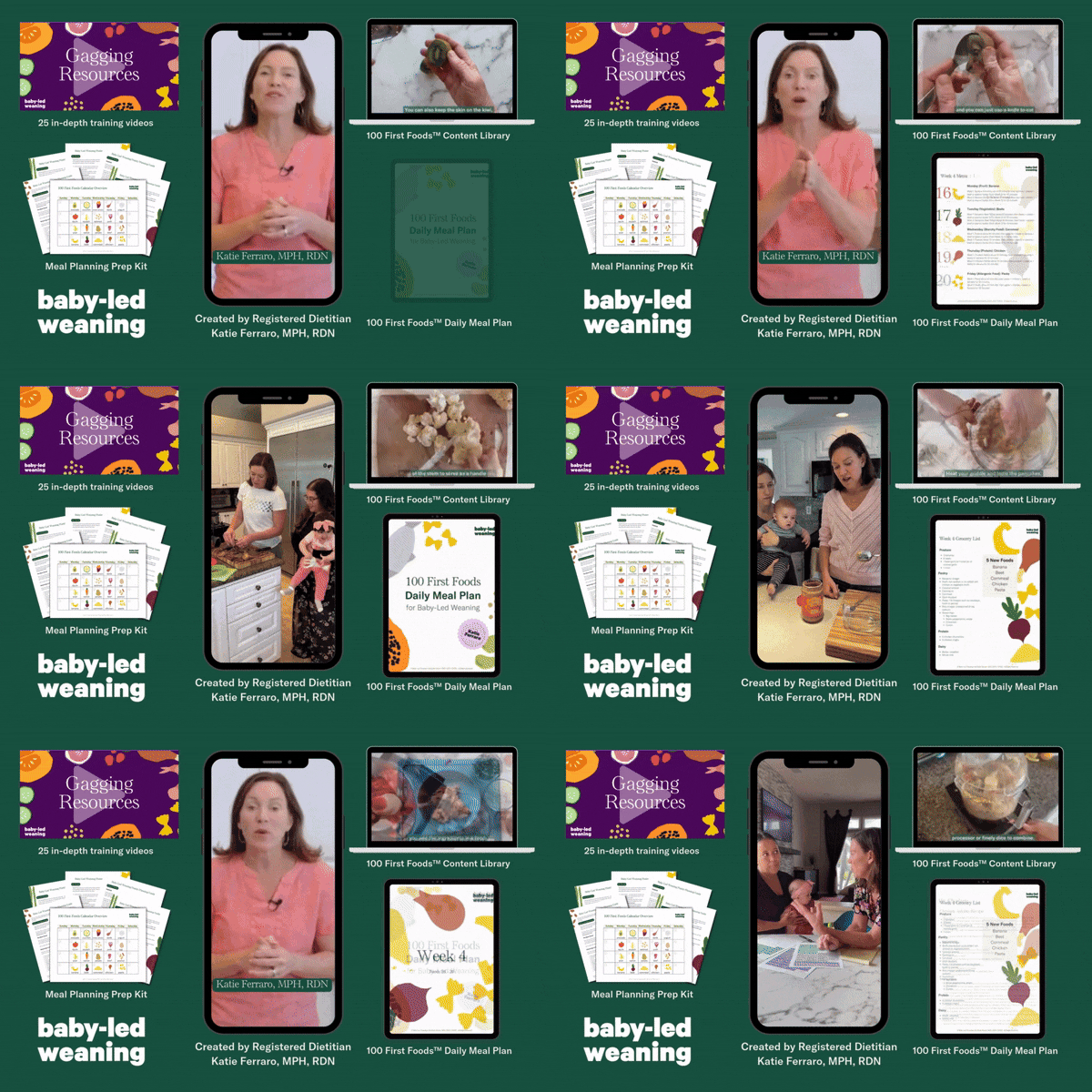
- Baby-Led Weaning with Katie Ferraro program with the 100 First Foods™ Daily Meal Plan, join here: https://babyledweaning.co/program and get $50 off when you sign up using the code BLWPOD50
JOIN NOW AT $50 OFF CODE: BLWPOD50
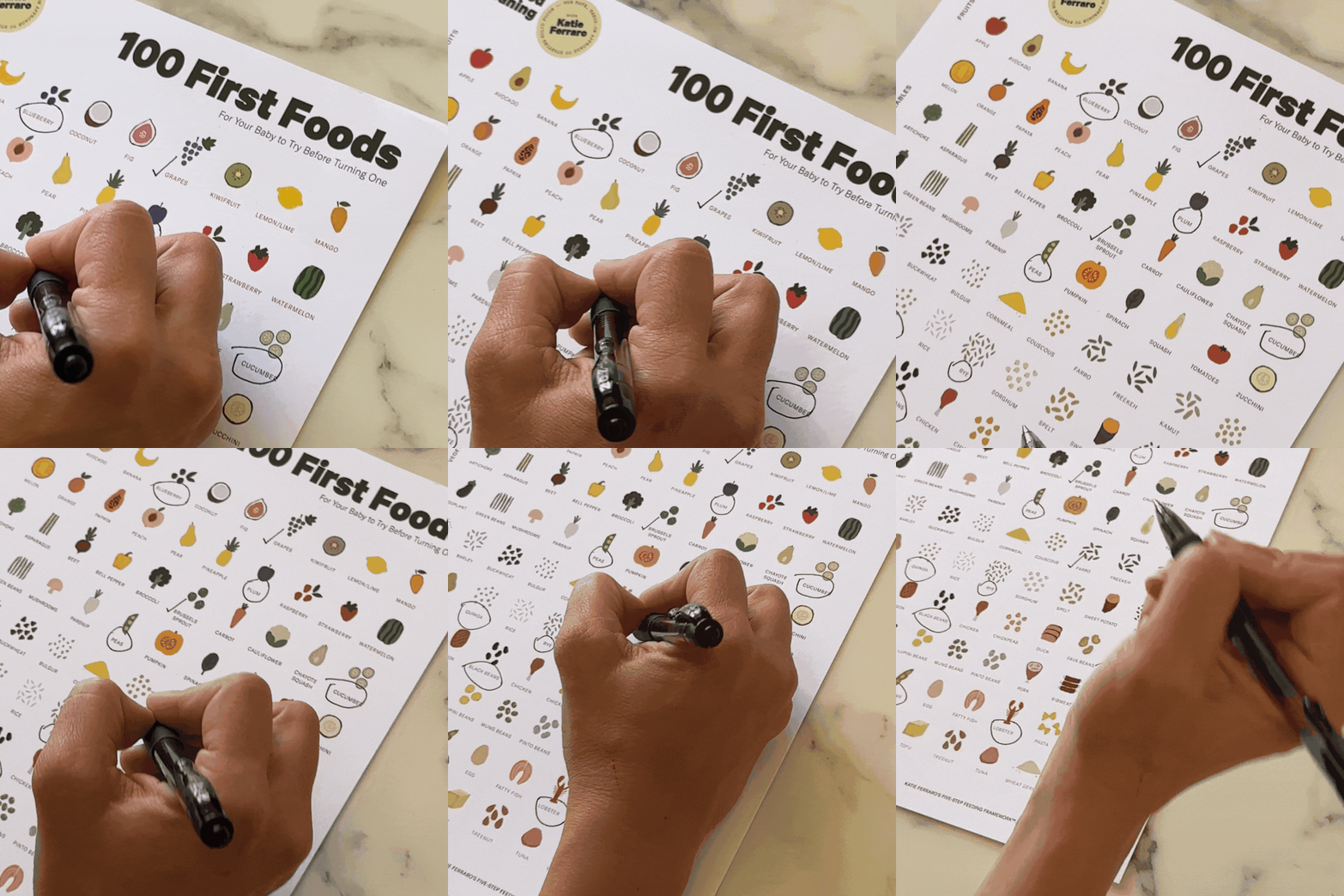
- Baby-Led Weaning for Beginners free online workshop with 100 First Foods™ list to all attendees, register here: https://babyledweaning.co/baby-led-weaning-for-beginners
Other Episodes Related to This Topic
- Episode 208 Heavy Metals in Baby Food with @consumerreports James E. Rogers, PhD
- Episode 232 Tuna Talk: Is it Safe for Babies to Eat Canned Tuna with @consumerreports Michael K. Hansen, PhD
- Episode 394 How Heavy Metal Levels in Baby Food Have & Haven't Changed in 5 Years with @consumerreports James E. Rogers, PhD
- Episode 474 How to Pick Your Next Breast Pump with @consumerreports Angela Lashbrook
- Episode 448 The Plastic Chemicals Hiding in Your Baby’s Food with Consumer Reports' James E. Rogers, PhD
- Episode 482 - High Chair Safety Testing with @consumerreports Joan Muratore
Resources and Research
- California Assembly Bill No. 899, which went into effect in 2024, mandates that baby food manufacturers test any product sold in their state at least once per month for lead, arsenic, cadmium, and mercury: https://legiscan.com/CA/text/AB899/id/2778090
- Consumer Reports Best Baby Food Companies for Reporting Lead, Arsenic and Other Toxic Elements https://www.consumerreports.org/babies-kids/baby-food/baby-food-labels-heavy-metals-california-ab899-a5779555429/

Latest Episodes



Hungry Root (1s):
It's that cozy comfort food season, time of year, soup season, pumpkin, everything season. But if you're anything like me, it's also just another month of, oh my gosh, how is it already? Dinnertime again. Season chaos work is so busy, which I love, but our kids' sports schedule is extra insane this month. I literally never know what's for dinner for my real family because I spend all day making baby led weed eating food and recipes and meal plans for your guys babies. So that's one of the main reasons why I love Hungry Root. Hungry Root is not just another meal kit, it's a personalized grocery and recipe service that thinks ahead. So I don't have to, and because I usually forget to, I tell Hungry Root, Hey, I'm trying to eat more high fiber, gut-friendly, plant-based foods, and then they load my cart up with hearty soups and grain bowls and fall veggies that I love. Plus, we just had this like incredible pumpkin spice granola. I am now low-key obsessed with every meal from Hungry Root. Takes 15 minutes or less to prep, which is perfect for that witching hour if you've got that in your house. When the babies are crying and someone else is asking for a snack and I'm trying not to lose my mind. The best part, no food waste. There's no midweek store runs. I actually enjoy cooking for my real family. Again, I'd love if you could check out Hungry Root and I want you to take advantage of this exclusive offer for our listeners. For a limited time, you can get 40% off your first Hungry Root box, plus get a free item in every box for life. Go to hungry root.com/weaning and use code weaning. That's Hungry root.com/weaning code weaning to get 40% off your first box and a free item of your choice for life hungry root.com/weaning code weaning and let Hungry Root help you streamline meal prep for your family out of the comfort of your own kitchen.
Rula (1m 53s):
I don't want to pile on, but being a mom and a new parent is not for the faint of heart. All of a sudden, you have this tiny person who's totally dependent on you and you are 24 7 fixated on keeping all the balls in the air with parenting and work and relationship. It's a lot. And we all know that periods of burnout or stress or anxiety take a toll on your mental health. And while high quality therapy can help with stressful situations, finding a provider that your insurance actually pays for is a challenge. Ruler is changing the game when it comes to finding the right therapist for you. That's in network covered care for most insurance providers because we've all used insurance to cover our physical health, right? So why shouldn't also it cover our mental health? Well rule Up makes sure that it does rule up partners with a network of over 15,000 therapists and psychiatrists nationwide, enabling you to find your personalized solution and the right therapist for you based on your needs, your preferences, and the requirements of your state. And what I love about Rua is their commitment to making the average copay just $15 per therapy session. That's real therapy from licensed professionals at a price that actually makes sense. So there's no wait lists or no frustrating back and forth rule makes it easy to find a mental health provider who is accepting new patients and appointments are available as soon as tomorrow. Plus rule sticks with you throughout your journey, checking in to make sure that your care is helping you move forward. Thousands of people are already using ULA to get affordable high quality therapy that's actually covered by insurance. Visit ula.com/weaning to get started. After you sign up, you'll be asked how you heard about them. Please support this show. Let them know I sent you, that's RUL a.com/weaning because you deserve mental care that works with you, not against your budget.
Jessica D'Argenio Waller (3m 47s):
So studies have shown that even in small levels of exposure, they can accumulate over time. The body doesn't get rid of these toxins very easily, they stay for a while. It's hard to grow with these toxins in your body as well. So we've seen that they can affect, you know, development from anything, from cognition to developmental delays across the board and just these effects can add up over time, even with small levels. So we wanna minimize that level of risk down to zero as much as possible.
Katie Ferraro (4m 13s):
Hey there, I'm Katie Ferraro, registered dietitian, college nutrition professor and mom of seven specializing in baby-led weaning. Here on the baby-led weaning with Katie Ferraro podcast. I help you strip out all of the noise and nonsense about feeding, giving you the confidence and knowledge you need to give you baby a safe start to solid foods using baby-led weaning. Did you know that some baby food companies are making it nearly impossible for parents to find out if their products contain toxic heavy metals? So even though a new California law requires baby food makers to test for things like lead and arsenic, cadmium, and mercury, and to publish those results, many brands are still bearing that information behind confusing codes and lot numbers or making it hard to access at all.
Katie Ferraro (5m 3s):
So I actually experienced this firsthand recently with a brand that I work with and recommend. I know their products aren't toxic, they're safe, but I'm a dietitian. I actually had to email my rep at the brand to get the info because it was buried so deep on their website. So when I went and had to go out to my garage, find the package, find the lot number, put the lot number in their website just to see if they were compliant with California's law, then the results that came up on the screen said, oh, we don't have those test results yet. And I'm sorry, that is not exactly inspiring a ton of confidence for parents who are just trying to pick out safe foods for their babies to eat, right? So as a mom of seven and a dietician who specializes in baby-led weaning, I personally am a firm believer that we deserve transparency when it comes to the foods that we're offering our babies.
Katie Ferraro (5m 50s):
So that's why I'm talking today with Jessica D'Argenio Waller. So she's a writer and an editor at Consumer Reports and she just authored a major investigation into how baby food brands in the US either are or are not complying with this new law. So Jessica is gonna break down what this AB899 actually means and why even if you don't live in California, it is affecting the packaging on the products and the foods that you are probably buying for your baby. Which companies out there are gonna be stepping up with full transparency? Which ones have which ones haven't done that yet? And I am not a paid spokesperson for Consumer Reports. I actually pay for my own consumer report subscription access because I'm sorry, but I do not have time to hunt and peck all over the internet or use AI to try to figure out what parent or baby electronic equipment or household appliances are the best consumer reports.
Katie Ferraro (6m 37s):
Does that work for you? But I love interviewing the Consumer Reports journalists. We've had their head scientists on for lots of different episodes related to the best breast pumps and highchair safety testing standards. Lots of interviews about heavy metals in baby foods, which is what we're talking about again today. If you do want to check out Consumer Reports, they are offering you $10 off your first year of Consumer Reports membership when you sign up at cr.org/blw. So that is not an affiliate link. Again, I have no financial relationship with Consumer Reports, just a huge fan of their comprehensive journalism and research. And if you are a parent, they have really stepped it up with the parent and the baby content recently.
Katie Ferraro (7m 18s):
So check out Consumer Reports at $10 off your first year when you sign up at cr.org/blw. And with no further ado, I wanna introduce Jessica Dario Waller talking about her team's major investigation into baby food brands that you know of and whether or not they are complying with the new law that requires them to test for heavy metals and to actually publish those results so that we can see if what's in the food that we're offering our babies is gonna be harming them or not. Here's Jessica.
Jessica D'Argenio Waller (7m 51s):
Yeah, so in 2018 I had my second baby and it was a, it was a trying time because that's when the first consumer reports came out. The story came out about heavy metals and baby food and I saw that and immediately panicked that I didn't know what to feed my baby. And I was in the middle of my nutrition training, I was getting all of this information from my schoolwork and thought I knew what I wanted to have my babies grow up. My older kid was about two years old and already eating solids and eating like a champ. I was so proud. But with my second baby I knew that like the sweet potatoes, I was feeding him maybe no, no longer were safe. And it really sort of struck a nerve. I was very scared and it was like a really anxiety driven time for me.
Jessica D'Argenio Waller (8m 32s):
I remember that fondly and I'm getting chills now speaking about it because it was so fraught. It's so stressful to be a parent and have all of this information come at you and then not know what to do with it. I really felt like I was in the dark, I was going back to work, I was going into an office and I knew I was gonna rely on other caretakers and caregivers to feed my baby as well and I didn't know what to tell them. I just felt like as a parent we already have to give up so much control over our baby's lives and what they do and how they are in the world. And I wasn't ready to give up control over what my baby was going to eat and like the food that was going to nourish them, it was really difficult. So I just felt like there was a lack of transparency around heavy metals specifically in baby food.
Jessica D'Argenio Waller (9m 13s):
And that was really, really difficult as a, as a young parent
Katie Ferraro (9m 17s):
That is scary and sometimes a little bit of knowledge is like, you know, they say like medical students when they're studying a disease, they're like like Oh I have that. Or when you have a baby and then all of a sudden a report comes out about the toxins and like the sweet potatoes, you're like, oh my gosh, we were gonna do sweet potatoes as the new food today. It's like sometimes you do wanna just bury your head in the sand. And so we're gonna talk about some the heavy metals and are kind of heavy topics and it's scary. And the point here is not to scare parents, but it's just to make us aware of these things. It's like you walk down the aisle at your grocery store and you would just assume that because we live in a country with a very safe food supply, one of the safest food supplies in the world that like, well all these things must be safe for our babies. And the reality is we don't really exactly know what's in there. So let's back it up Jessica, for parents who may not have heard of California's AB 8 99, can you explain in simple terms what this law is?
Katie Ferraro (10m 6s):
What does it require that baby food companies do? And I'm in California so I pay attention, but like if I'm a family not in California, does this even matter to me?
Jessica D'Argenio Waller (10m 17s):
Absolutely. So a first of its kind law passed in California in 2023. It was known as assembly bill eight ninety nine. We call it AB899 for short. And it requires baby food manufacturers making food for kids under two, not including infant formula however, but yes, including dietary supplements as well. They were required to test all of their products for sale in the state at least once a month for lead, arsenic, cadmium, and mercury. And so this of law officially took effect in January, 2024. It was passed at the end of 2023. And then companies had to finally make those test results public in January of 2025. So this year, January, they had to start to publish those test results every month on their websites and through QR codes available on their product labels.
Jessica D'Argenio Waller (11m 7s):
This had an incredible nationwide effect because even though AB899 is California specific, parents anywhere can access those test results on those websites as long as they're easily accessible and available to see. And you can also probably go into any store near you and see a QR code on the back of that baby food pouch or jar or snack. Now because most brands aren't going to create state specific product packaging, it's too expensive, it doesn't make sense from their operations standpoint, it's much more cost effective for them to, to simply make all of their food labels compliant.
OSEA (11m 40s):
Hey, we're gonna take a quick break, but I'll be right back. My oldest girls are just coming into the age where they're now interested in skincare and I've had to kind of start hoarding some of my favorite products. I recently began using OSEA undaria algae body oil, so it officially earned a spot on my bathroom counter, but now I have to hide it in my drawer because the girls are after it. I wasn't really a body oil person before, but this one has completely changed my mind. It's rich and hydrating but still like somehow super lightweight, never greasy. It soaks in fast and makes my skin feel noticeably softer. That like silky healthy kind of glow, kind of soft that I guess everybody is after, including middle school girls. But the secret is seaweed because OSEA uses a specific type of seaweed called undaria seaweed. It's full of vitamins and minerals and antioxidant. It helps your skin feel more firm, smooth and just better. So seaweed is a nutrient dense superfood, which I know as a dietician and it's patched with vitamins, minerals, antioxidants, but it also helps replenish your skin's moisture barrier and helps your skin stay looking healthy. Now I love that I'm using a product that's not only high performing, it totally aligns with my values because Osea is vegan, cruelty free, it's climate neutral certified. They even harvest their seaweeds sustainably, which just makes me feel good about what I'm putting on my skin because as a dietitian I'm a big proponent of like what you put on your body is just as important as what you put in your body. And I was FaceTiming with my brother who, I mean I love him to death, but he literally never says anything nice in New York. And he was told me, he's like, are you doing something different with your skin? It looks really good. Well first he said, did you get a new phone because your skin looks really good. But I think what he really meant was my skin looks really good. You can get healthy glowing skin for summer with clean vegan skin and body care from ea. You get 10% off your first order sitewide with the code weaning when you go to OSEA malibu.com, you get free samples with every order, which is so cool. And free shipping on orders over $50. Head to OSEA malibu.com and use the code weaning for 10% off.
Katie Ferraro (13m 59s):
Okay, so we've covered heavy metals and toxins pretty extensively here on the podcast in the past. And I think our audience is, you know, in general agreement like minimizing heavy metals in our babies' bodies is the goal. Okay. And you and your team most recently reviewed 39 different baby food brands for this current report. So what surprised you the most about how easy or how difficult it is for parents to actually find these toxin test results that are now required?
Jessica D'Argenio Waller (14m 26s):
Yeah, we looked at 39 baby food brands as you explained. And what surprised me the most was that we found such a wide level of transparency in that food, in that heavy metal contaminant reporting, there were so many companies that were sharing their results but there were many more who weren't sharing them and making them or were sharing them but making, making them inaccessible. So what that means for us is when we looked at companies, we saw that 16 of the 39 we tested were just listing all of their results for all of their products easily and easy to find on their website. But 21, the majority were making consumers track down extra data like the UPC code and entering that into the website or the lot number or the best buy date. And so you usually have to have the package or the product in hand to get that tiny number.
Jessica D'Argenio Waller (15m 10s):
Sometimes it's misprinted, sometimes it's hard to read. And trying to make that into the website, it just makes more work for the parent and you're, you know, you don't have a lot of time to do that so it just, it makes it more difficult.
Katie Ferraro (15m 21s):
So 21 of the 39 basically were like not transparent, is that what you would say?
Jessica D'Argenio Waller (15m 26s):
We rated them on a scale from better to worse and many of them fell into the middle of that scale. But we did find two companies that were not sharing their reporting at all that we could, that we could find. And we also found several large larger companies that were making parents go to a third party website, enter that lot code, making it still even harder to access that information.
Katie Ferraro (15m 46s):
And I, I can imagine like parents are super busy and this is a problem, right? If a company's gonna make you look up these numbers, the best buy dates, the UPCs, what would you say is the best practice? 'cause there was some of them that really did do a good job and made it easy. I did the same thing, like one of the, I was surprised in your report that there was a brand that I work with and they had been listed as like they didn't respond to you guys. I was like, well wait a minute, I work with them. So I went on their website and tried to find it and it was like I had to go back out to my garage, find the product, get the most recent batch find, I put it in there and then even then it was like, oh, these results aren't available. So then I wrote to my brand manager and she's like, oh those results will publish like next week. And I was like, okay, I know they're not hiding anything because then I did see the results.
Katie Ferraro (16m 28s):
It also, they're a really small company and I can imagine that like, yes you had a year to roll this out, but like, you know, to redo packaging if you're a really small company that is pretty burdensome. Are some of these companies saying like, hey, like this is just like financially not tenable for us? Or do you think, I guess some of them are actually hiding something like, like I'm sure some of these brands wrote back to you after this report, what do they say?
Jessica D'Argenio Waller (16m 51s):
Yeah, I think that is definitely part of it. It's really expensive to run these tests. Oh yeah. Especially down to the sensitivity level that the law requires, which is six parts per billion. It's a pretty sensitive test, but it's, and it's also expensive to redo packaging and labels if you, you know, if you're a small company and don't have a ton of resources or time on your hands. But on the other hand it's really tough to be a parent now and to know that there's potentially, you know, heavy metals lurking in your baby's food and not be able to tell what or how much is really scary. And so you wanna make sure that you are providing that information to parents and families or you have to make the tough decision not to sell in the state that's requiring that transparency.
Katie Ferraro (17m 27s):
So California, I mean I live in California like very difficult state to do business in already. Like great idea, but like I know some of these companies like struggling with very small margins, but at the end of the day, hey we are putting food into a very small baby's body. And maybe you could just remind us, right, with your nutrition background, and I've talked about it before in the podcast, but like why does this matter? Like even very, very small amounts like to the baby who's rapidly developing, what do these toxins do in the baby's body?
Jessica D'Argenio Waller (17m 55s):
Yeah, so studies have shown that even in small levels of exposure they can accumulate over time. The body doesn't get rid of these toxins very easily, they stay for a while. It's hard to, it's hard to grow with these toxins in your body as well. So we've seen that they can affect, you know, development from anything from cognition to, to kidney and organ development. They can lead to potentially cancer down the line, which is really scary and not something a parent wants to think about, especially when they have a six month old just developmental delays across the board and just these effects can add up over time even with small levels. So we wanna minimize that level of risk down to zero as much as possible.
Katie Ferraro (18m 32s):
One thing I love about the consumer Reports reports is that they go like they show you the pictures of the brands, of the foods that you see at your grocery store, at Target, at Walmart. Like these are nationwide brands. I try not to mention brands, I'm not, I'm not here to brand bash or pick one over the other. I'm not, I don't work with any of these brands 'cause we teach parents how to make real food, but I totally acknowledge that parents rely on package and process baby foods from time to time. It's, they're great for travel sometimes for convenience or like you said, hey occasionally, you know, like you have other people help you raise your babies and feed your babies and, and these are very convenient foods, however, it does come with a caveat. They're not all created equal. So I would encourage parents go look at the report, it's gonna be linked up where you're watching or listening to this because you're gonna see the pictures of foods like you have very likely bought for your baby.
Katie Ferraro (19m 20s):
And so without mentioning particular brands, Jessica, could you just say share your thoughts as a parent and a nutrition professional like some of the companies that you guys referenced in your report are making the results easy to find while others aren't. What do you think parents should take away from these differences when and if they are choosing a baby food brand of, of an item that they're gonna select to then put in their baby's body?
Jessica D'Argenio Waller (19m 42s):
Yeah, absolutely. So in our analysis, the highest ratings we gave to brands that made test results easily accessible right on their websites, whether it was like in a footer on their site that said AB 8 99 or Safety and Transparency, you can easily navigate to that destination without having to jump through many hoops. We, we gave high scores to brands that didn't require you to enter that 12 digit UPC, that lock code, that best Buy date. We wanted to make sure that when you were accessing the sub the website you could see all of the products listed and then also sort down by batch number if you wanted to find your specific product you had already or just get a sense overall of what the levels were. If you were about to go shopping or wanted to, you know, order something online for your family.
Jessica D'Argenio Waller (20m 23s):
But that transparency lets parents make that the most informed choice, which is what we're all about at Consumer Reports. Helping you have the information at your fingertips so you can make the best decision for your family. Yes, these foods are convenience focused and some of them have better nutrition qualities than others of course. But you know, transparency is, is key here when you're shopping and we wanted to make sure that that was easily accessible for parents. But it's also important to note that transparency doesn't always mean that the product is low in contaminants. You have that information now at your fingertips. Hopefully you can then check the sites and look at those results or scan the QR code if you're shopping in the aisle and you have time to look at what those heavy metal levels are. But then again, if a brand can offer you more context as the parent or consumer, that's helpful too because the FDA has set thresholds for one of the contaminants for lead only at 10 parts per billion.
Jessica D'Argenio Waller (21m 14s):
But the other levels for arsenic, cadmium and mercury are still in draft progress. So they haven't been set yet, which is tricky. If you're a parent in the aisle and you see a le a level of 13 parts per billion, what does that mean? It's hard to know without having having more context added.
Katie Ferraro (21m 30s):
And does that, I don't know if you know this, but that a 8 99 does it say like, okay A you have to disclose and you have to put it up on your website, blah blah blah, but B, if it's above a certain level then you need to recall it at least for lead.
Jessica D'Argenio Waller (21m 44s):
No. So everything now, because that lead standard is set by the FDA, everything must be under,
Katie Ferraro (21m 48s):
Oh that's federal
Jessica D'Argenio Waller (21m 50s):
Threshold for federal. Okay. But everything else is still up for grabs really. So, okay. Yeah, there's no other regulation currently
Katie Ferraro (21m 55s):
Set. And again, I know when this kind of came out everyone's like, oh this is so California, but this is now we see new laws being passed in other states like Maryland, Virginia, I think potentially Illinois. What do you think the future of baby food transparency looks like? Like do you see this becoming a nationwide standard?
Jessica D'Argenio Waller (22m 10s):
It's tricky to say whether it's gonna become a nationwide standard, but I do think that this transparency focus will extend to other products that people use with their families every day. We're seeing for example, a New York state law that just passed about diaper transparency and what's in your child's diapers because interesting, previously you didn't have to like companies didn't have to list the ingredients on their diaper packages. And so you're kind of flying blind there too. And we'll see more as well around other toxic elements in things like prenatals. I know a law recently passed or is about to pass in California that will require a similar level of transparency for prenatal vitamins, which is huge.
Katie Ferraro (22m 46s):
It's pretty wild. We just recently did an episode, I don't know if you know Helena bought a Miller average from Food Fix, but we did a episode called, you know Prenatals are a hot Mess. And it's like I didn't actually realize how unregulated it was and she had just recently been pregnant with her second baby and she's like, Katie, we need to cover this. Like this is, there's so little regulation, it's like this, this is so important but we don't really realize it. And again, as a dietician I'm a huge proponent of, you know, as parents we need to be educated because what you put on your children's body is just as important as what you put in it. And that's what I really love this push that Consumer Reports is doing with a lot of stuff related to baby and toddler.
Katie Ferraro (23m 27s):
It's not to scare parents, it is to increase transparency. And I have absolutely no financial affiliation with Consumer Reports. We do have a link where you can get a discounted subscription but I, I don't have any affiliate like I don't make any money from that. I pay for my own consumer reports login because sorry I don't have time to like hunt and peck all over the internet or AI to figure out which one's the best. Like your scientists are doing the breakdown on the car seats for me, you guys are looking at what's actually in the diapers, what's in the baby food. Like no one else out there is doing that kind of work anymore. So I just wanna say how much I appreciate the work that your team is doing and especially the push that you guys have made into baby and toddler.
Katie Ferraro (24m 8s):
And I think it's important that parents know about it. 'cause I think there's a lot of parents who kind of came up when they're like, oh consumer reports, like that's like what my, like mom used to pick out a washing machine and it's like no, it's what you should be using now to like pay attention to these products that you're buying to either, you know, put on your child or put in your child.
Jessica D'Argenio Waller (24m 25s):
Absolutely. Thank you for saying that. That's so kind and generous and I totally agree. I think I have been recommending CR memberships to all of my friends with kids because it's so helpful to get a clear evidence backed recommendation. You know, it's been through rigorous testing we do, we have a lab where we test, we have 60 different labs on our, on our Yonkers headquarters site where we test a range of different products. Then we also have the advocacy and research arm where we are pushing for stronger regulation and better transparency for consumers and heavy metals in in children's food as one of our big 10 poles.
Katie Ferraro (24m 57s):
My goal, I really want to go to the Yonkers site, like I wanna go to an adult field trip there one day we had Joan who does all the high chair testing on recently and like my house kind of looks like a high chair testing facility but I don't have like all of like literally the crash test dummy equivalent of how you guys test highchair, which I think I'd love to see it in real life. So when your report came out it was funny 'cause a lot of people, anytime there's a baby food report, everybody sends it to me and they're like, you know, some moms send it to me and they're like, see this is just another reason why moms should only make real baby food from scratch. And it's like, that's not the point of this report. Okay. We know that heavy metals cannot completely be avoided since they're in our soil and our food supply. So even if you're like a strict adherent to preparing all your baby's food at home, realistically some of this stuff is gonna get in there.
Katie Ferraro (25m 40s):
Okay, so Jessica, tell us some realistic stuff that that parents can take to lower their baby's exposure at home. Even if you're making all the food from scratch. 'cause this is not just a problem that's only in the processed baby foods, this is across our food supply. 'cause guess what? Those processed baby foods, those toxins originated not from the processing process, it came from the actual food itself, the sweet potato rice, et cetera.
Jessica D'Argenio Waller (26m 4s):
Yes, absolutely. We know that heavy metals a bound in our natural environment from both, you know, environmental and manmade sources, they're really hard to avoid. But the, the levels that we're seeing now do give me some hope that we can start to remove those and, and you know, make other food combination choices in the, in the products that we're seeing. So I recommend that your, you rotate what your baby eats, increase that variety. Following your 100 food list is incredible. It's a wonderful resource for families to try to make sure that they are hitting, you know, various buckets and different types of food for their infant to make sure you're not over-indexing on sweet potatoes or leafy greens because those can be more, you know, susceptible to that heavy metal contamination and exposure, which is a bigger risk.
Jessica D'Argenio Waller (26m 45s):
So just make sure that you aren't, it's easy to panic like I did when I was, you know, having my second kid and figuring out what not to feed him and what to feed him and just try to take it with a grain of salt. Just try to, you know, increase variety, shop at different locations, shop at your farmer's market but also shop at your grocery store. Just make sure you're not getting one source exclusively that you're offering that wide variety of foods and therefore nutrients.
Katie Ferraro (27m 8s):
And I appreciate you pushing that, that diet diversity message is everything. Like if, if we just need another reason to hear the importance of pushing a variety of different, not pushing, encouraging a variety of different foods, like here's another reason to do
Jessica D'Argenio Waller (27m 20s):
It. Exactly. And then you also wanna look for, if you are shopping for packaged foods, look for blends. So multi ingredient baby food blends, you're not just looking for that sweet potato pouch but you're looking for, you know, pear, kale, apple and whatever else may be in it. So that multi ingredient puree or jarred food because it can help increase that dietary variety too.
Katie Ferraro (27m 38s):
The parents will do that. They're like, oh I know my baby just likes this one thing and so just to be on the safe side when I send 'em to daycare, I'm only sending with this one food. It's like, no, no, no, no man, babies will eat way more foods than we give them credit for. We wanna mix it up. That's why we introduced five new foods to babies every week. We do a new fruit on Monday, a new vegetable on Tuesday, a new starchy food on Wednesday, a new protein on Thursday, a new allergenic food on Friday that's five new foods a week. You, that's 20 new foods a month in five short months your baby's eating a hundred different foods. Sure it's fine to you know, loop in some of those pouches on occasion if you need to. But in reality, you know, it's developmentally appropriate for babies to learn how to eat finger foods starting at six months of age. So I know your baby knows how to eat a puree off of a spoon, but we don't want them to suck it out of a pouch 'cause developmentally that's not appropriate.
Katie Ferraro (28m 23s):
There's certainly room for purees, but we wanna put that on the spoon and let the baby bring that to their mouth. But work on that diversity like Jessica is pointing out and a variety of foods is always a good idea as well as tastes and textures from a nutrition standpoint but also from the safety standpoint. So real quick to wrap it up here, let's say you've got a mom friend, her baby just turned six months of age, consumer reports drops this report. Hey there's toxins in these baby foods and most of these companies, sorry they're not making it easy for you to find out. What do you suggest to parents who in the real world need to function and they're gonna buy some of these products? What should they do moving forward when they're standing in that aisle at the grocery store just totally overwhelmed by all the options out there.
Jessica D'Argenio Waller (29m 2s):
Yeah, absolutely. I would say check our report. Look for the list of the brands that made it easiest to see their test results and prioritize shopping from those brands. As a parent, you shouldn't have to, you know, become an expert scientist or a detective to figure out what's in your baby's food. That increased transparency just makes it easier for you when you're in that store aisle to compare products, avoid higher risk options and not have to jump through hoops to do so. We also, when we heard from companies when we were putting this report together, we found that the ones that were prioritizing that transparency were also taking extra steps at multiple stages of their production to try to, you know, minimize that exposure to heavy metals and contaminants, tweaking their recipes to minimize their risks with different formulas and keeping a close eye at all levels of their supply chain.
Jessica D'Argenio Waller (29m 44s):
So we wanna reward that behavior and encourage companies to do more in that sense. So as parents are buying choices can send a clear message that we like what we see and we want companies to work harder to make baby food as safe as possible.
Katie Ferraro (29m 56s):
And it wasn't just like the big old like you know, bougie brands or ones that you're like, oh dude, there are massive corporations that have tons of money. Like there's some of the newer brands out there that are like making an effort. And one thing I love about Consumer Reports is I know you're gonna stay on this. Like I know this isn't a one and done, you're gonna come back in five years, you're gonna do the report again. Hopefully a lot of these brands are still in business and that the cream will writes at the crop, the top, what is it? The cream. The cream of the crop. The cream rises to the top, okay the good ones are gonna stick around and I hope that they'll be the leaders and lead the way because we shouldn't be covering up the fact that there's toxins in baby food. Everybody knows it, there's toxins in foods, but these are really, really, really important developmental phases of our children's lives, especially when they're starting solid foods.
Katie Ferraro (30m 39s):
And I love that the state of California is actually leading the way on it and I do hope that some of these brands moving forward are like, hey we gotta put it out there, here's best practices and that some of the other brands will start to follow suit because parents should be aware of what's in their children's food. And I, I hope we kind of continue on this trajectory and thank you to Consumer Reports for continuing to shed light on it and and for all the brands out there that I, I know a lot of them are struggling to stay afloat and that this is a challenge but you have the privilege, I mean PE you are taking people's money and in return giving them nourishment to put in their child's food. Like we need to ensure that we're not poisoning the children with the food that we're putting in their bodies.
Jessica D'Argenio Waller (31m 13s):
Exactly, yes. We saw similar things with our infant formula contaminant story too. We saw that it is possible for manufacturers to make safer infant formula without these heavy metal toxins included as well. And we expect the same from baby food.
KiwiCo (31m 26s):
Hey, we're gonna take a quick break but I'll be right back About 10. I spent an entire summer in my garage trying to build a co cart out of scrap wood and bicycle wheels and spoiler alert it did not go that well. But I'll never forget the feeling of sketching out a design and trying and failing and then trying again and it didn't feel like school. It felt like play and without realizing it I was learning problem solving and patience and how it feels like so good to just bring an idea to life. And that is exactly what I love about Kiwi Co. Our kids get to have those same aha moments but with projects that actually work. Each kiwi co create is designed so that kids are learning the fundamentals while having fun. They're building skills that grow with every new project. So they might start with something simple like a bow and arrow and down the line. I mean they're engineering robots in our house. We've been doing the Tinker crate lately, so my daughter just built a working pinball machine, she's been playing with it nonstop. The best part she did not just put it together, she understood how it works. So there's springs and leader's intention, all those concepts that like really click when you're using your hands to make something real. And Kiwi Co isn't just one size fits all. They have crates for every age and interest science, technology, engineering, art, math, you name it. Plus Kiwi co members get perks like 10% off orders, free shipping in the US and early access to new crates. These Kiwi co projects do not just get built and tossed aside, they get played with Revisited and they spark that curiosity that kids will carry into everything else that they do. So if you want something that will keep your kids engaged and off of screens and excited to learn, Kiwi Co makes it so easy to spend quality time together while building creativity and confidence you and your kids can tinker, create and innovate with Kiwi Co too. Get up to 50% off your first crate@kiwico.com promo code weaning that's up to 50% off your first crate at K-I-W-I-C o.com promo code weaning.
Katie Ferraro (33m 33s):
You know when you were talking about like you kind of were shuttering at the beginning when you were telling the story about like going back in your mind like I em my oldest is just turned 11 and I remember like I pumped like crazy and I had to go back to work and then I wasn't making it another the, I had to give her formula. I was like, ah, and the first ingredients, five ose corn syrup. I was like, wait a minute, like, or corn syrup, solids. And it was like I, I don't know very much about formula and I feel already terrible that I can't make enough breast milk, but like also this feels kind of weird and there was literally no other alternative. Like no one was talking about European breast milk. This is pre COVID and like look where we are today. Like it's not all solved, but at least there's alternatives and we're having a conversation about it and it doesn't help my 11-year-old who had corn syrup, salt, well whatever.
Katie Ferraro (34m 14s):
She's fine everybody. But the point is like having the conversation about it and shedding light on it and in that case it took, you know, the formula shortage, a lot of work by consumer reports, you know, European brands just kind of, you know, just taking that little crack in the door with the FDA and and now there's opportunities for parents to have other options that wasn't around 11 years ago. So I like that parents today have more options and I think knowing what's in our baby suit and then you can choose whether or not you decide to buy that product or not.
Jessica D'Argenio Waller (34m 42s):
Exactly. It's having that information at your fingertips so you can make the best decision for your family and that's exactly what Consumer Reports mission is all about
Katie Ferraro (34m 48s):
And I love that. And also, can you just tell us real quick, like these baby food companies are not paying you guys to review them. Like you can't call Consumer Reports and be like, Hey, review my product, or hey, here's some money, can you not include me in the report? Like you guys are not at all influenced by the food industry, you're not sponsored by them, there's no ads on your website. Like I think people really, really need to get that because in this day and age, like the line is so blurred between industry and info, but it's not like that with Consumer Reports and you're also not government subsidized either.
Jessica D'Argenio Waller (35m 18s):
Exactly. We are a nonprofit mission supported organization. We accept donations and we have our membership that supports our, our mission driven work. We don't take any advertising dollars, we don't, we shop at regular stores to buy our products with secret shoppers. We don't accept any manufacturer samples or gifts. So everything is as unbiased as possible so that we can mimic the experience of it, of being a consumer in the US today as much as possible. And we've been around and doing this since 1936. It's been about 85 years.
Katie Ferraro (35m 48s):
That's so awesome. I wanna be like a secret shopper on the west coast. I know a lot of you guys are all on the East coast, so like if you ever need a secret shopper in San Diego, call me up. I promise I'll be incognito. Awesome. Well thank you so much Jessica. I really appreciate your time and this info can be scary, but thank you so much for elucidating it for us and please everyone go read the report. Just look at the pictures. I mean, your graphic designers do such a good job too because you very quickly, I love the tables, I love how easy it is to read it. It's definitely worth the subscription. If you have kids and you're buying things for them, consumer Reports is gonna save you a lot of time and money because they did a lot of the legwork for you.
Jessica D'Argenio Waller (36m 20s):
You can go to cr.org/blw to get $10 off your first year of Consumer Reports membership and to learn more about our mission.
Katie Ferraro (36m 26s):
Awesome. Thank you so much Jessica. I really appreciate you and your team's work.
Jessica D'Argenio Waller (36m 29s):
Thank You. It was great to be with you Katie. Appreciate it.
Katie Ferraro (36m 32s):
Well, I hope you enjoyed that interview with Jessica D'Argenio Waller from Consumer Reports. She's got the whole report with pictures. I love the pictures with all of the brands that are or are not complying. You gotta check it out. I'll put it in the link to the show notes, which you can find@blwpodcast.com/66. Also don't forget, if you wanna check out Consumer Reports, they're giving you $10 off your first year of your subscription if you go to cr.org/blw. I also want to say a big thank you to our partners at AirWave Media. If you guys like podcasts that feature food and science and using your brain, check out some of the podcasts from AirWave Media or online@blwpodcast.com. Thank you so much for listening and I'll see you next time.
Child Proof (37m 21s):
Parenting is hard. We are out here trying to childproof everything Corners at tables, electrical sockets, pet water bowls, our own emotional overwhelm. It's Easy to get overwhelmed by tiny humans. You're somehow responsible for not messing up. It's nice to know you're not alone though We've been there. I'm Tori Phantom. And I'm Gwenna Lakeland and we host childproof. We cover the good, the great, the hard, the feels impossible on childproof an AirWave Media podcast available everywhere you find your favorite podcasts.
The Program Baby-Led Weaning with Katie Ferraro
A step-by-step digital program for starting solid foods safely and navigating the original 100 FIRST FOODS™ meal plan with baby-led weaning.
 EXPERT-LED, PROVEN APPROACH TO EATING REAL FOOD
 CONCISE VIDEO TRAININGS TO MASTER BABY-LED WEANING
 100 FIRST FOODS DAILY MEAL PLAN WITH FOOD PREP VIDEOS
Baby-Led Weaning for Beginners Free Workshop
Is your baby ready to start solid foods, but you’re not sure where to start? Get ready to give your baby a solid foundation to a lifetime of loving real food…even if you’re feeling overwhelmed or confused about this next stage of infant feeding.
Get baby-led weaning recipes and tips delivered to your email inbox.