
Are Produce Washes Helpful or Hogwash for Food Safety?
- What produce washes are and whether they are better than running water + friction
- Which type of fruit you need to be particularly careful about washing well before cutting
- Why the “banana lipstick” is dangerous and can increase your baby's risk of choking
LISTEN TO THIS EPISODE
Episode Description
Nobody wants to give their baby a foodborne illness…but do you need to be buying produce washes to prevent disease? In this episode we'll look at some produce washes including what they do, what they claim to do, and whether or not they're any better than good old fashioned friction and running water when it comes to making fruits and vegetables safe for your baby to eat.
Links from this Episode
- Center for Food Safety About Produce Washes
- FoodSafety.gov Fruit and Vegetable Safety
- FDA: Food Safety for Moms to Be
- CDC: Fruit and Vegetable Safety
- Check out some popular produce washes here, here and here
- Baby-Led Weaning with Katie Ferraro program with the 100 First Foods™ Daily Meal Plan, join here: https://babyledweaning.co/program
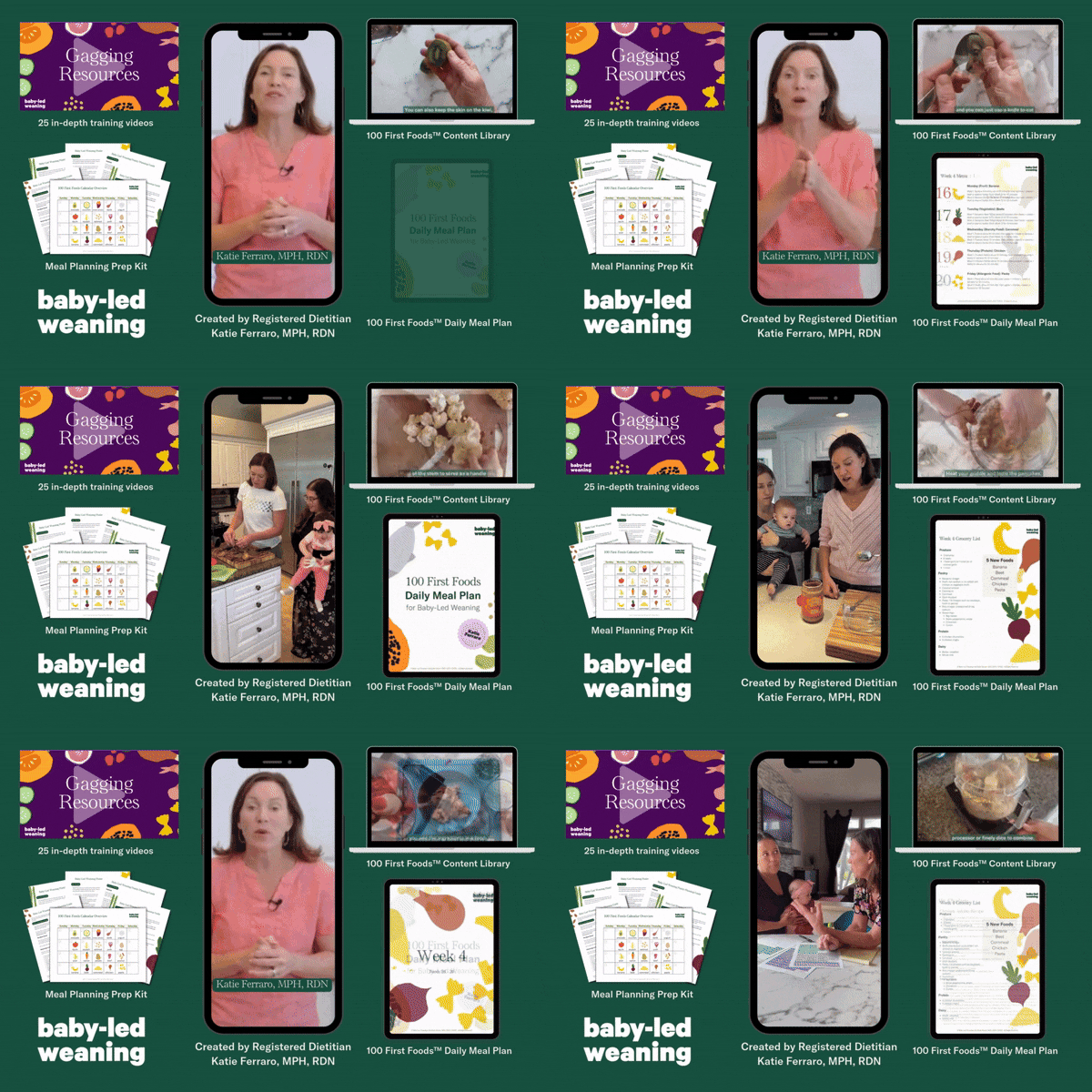
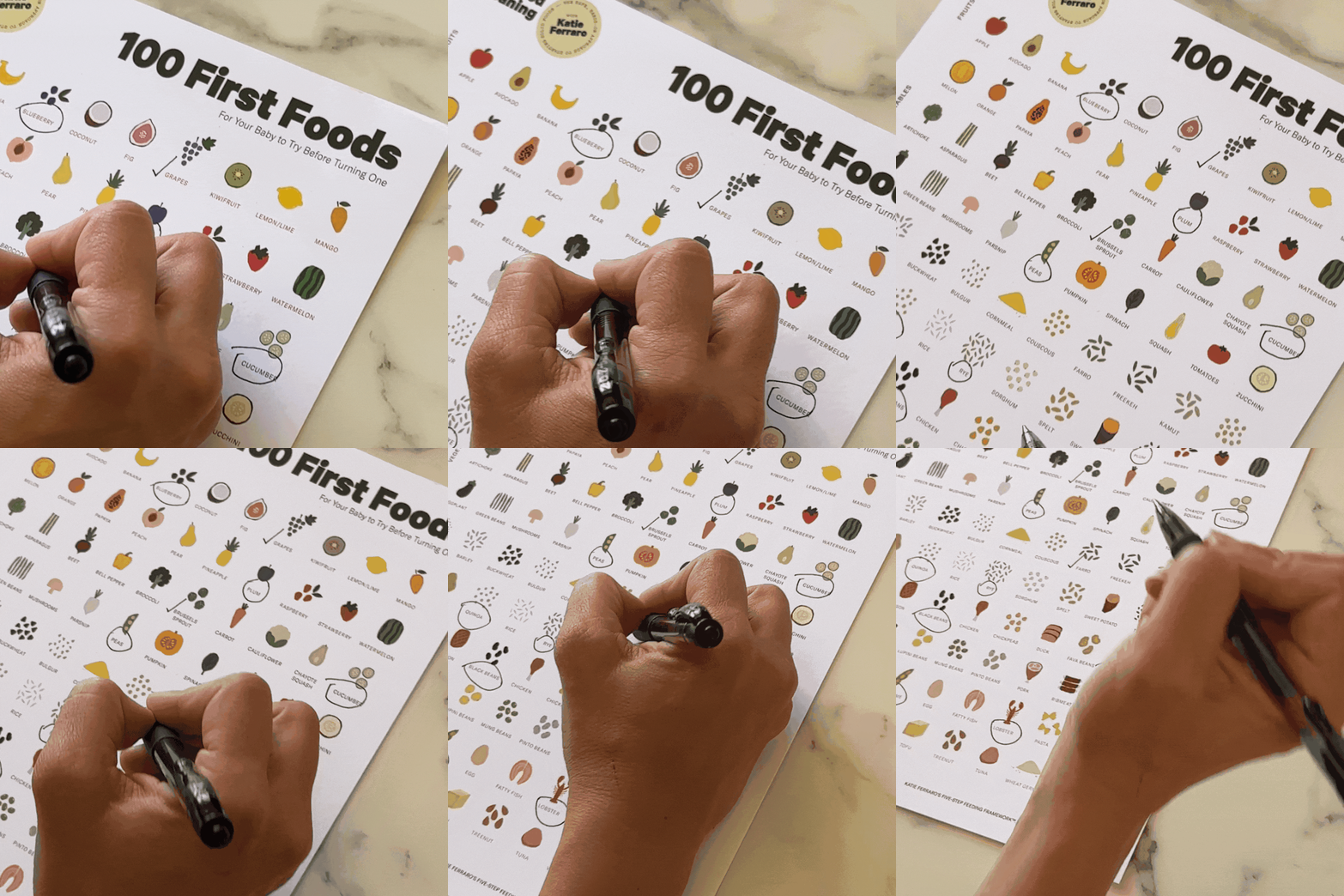
- Baby-Led Weaning for Beginners free online workshop with 100 First Foods™ list to all attendees, register here: https://babyledweaning.co/baby-led-weaning-for-beginners
Other Episode Related to this Topic

Latest Episodes

0 (1s):
So, which foods are not safe for your baby to eat? You guys know I'm usually all about sharing all of the foods that your baby can safely eat, but there are definitely some foods that we steer clear of when starting solid foods. I have a free feeding guide called 15 Foods Never to Feed. That will help you recognize which foods aren't safe. Now most of the foods inside the 15 Foods Never to Feed Guide we avoid because they're choking hazards. But I'm providing you with tips on how to modify those foods so they are safe for your baby to eat. You can download the 15 Foods Never to Feed free feeding guide by going to babyledweaning.co/resources.
0 (41s):
Again, that's s babyledweaning.co/resources to download your free feeding guide 15 Foods Never to Feed with the modification tips on how to make those foods safer. Happy Feeding! Anyone have a picky eater? A mom who signed up for my workshop this week said I wasn't brave enough to try Baby-Led Weaning with my firstborn, who's now a picky eater. Second baby turns six months soon I want to provide him with the resources to do Baby-Led Weaning. If you are looking for those resources too, they're all inside of my free online video workshop called Baby-Led Weaning for Beginners. We're gonna cut through the confusion and set the record straight about starting solid foods safely so you can finally stop hunting and pecking all around the internet.
0 (1m 22s):
For your answers, sign up for this week's workshop times at babyledweaning.co. I'll see you there. And produce is porous So If you're thoroughly washing it if you set it in a product that has bleach or detergents in it, there is of course the risk of becoming ill, right? Because the fruits and the vegetables can still absorb that soap and some of the other disinfectants. Why we never use soap or bleach or sanitizer, alcohol disinfectant, or really any other chemicals to wash produce. I'm Katie Ferraro, Registered dietitian, college nutrition professor and mom of seven specializing in infant feeding and Baby-Led Weaning. But it wasn't all that long ago that I struggled tremendously while trying to spoon feed my oldest baby.
0 (2m 6s):
Fast forward to my next pregnancies, quadruplets, and then twins. And we decided to go all in on Baby-Led Weaning, and those babies ate over 100 real wholesome foods before turning one. No force feeding by spoon, no short order cooking, no mealtime battles with picky eaters. Baby-Led Weaning was such a transformational experience that I shifted the entire emphasis of my nutrition career. And I focus exclusively now on helping parents, caregivers and healthcare providers give their babies a safe start to solid foods using Baby-Led Weaning. I created the Baby-Led Weaning with Katie Ferraro podcast to give you simple, actionable, proven strategies that you can use right now to master Baby-Led Weaning.
0 (2m 53s):
If you're a new parent or a seasoned veteran looking to learn more about this evidence-based approach to raising independent eaters and starting solid food safely, you are in the right place. Let's get started and happy feeding. You are a good mom or a good dad or a good grandparent or caregiver, and you're spending all of this time helping your baby learn how to eat real food. And some of the foods that you're offering are very likely fresh produce like fruits and vegetables. But when it comes to your baby's safety, should you be using a produce wash? In today's episode, we're talking all about produce washes are what they are, what they claim to do, whether or not they're any better than good old fashioned running water and elbow grease.
0 (3m 35s):
And I like to start each of these mini training episodes with a Baby-Led Weaning tip of the day. And today's tip is to be particularly vigilant when it comes to washing your melons. So melons, thinking honeydew or cantaloupe or watermelon. When you think of melons as a class of produce that is to be washed before you eat it. The reason is because melons are ripe for foodborne illness. That was a terrible pun, sorry. But melons grow on the ground, right? It means that the melons can very easily come into contact with animal feces and other runoff that could contain potentially harmful pathogens. And so when you wash your melon, what you do is you remove any of the potentially harmful pathogens from the outside of the rind.
0 (4m 15s):
Now of course, your baby's not eating the rind, but if you don't wash your melons, and we've seen this recently, melons have been the culprit in a few foodborne illnesses as of late. If you don't wash them, what happens is the pathogens from the outside, when you take your knife, you're transferring the pathogens from the outside, the rind, right through the middle of that fruit all the way down the inside of it and out the other side. And when you open the melon up, you now have the potentially harmful pathogens on the inside of the fruit. So the rind is the built-in protective mechanism, but we don't wanna transfer the bad stuff from the outside through to the inside where it's supposed to be nice and clean and essentially sterile. So, If you can rinse your melons under running water using your hands, and some friction.
0 (4m 59s):
You can remove the potentially harmful pathogens. And then when you cut through the melon, it will be perfectly safe for your baby to eat. And I want you guys to hang tight till the end of this episode 'cause we're also gonna be sharing some ideas about how some of the produce washes are actually harmful for your baby. So let's get started talking about produce washes. First off, what is a produce wash? Okay, so according to the Center for Food Safety, a produce wash is not surprisingly intended to wash vegetables in many cases can use chemical rinses and other treatments. Okay? And produce washes purport to work by saying that they're going to get your food cleaner, you're basically gonna make it be rid of bacteria and chemicals better than water will.
0 (5m 41s):
Okay. So, the way that the produce washes generally work is they say like, okay, before you chop your fruits or your vegetables, you would, you know, spray the harder produce, rub it for 20 to 30 seconds, rinse it, and then dry it. And you're buying a product at the store or online that again purports to reduce the potentially harmful things in your fruit more so than water would. Okay. And the idea is to make it easier that these washes would make it easier to lift the bacteria and the other residue up. Okay? Now, are they better than good old fashioned friction and water? The Center for Food Safety states that these products are just as good as ordinary tap water at cleaning produce.
0 (6m 23s):
And in fact, studies have not demonstrated that produce washes work any better than using tap or distilled water to wash your produce. Okay? It can actually be harmful to use some of those produce washes because they can either add contaminants and in some cases remove nutrients from the produce. foodsafety.gov also recommends against the use of produce washes. They advise as most feeding professionals, dietitian would as well, that you would just wash your produce under running water without the use of soap bleach or store bought produce washes. Okay, before you are gonna peel the food or you know, offer it to your baby, you wanna rinse it if you can. And you could use, if you needed to add an implement of sorts to this situation, you could just use a clean produce brush to scrub your solids, especially some of those tougher ones.
0 (7m 11s):
I know like for cantaloupe and because they're oftentimes implicated in some of these foodborne illness outbreaks, whenever I'm prepping melons for a baby, I'm always going to use my produce brush to scrub it just with water a little bit, do it a little bit better job than I could do with my own hands. But you never want to use soap or bleach or sanitizer, alcohol, disinfectants, or any other chemicals to wash your produce. Okay? It also hasn't been demonstrated that using, sometimes people will recommend home remedies like salt or pepper or vinegar, lemon juice or lime juice to effectively remove bacteria. Hey, we're gonna take a quick break, but I'll be right back.
0 (9m 18s):
The Centers for Disease Control recommend that you wash or scrub your fruits and vegetables under running water, even if you plan on not eating the peel. So sometimes I think I'm, you know, I'm in a hurry, I'm like, oh, I'm gonna get lazy about washing this avocado. Now I'm not gonna ever offer avocado peel to a baby. And you see that sometimes, unfortunately on other social media accounts, you'll see a baby being given a piece of avocado with a part of the peel still on it and they say, oh, it helps the baby with the grip. Well what it does is offer a potentially harmful choking hazard, i.e. The peel of the avocado to the baby. You don't eat avocado peels. Babies don't need to eat avocado peels. Babies can learn how to pick up slippery foods like avocado. You don't keep the peel on them. And the same goes for banana as well.
0 (9m 58s):
This is unfortunately a practice that's gotten popular also because of social media. It's what I call the banana lipstick. Someone will offer a baby a half of a banana, but the bottom quarter of the banana has the peel still on and and they say, oh, it's easier for the baby to pick up. Guess what? Your baby can learn how to pick up strips of banana that are shaped about the size of your adult pinky finger. You don't eat a banana peel. Babies should not be offered banana peels as well. We know of a baby who followed one of these accounts and actually choked on the banana peel. Now, fortunately, the baby didn't die, but banana peels are a huge choking hazard. So you're not making your baby's life easier by offering them peels of fruits and vegetables that you normally would not eat and your older baby.
0 (10m 38s):
And we get into this in our program teaching about when it's okay to start offering certain fruits with peels on them. That comes later when your baby is much more advanced as far as being able to handle multiple textures and has had ample experience doing single textured foods. But when in doubt, leave it out. And especially early on in starting solid foods in our program, that's phase one, the first eight weeks of Baby-Led Weaning, we do not offer any peels to babies. Now what about these produce washes? You've probably seen them in the produce section at your grocery store or maybe you've seen ads for them. The second the internet finds out you have a baby, they're totally focused on selling you things. Of course that will make you think that it's going to be safer for your baby. I've looked at a couple of the different, probably the three most popular ones and they range in price.
0 (11m 23s):
I was dying because one of them was $45 for like three pounds of this cleaner claiming that it would, you know, you can experience the revolution of cleaner, safer, longer lasting fruit and veggies. And that this product had absolutely no data to support any of its claims. I think a lot of these websites employ a fearmongering approach. They list all these chemicals that you can't pronounce and then claim that their products remove them again with absolutely no data to support the idea that these are making your products any safer. There's nothing wrong with good old fashioned water and friction and running your fruits and vegetables underneath the faucet for a little bit to remove any of the potentially harmful pathogens. Some of the products that you see on the market online on Amazon, they claim to eliminate like 99.9% of dangerous germs.
0 (12m 8s):
And then the list all the dangerous germs that you heard of and you hear of in the news. But please also know that water and friction has been shown to do that as well. So I know that you don't need one more thing to buy for your baby. And my suggestion as a Registered dietitian is that you can steer clear of produce washes for your baby, stick to the good old fashioned running water and friction, use a produce brush for some of the tougher things as the cantaloupe comes to mind. And please don't offer your baby foods with peels like banana peel or avocado peel on them. If you don't eat the peel of that product, your baby doesn't need to do it either. And if you're not sure if you should remove the peel, I always say, when in doubt, leave it out. I hope you found this quick episode helpful when it comes to deciding whether or not you wanna buy a produce wash, I'll link to some of the studies and the resources and I'll even put a few of the wacko products out there on the Shownotes page for this episode if you want to check it out.
0 (13m 0s):
That's all at BLWpodcast.com/405. And thank you so much for listening. Like a lot of moms out there, I will totally admit I am quite Type A. I am a total task master and one of my weekly work tasks is to review the feedback forms that are new students in my program, which is called Baby-Led Weaning with Katie Ferraro that they leave for us. So basically this form asks a lot of questions about you and your baby and your baby's feeding and medical history, any concerns that you might have or fears about starting solid foods. And all of this data helps me when I'm answering parent questions inside of our weekly live office hours so I can then tailor my response to your particular baby and situation, right?
0 (13m 43s):
Because it's not a one size fits all approach when it comes to what your baby's eating, right? Because maybe your baby has an egg allergy or another mom in the program. She might really be struggling with how to make meat safe 'cause she doesn't like to cook. So this week on the form, there's a new mom named Janine and she wrote, and this is her quote, "I researched a lot on the internet and I have a lot of books. I saw a lot of other Baby-Led Weaning programs. But in the end, this is the one that I realized is what I'm really looking for as a new mom. I love that Katie's program has a community and that there are videos for everything you need to know and how to make the foods. And what I love the most is that there's already a meal plan ready". And this just like stopped my heart because this is exactly why I created the Baby-Led Weaning with Katie Ferraro program.
0 (14m 28s):
I wanted to literally put everything that you need to know about starting solid food safely in one place with a super easy to follow 20 full weeks meal plan. Okay, there's 20 weeks 'cause it's five foods a week. I want your baby to get to those a 100 new foods before they turn one. 'cause I also know you have a lot going on as a new mom and hunting and pecking all over the internet to try to figure out what am I gonna feed this baby That is not the solution. So If, you want to check out the Baby-Led Weaning with Katie Ferraro program. I would be honored to work with you and your baby. You can head to babyledweaning.co to get started and hopefully I'll be reading your feedback soon too.
The Program Baby-Led Weaning with Katie Ferraro
A step-by-step digital program for starting solid foods safely and navigating the original 100 FIRST FOODS™ meal plan with baby-led weaning.
 EXPERT-LED, PROVEN APPROACH TO EATING REAL FOOD
 CONCISE VIDEO TRAININGS TO MASTER BABY-LED WEANING
 100 FIRST FOODS DAILY MEAL PLAN WITH FOOD PREP VIDEOS
Baby-Led Weaning for Beginners Free Workshop
Is your baby ready to start solid foods, but you’re not sure where to start? Get ready to give your baby a solid foundation to a lifetime of loving real food…even if you’re feeling overwhelmed or confused about this next stage of infant feeding.
Get baby-led weaning recipes and tips delivered to your email inbox.