
Podcast
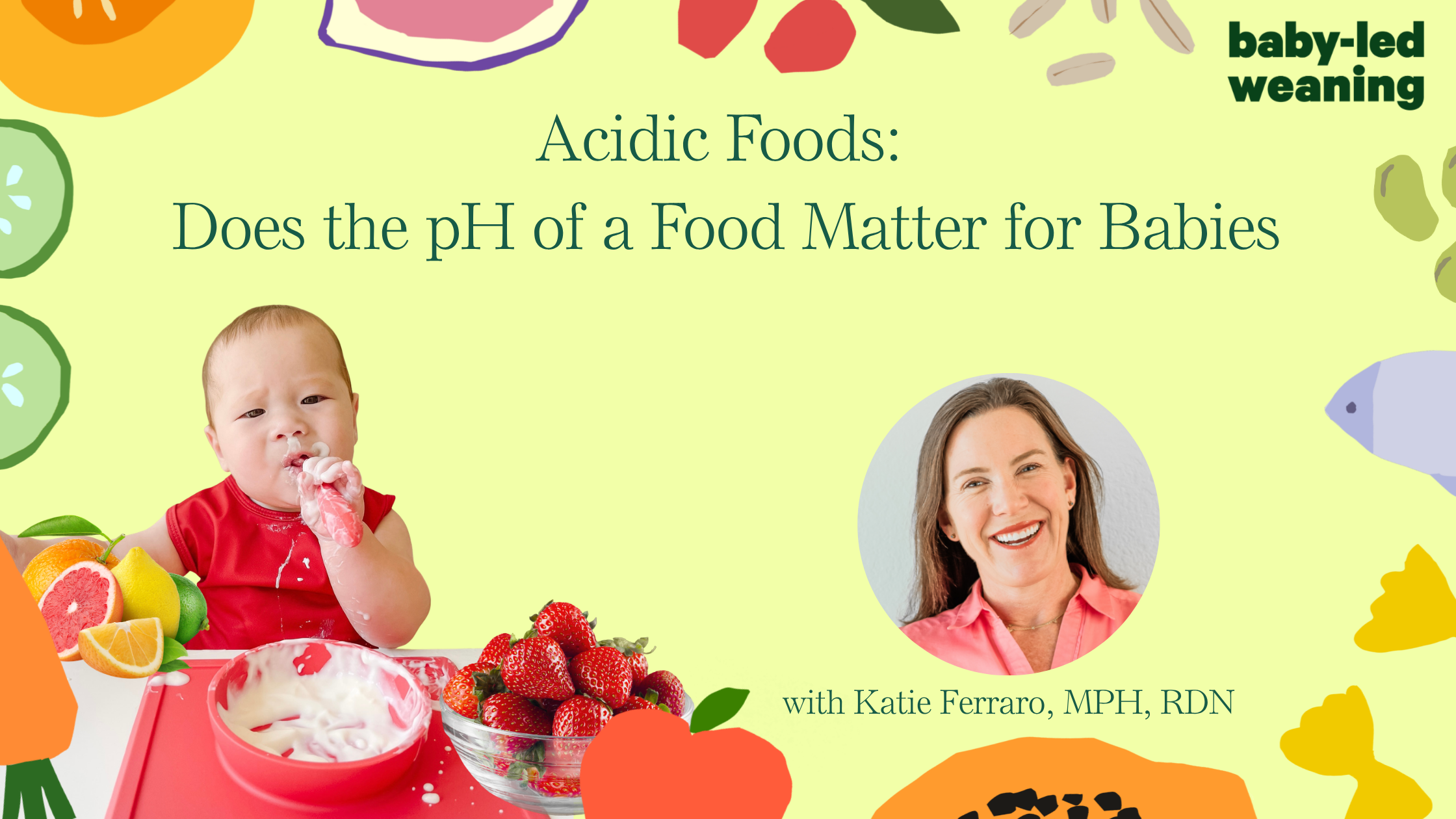
#121: Acidic Foods for Babies: Does the pH of a Food Matter?
In this episode
- Why acidic foods like tomatoes, strawberries, citrus, and yogurt are not automatically off-limits for babies
- What a little redness around your baby’s mouth after eating acidic foods might mean
- How to focus on safe food preparation and variety instead of worrying about the pH of your baby’s food
Episode Description
Are acidic foods like tomatoes, strawberries, citrus, or yogurt too harsh for your baby? In this episode, we’re looking at whether the pH of a food actually matters when your baby is starting solid foods. You’ll learn why acidic foods are not automatically off-limits, what a little redness around your baby’s mouth might mean, and how to keep the focus on offering a variety of safe, nutritious foods without overthinking every bite.
Links from this Episode
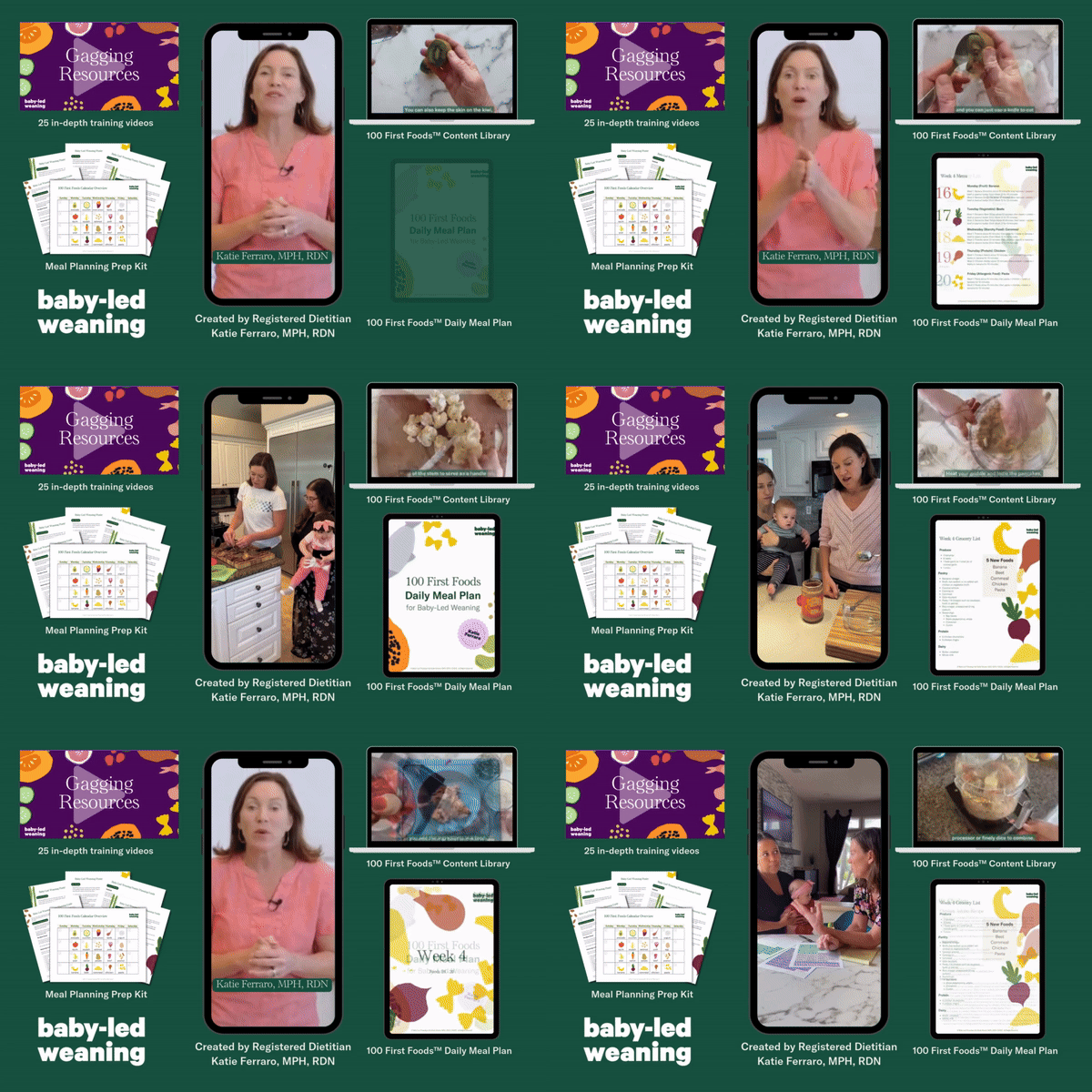
- Baby-Led Weaning with Katie Ferraro program with the 100 First Foods™ Daily Meal Plan, join here: https://babyledweaning.co/program and save $50 when you sign up using the code BLWPOD50
JOIN NOW AT $50 OFF CODE: BLWPOD50
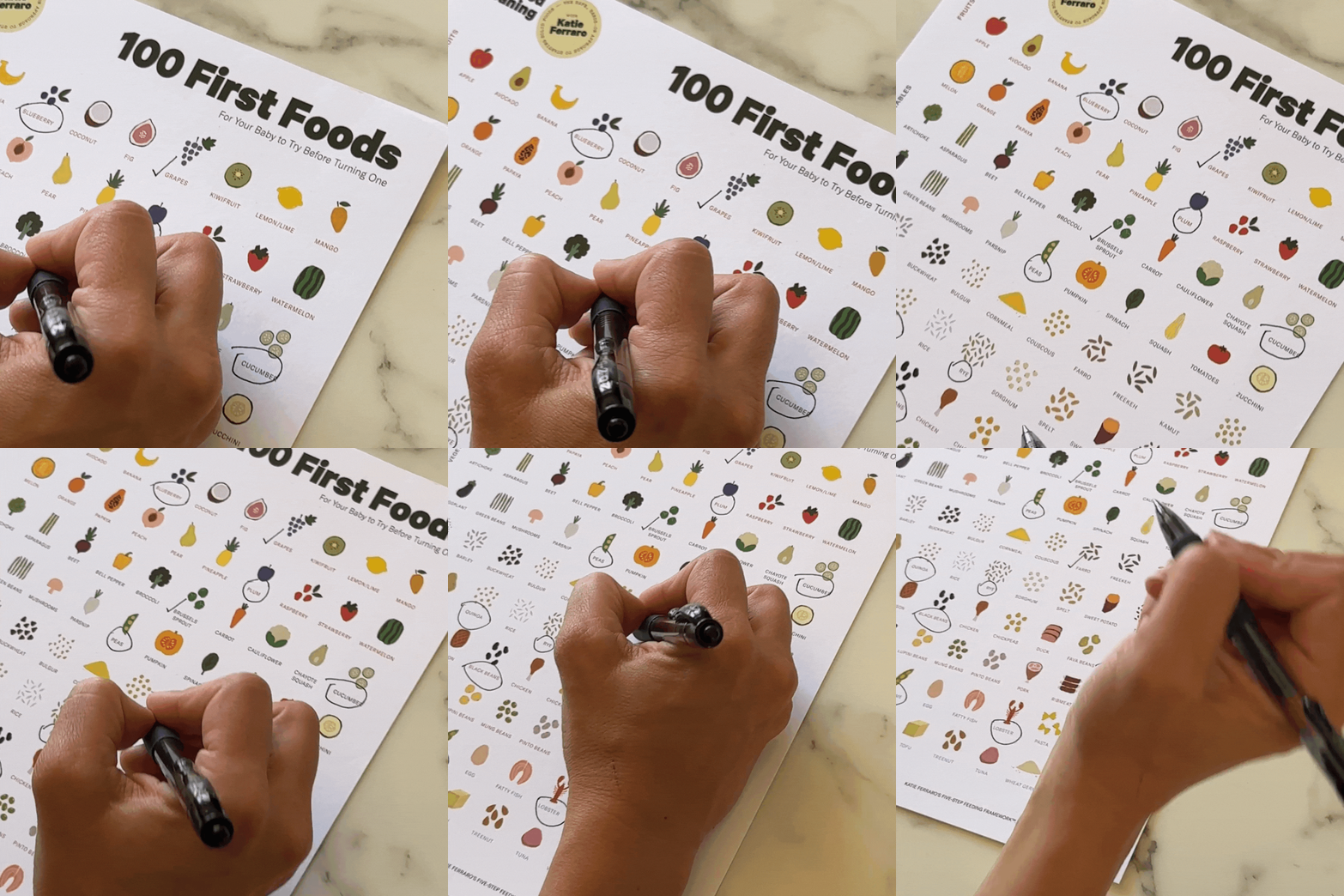
- Baby-Led Weaning for Beginners free online workshop with 100 First Foods™ list to all attendees, register here: https://babyledweaning.co/baby-led-weaning-for-beginners
Other Episodes Related to This Topic:
- Episode 48 - How to Flavor, Season & Spice Your Baby's Food with Kanchan Koya, PhD
- Episode 123 - HELP! My Baby has a Contact Rash from a New Food with Ron Sunog, MD
- Episode 471 - 5 Seemingly Unhealthy Foods for Babies that are Actually OK
Resources & Research
- Learn more about pH & water from USGS here
- Debunking the Alkaline Diet article from UCSD here
- More info about GERD from Johns Hopkins here
Click Here for Episode Transcript
Whisker (0s):
Today's episode is sponsored by Whisker makers of the Litter Robot, the self-cleaning litter box for cat families who do not need one more gross chore on their list. Because You know how every stage of parenting comes with a whole new category of cleanup, right? First it's the pump parts and then the dirty diapers you're getting used to. And when you're starting solid foods, suddenly you're scraping sweet potato out of crevices of the highchair that you never knew existed, right? But for cat parents adding daily litter box duty on top of all of that, that is a lot. And honestly, it's the litter box part. The thing that always made me hesitate about cats, not the cat, the litter, the scooping, the smell, the whole daily maintenance situation. And that's why Litter Robot by Whisker makes so much sense. It automatically cycles after every use, so you're not scooping every day and you're not handling waste like you would with a regular litter box. I especially love the No Contact Benefit Litter Robot handles the dirty work so that nobody in the house has to be assigned daily litter duty. And with the Whisker app, you can stay on top of things without thinking about litter all day. The app can notify you about your unit, like completed clean cycles, litter and drawer levels, or when the unit needs attention. So whether you already have a cat or you're thinking about getting one, or you just want one less household chore to manage, Whisker helps Take Litter Box duty off of your daily list, maintain your cat's litter while focusing on your family. Learn more about Whisker litter robot models and their starter kits today so that you can get set up for this busy season of parenting. Take an additional $50 off bundles with the code weaning when you shop Whisker dot com slash weaning. That's an additional $50 off bundles with code weaning at Whisker dot com slash weaning.
Once Upon a Dance (1m 54s):
This episode is sponsored by Once Upon A Dance. You know, I talk a lot here about helping your baby explore the world through food, but as your child gets older, there are so many other ways we can help them explore, imagine, and build confidence. And one of those ways is through movement. Now, I personally did not grow up doing dance myself. It wasn't a part of my childhood, but all three of my girls did dance. And I have to say it was such a formative experience for them. It wasn't just about learning steps or performing on stage. Dance helped them practice discipline, confidence, creativity, perseverance, and being part of something bigger than themselves. And that's why I love the idea behind Once Upon a Dance, these are interactive children's books that turn story time into movement time. So your child isn't just sitting and listening, they're twirling, leaping, imagining, and connecting with you through the story Once Upon a Dance offers award winning dance along stories created by a former dance teacher with her daughter, Ballina Kay. As a gentle guide and positive role model. The stories celebrate friendship, family, self-acceptance, empathy, practice, perseverance and kindness, all through whimsical adventures featuring things kids love, like unicorns, bats, puppies, cats and more. So whether you're listening with a baby now, or you also maybe have a toddler, a preschooler, or an older child at home who loves to move, this is such a sweet way to bring books, imagination and activity together, swap screen time for connection, get your kids off the couch and into a story. Jump twirl and leap on over to Once Upon a Dance dot com or find Once Upon a Dance books wherever you buy books online. That's Once Upon a Dance dot com.
Katie Ferraro (3m 41s):
And there's also the case where sometimes these acidic foods like you're offer your baby tomato or oranges and then they'll get a diaper rash. So in that situation, should we stop offering those foods? It it is true. Some acidic foods will make stools a little bit more irritating for babies. And especially if your baby is teething, they're drooling more for those that have sensitive skin or they're already prone to diaper rash. You may notice an uptake in the irritation after certain acidic foods have become part of the diet, even if you've been doing it for a number of days or a number of times, or they've like become one of the familiar foods in your baby's diet. Hey there, I'm Katie Ferraro, registered dietitian, college nutrition professor and mom of seven specializing in baby led weaning.
Katie Ferraro (4m 21s):
Here on the baby led weaning with Katie Ferraro podcast. I help you strip out all of the noise and nonsense about feeding, giving you the confidence and knowledge you need to give your baby a safe start to solid foods using baby led weaning. If you've already started foods, I don't know if this has happened to you, but you offer your baby some tomato sauce or strawberries, maybe some oranges, pineapple yogurt. And then you think, wait a minute, is that too acidic for my baby? Like maybe your baby got a little bit red around their mouth after trying tomato. Or you heard someone say, oh, acidic foods are really hard on your baby stomach. Or maybe you saw like a list online says you should avoid citrus and avoid tomatoes and avoid berries and yogurt.
Katie Ferraro (5m 3s):
And you're wondering like, am I supposed to be checking the pH of my baby's foods before I offer it? Like is this high school chemistry class? The answer is no. All right. You don't need to test and track and manipulate or worry about the pH level of foods before you offer them to your baby. And I even hesitated making this episode. I'm like, is this too niche of a question? But I do get questions about this in my program sometimes, And I really love the topic because it's a good example of how complicated starting solid foods can feel when you're getting information from too many different places, right? Because one minute you're trying to figure out like, how do I just make a strawberries safe for my baby to pick it up and feed it to themselves? And then the next minute someone on the internet has you wondering like, does the acidity of the strawberries matter to my baby's stomach?
Katie Ferraro (5m 48s):
And is it gonna cause a rash or trigger reflux or damage their teeth or like throw off their whole internal body chemistry? So in today's episode, we're gonna unpack what acidic foods really are, whether the pH of the food matters for babies, and then what to do if your baby does get a little bit of redness around their mouth after they eat certain foods. And then how do we think about acidic foods in the bigger picture of helping your baby learn to eat a wide variety of foods? Because the goal here is not to make feeding more complicated. The goal is to help you feel calm and confident when you're offering your baby real foods. Now, I like to start each of these mini training episodes with a baby led weaning tip of the day. And today's tip is you do not need to avoid an entire category of nutritious foods just because someone online made that food sound scary.
Katie Ferraro (6m 35s):
Okay, this happens. All right. A couple years ago, the big trend was babies can't digest grains. I'm like, oh, really? I got a hundred First Foods list, 20 starchy foods on it. Most of 'em are whole grains full of iron and wonderful B vitamins and plant protein and great nutrition for babies is literally totally safe for them to pick it up and feed it to themselves. And it's a good source of carbohydrate for them as they're learning how to eat. Okay? You'll hear junk like fruit has too much sugar. Guess what? The type of fruit sugar called fructose is totally safe for babies to eat. Do I want them drinking fruit juice? No. Do I need them sucking fruit out of mesh teether bags when they can learn how to eat soft strips of fruit?
Katie Ferraro (7m 16s):
Absolutely not. All right? Things like tomatoes are too acidic or dairy causes inflammation. So you should only offer alkaline foods. That was a trend a while ago. Ugh. When you hear sweeping statements like that, that little alarm bell should go off in your head, right? Because babies can eat a wide variety of foods. And in baby led weaning a variety is literally the point of the approach. Okay? Your baby is gonna learn how to eat. They're gonna love trying all these different tastes and textures and temperatures and shapes and smells and flavors. And the truth of the matter is, is that as your baby's weaning off of breast milk or formula, the body is gonna need some nutrients from lots of different types of foods. So when we start removing foods or food groups because they sound scary or because someone made a dramatic claim about them on the internet, we actually make feeding harder than it has to be.
Katie Ferraro (8m 4s):
Now, are there some foods that we need to modify for safety? Yes. Are there some foods that babies should not have? A hundred percent. Okay? Are there some foods that we prepare differently in order to lower the risk of choking a hundred percent. But acidic foods as a broad category are not foods you need to avoid. Now, hang tight because I'm gonna be sharing the specific ideas of what types of foods babies can safely eat In this episode because I'm a dietician, but I never wanna come across as the food police and tell you all the things your baby can't eat. I want to stress that with baby led weaning, we really emphasize all of the foods that babies can eat. Now, I wanna tell you about a baby that I was working with just recently. So this is a family I was doing parent coaching for. They have their second baby.
Katie Ferraro (8m 45s):
They did the hundred First Foods with their baby, who's their toddler, who's now three when he was a baby, and now there's a baby sister. She's in the mix. She just started solid foods. We did tomatoes and the mom's Filipino and the dad's Vietnamese. So they cook a variety of different foods. They actually live with grandparents who also help a variety of foods. Like these kids are exposed to a lot of different flavors, a lot of different flavor compounds, a lot of family foods that they're kind of eating right off the bat. And every time the baby girl has tomatoes, she gets a rash and it freaks the grandma out. But the mom was telling me, she's like, I just had to tell grandma like she's not allergic to tomatoes, okay? Because she gets a little rash around her face and then it goes away on her own.
Katie Ferraro (9m 25s):
The baby's also drooling like mad 'cause she's teething right now. She's already cut a couple of teeth, she's eight months old. She's got a couple teeths on the bottom, one's coming in on the top, tons of drool. And a lot of times when there's drool and it comes into contact, especially with new food compounds, okay, that can cause some contact rash. All right? She also got some diarrhea because when they're swallowing the drool from all the eating that can cause diarrhea, okay? And the grandma's like, oh, she's allergic tomatoes. But the rash goes away on its own with no other signs of allergic reaction. So the child is not having a food allergy. And the coolest thing about this family is that the older child, the 3-year-old, does have true food allergy. The child is allergic to tree nuts. They were just at a baseball game the other day, And that kid had wear Padres fans and they have this banana pudding at Teco Park that everyone like goes crazy for.
Katie Ferraro (10m 13s):
And like I'm literally like, this is like jello pudding with like some walnuts on top, but everyone pays $12 for it. And so the son had tried it and it had the walnuts on it, and he had a reaction and he actually had to go to the ER from the stadium. Long story short, this family knows what allergic reaction looks like. So they also know that like a little bit of a contact rash on baby number two, that goes away on its own, not a big deal, okay? It's not a reason to remove tomatoes because the baby is in no obvious distress. And especially as the drooling and the teething subsides and she gets better at keeping the food in her mouth instead of all over her face, she won't have reaction to the tomatoes.
KiwiCo (10m 45s):
Hey, we're gonna take a quick break, but I'll be right back. Last summer, I had this like epiphany moment where I looked around And I realized my kids are basically doing the same three things on repeat snack, argue screens. And I remember thinking, okay, how are you supposed to make summer feel fun and adventurous without turning it into a full-time job for myself? And that's why this year I am very grateful for KiwiCo Kiwi CO's Summer Adventure Series has been such a lifesaver in our house. So KiwiCo delivers kits directly to your house that are, in my opinion, a godsend because again, I don't have all day to figure out stuff that we're going to be doing. We're doing the make and play kits because they came to my house in KiwiCo said, we are. What I love is how they instantly turn into an activity that actually sticks. So we opened up one crate, the kids get absorbed. They're trying something new, they get stuck, they figure it out again without asking me and without me needing to like swoop in and fix it or figure everything out. And then they wanted to take it outside and they kept going and they're like, mom watch, mom watch. Which I'm sorry, that's like my favorite type of like, mom, mom, mom, mom, mom for the summer. I love that noise as long as they want me to watch something that they actually put together by themselves. This summer Adventure series is designed to get kids outside and exploring and away from screens. They get six hands on projects over six weeks with fun activities that go with each one. And it's super convenient because KiwiCo does the legwork for you. You can even choose to get all of the crates delivered at once, or you can have them arrive like kind of drip over a period of six weeks. So if you want to build the best summer ever, do check out KiwiCo. Get $10 off your summer adventure series at KiwiCo.com/summer promo code weaning. That's K-I-W-I-C-O.com/summer promo code weaning for $10 off.
Katie Ferraro (12m 48s):
So let's start with, what does the word acidic, acidic even mean? Real quick, chemistry refresher. I promise this will not be painful. pH is a measure of how acidic or basic something is, right? The pH scale goes from 0 to 14. So a pH of seven is neutral. Anything below seven is acidic. Anything above seven is basic or alkaline. So when people talk about acidic foods, they're usually referring to foods that naturally have a lower pH. So some examples include citrus, fruits like oranges, lemons, limes, grapefruit, tomatoes, tomato products, acidic berries can be acidic, pineapple can be acidic, yogurt, acidic. A lot of fruits have like some level of acidity, and those are great, wonderful foods for babies. Okay? But this is where that topic gets tricky because if you start avoiding these foods simply because they're acidic, then we're cutting out a lot of foods that could help your baby learn to eat and enjoy flavor and get important nutrients.
Katie Ferraro (13m 37s):
Now, can the pH of a food change your baby's blood pH? That's what this like, sorry. A conspiracy theory is based on. So one of the reasons the topic gets confusing is 'cause there's like bogus wellness content online about acidic foods, alkaline foods, and then changing your body's pH. Okay? Your baby's body, your body is not that fragile, all right? Your body's got a very tightly controlled system that regulates blood pH. So your lungs, your kidneys, constantly working to keep your blood pH in a very narrow range. So this idea that eating an acidic food is gonna make your baby's blood acidic. Sorry, but that is not how the body works. All right? Your baby's body's not sitting there helplessly waiting for a strawberries to come along and ruin everything, okay?
Katie Ferraro (14m 18s):
The stomach itself is supposed to be acidic. That's normal, right? Stomach acid helps with digestion, it helps break down food, it kills harmful microbes. It helps create the right environment for certain nutrients to be released and then absorbed later in the digestive process. So acidic does not automatically mean bad acid is part of normal digestion. And then when your baby eats a food that has some acidity like tomato yogurt or orange, that food is entering a digestive system that's already designed to handle acid. So are aesthetic foods harmful for babies? For most babies, acidic foods are not harmful. You do not need to avoid tomatoes. You do not need to avoid strawberries or oranges or yogurt. You don't need to make a list. Oh my God, I saw this the other day on Instagram. High acid and low acid foods, babies, shouldn and shouldn't eat.
Katie Ferraro (15m 0s):
Like for real. Okay? Now, can some acidic foods be irritating for some babies? Yeah, sometimes. But irritating is not the same thing as dangerous. Some might say my voice is irritating. It's not technically dangerous unless like you're listening to this at like super high volumes. Okay? This is where a lot of parents get nervous though. 'cause they're like, okay, the babies can eat tomato sauce and then there's the redness around the mouth, or they have some strawberries and their chin looks a little pink, or they have some oranges and the skin around their lips looks irritated. Yeah, that can happen. 'cause babies have sensitive skin 'cause they drool and they smear food all over their faces and they rub it in their cheeks, okay? And on the floor and the dog. So when that acidic food sits on your baby's skin, especially when it's mixed with drool, it can cause that contact irritation doesn't mean your baby's allergic to food.
Katie Ferraro (15m 41s):
Remember a contact rash around the mouth if it's not accompanied by any other sign of reaction. So there's no difficulty or labored breathing. Your baby is not vomiting or having diarrhea. Your baby is not having, You know, uncontrollable inconsolable crying, okay? Wheezing, difficulty breathing. If none of that is involved and it's just skin stuff that goes away on its own, not a food allergy. Alright, what about reflux? Another place where parents get worried, they might hear that acidic foods make reflux worse. Okay? So for babies who've been diagnosed with gerd, gastroesophageal reflux disease, certain foods can be more irritating, okay? But the average baby who's starting solid foods, you don't need to preemptively avoid acidic foods 'cause you're worried that they might cause reflux. Alright? There's a big difference between a baby who has a medical diagnosis, whose needs had like individualized guidance, and a healthy baby who eats a variety of foods.
Katie Ferraro (16m 29s):
So if your baby has significant reflux and they've got poor growth and they're feeding refusal like you are working with a pediatric dietician, who's gonna help you through that? Okay? Otherwise, if your baby's healthy, ready to start solid foods, you don't need to take the acidic foods off the table. What about the diaper rash? Sometimes parents will be like, oh, every time my baby has these acidic foods, they get a diaper rash. Should I stop offering them some acidic foods might make foods a little bit more irritating for babies. And if your baby's teething and drooling more and has sensitive skin or they're already prone to diaper rash, you might notice irritation after certain foods. Okay? But again, that doesn't mean the food is like harmful. You need to make sure the diaper changes happen promptly. You might need to do a barrier cream if the prone skin is prone to irritation. Okay?
Katie Ferraro (17m 9s):
When can avoiding acidic foods backfire that bigger picture? If you're avoiding large groups of foods and nutrients, remember exposure matters. We wanna offer babies of a variety of foods. Some parents are like, well, all those foods you mentioned are fruits and babies shouldn't have fruit anyway. Fruit is a wonderful source of nutrients, it's a wonderful source of fiber, great texture and taste opportunities. But remember, fruits are just one part of the picture. Babies can also have vegetables, starchy foods, protein foods, allergenic foods. That's the variety that we want. Okay? A lot of you working through my hundred First Foods list, you're doing five new foods a week already. Don't pick out certain ones that are acidic and stay away from those. Okay? We got a nice blend of all sorts of foods on that list. Your baby naturally is going to achieve diet diversity.
Katie Ferraro (17m 50s):
If you're doing one new food a day, five new foods a week, and working towards 20 foods a month, and then in five short months, your baby eats a hundred foods. If you need to grab a copy of that a hundred First Foods list, I give it away to everybody for free on my baby LED WEANING FOR BEGINNERS masterclass. It's a one hour video workshop where I show you how to make all these foods safe for your baby. You can sign up for that free masterclass at baby led weaning dot co slash masterclass. And if you're ready to get started, actually learning how to make these foods safe for your baby's age and stage following a done for you meal plan with everything for baby led weaning all in one place, come check out my program. It's called Baby Led Weaning with Katie Ferraro. I've got a $50 off coupon code for you in the description where you are listening to this podcast.
Katie Ferraro (18m 35s):
That program's available at baby led weaning dot co slash program. So what if your baby seems sensitive to acidic foods? Alright, you can offer a smaller amount. You compare the acidic food with another food like mixing the tomato sauce into a pasta dish or stirring that fruit into the yogurt, okay? At the end of the meal, you can wipe your baby's face gently, okay? Don't want that food. Sit on the skin. You can use a thin layer layer of barrier ointment around the mouth before meals if your baby's really prone to contact irritation, okay? We want you to check with your pediatrician. If your baby has significant eczema or skin concerns, you can pause and try it again later. But what I don't want you to do is decide that all acidic foods are bad and your baby can't handle them. Because in most cases, your baby can so quick win.
Katie Ferraro (19m 17s):
Does the pH of a Food Matter for babies for most babies? No. You don't need to measure it. You don't need to manipulate it. You don't need your beaker from chemistry class out. I don't want you taking acidic foods out as a category. All right? If you got a little redness around the mouth after eating something acidic, that's contact irritation, especially when drool is involved. Our bigger goal here is to focus on variety and all the benefits your baby's getting from trying all of those different foods. Alright, I'm gonna put some of the resources from today up on the show notes@blwpodcast.com/121. A special thank you to our partners at AirWave Media. If you like podcasts that feature food and science and using your brain, check out some of the podcasts from AirWave Media. We're online@bwpodcast.com.
Katie Ferraro (19m 58s):
So thanks so much for listening. I'll see you guys next time. Bye now.


THE PROGRAM
Baby-Led Weaning with Katie Ferraro
Stop guessing and get confident with the step-by-step digital guide and community that makes starting solid foods fun!
 Expert-Led, Proven Approach to Eating Real Food
 Concise Video Trainings to Master Baby-Led Weaning
 100 First Foods™ Daily Meal Plan + Food Prep Videos


FREE MASTERCLASS
Baby-Led Weaning for Beginners
Ditch adult-led spoon-feeding and raise an independent, adventurous eater...who actually loves to eat real food!
Free 1 Hour Video Training
 Taught by Katie Ferraro, Registered Dietitian
Free 100 First Foods™ List Given to All Attendees
Taught by Katie Ferraro, Registered Dietitian
Free 100 First Foods™ List Given to All Attendees